
At the risk of coming across as hyperbolic, I am going to open by claiming that I think I’m sufficiently familiar with Stephen King’s writing to comfortably call him a complex guy. Over the course of his long and prolific career he has earned himself a moniker of one of the Masters of Horror, specifically on the back of what he wrote in the first two decades of operating as a professional novelist, what with Carrie, The Shining, ‘Salem’s Lot, It and many others. However, as I think I have been able to outline in my own writing (as undoubtedly have many others more skilled and better published essayists before me), King’s prose is not all scares and gross-outs because—maybe sometimes instinctively or inadvertently—King often smuggles a lot of emotional baggage into his work. And he also does so with his own sense of style too.
Therefore, whenever I think of filmmakers who get King, I don’t think I can name one who gets him completely. Some, like Mike Flanagan, get the way he oppressively creates horror out of seemingly mundane scenarios. Frank Darabont gets his appreciation of character. Rob Reiner gets King’s take on American culture. But very few filmmakers have been able to nail King’s odd sense of humor. And I think one of those filmmakers who vibe with King on that frequency might be one Osgood Perkins.
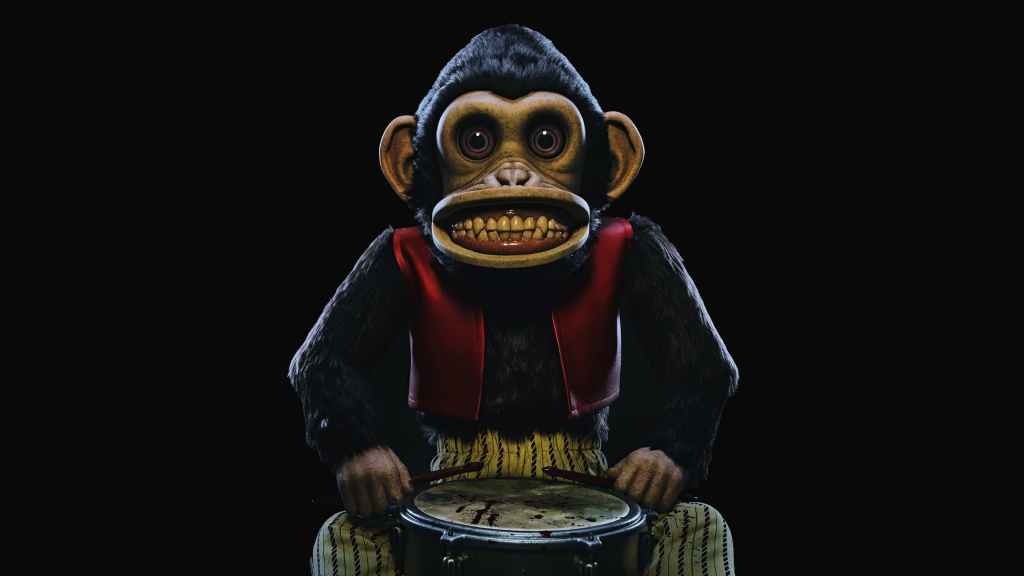
Having recently released Longlegs, Perkins has now come out with his take on Stephen King’s writing, an adaptation of his 1980 short story The Monkey that was later collected in the Skeleton Crew volume in 1985. Now, the idea to adapt this short story dates back to 2007 when Frank Darabont, who had just directed The Mist, announced he was interested in bringing this little story to the screen, but got nowhere with it. The idea was resurrected by James Wan who then hired Osgood Perkins to write and direct and the rest is history. Or is it?
Because why is this story such a big deal? It’s not The Dark Tower or anything with substantial fan following that viewers would be gunning to see. In fact, it is quite the opposite. Much like many of the myriad short stories King has penned throughout his career, The Monkey qualifies, at least superficially, as one of those fire-and-forget exercises in genre storytelling the author composed as a breathing exercise in between bouts of more substantial writing. But there is something about this seemingly innocuous little novella about a cursed wind-up monkey who causes someone to die when it jangles its cymbals that may escape an untrained eye and that Perkins looks to have noticed.
King’s short story concerned a family who discover a wind-up toy in the attic, which triggers the father’s long suppressed memories of his childhood when his mother had a stroke at work and it was all because he had wound up the toy. Now, there’s more to the story because it is clearly established that the toy itself is responsible for people dying the minute its cogs and springs make it come alive in a cacophony of cymbal-derived noise, but I think that it is safe to boil its messaging down to the idea of grief, processing loss and dealing with suppressed childhood trauma. Interestingly, The Monkey is never mentioned in the context of King processing his own grief through his work because it is something he may have done more openly in The Woman in the Room and to a lesser extent in The Last Rung on the Ladder. However, it doesn’t change the fact this theme is there in The Monkey as well.
What sets The Monkey apart is its tone, which isn’t exactly tongue-in-cheek, but it’s not serious either. It’s morbid and dark and also somehow goofy, predominantly thanks to its ending where the cursed wind-up monkey ends up dropped to the bottom of the lake and later it is reported that a mass of dead fish was discovered in this lake, as though to suggest that the monkey had something to do with it. While this could very well be an example of King not necessarily knowing or caring about a good way to finish his story—and as a self-diagnosed “pantser” (a writer who does not plan but flies by the seat of his pants while working) he has been known to botch a landing even in some of his more prominent novels—it also gives us an indication of the kind of stuff King finds funny. And I believe this was more or less the baseline for Osgood Perkins to work from while adapting this story.
In fact, even calling this movie an adaptation of The Monkey should come with an asterisk because, as I have also written about in a separate piece some time ago, King’s short stories lend themselves to different kinds of transcription from page to screen. You can either take them at face value, stretch them, expand their world-building or figure out their central idea or a theme and run with them in a manner you see fit. Perkins’s movie looks definitely like an example of why-not-try-a-bit-of-everything kind of way of adapting a King shortie, which is something viewers and King readers alike might be more inclined to reject. Put simply, The Monkey as envisioned by Osgood Perkins is a bit of a mess. But a likeable mess.
Thus, while the story retains the basic structure of what King wrote—both the central concept of a cursed wind-up toy and the idea of wrapping a thematic conversation about childhood loss and grief around the narrative—it might feel like a bit of a best-of mixtape with a slightly deranged whiff to it. To this end, the movie is divided into two distinct parts, one set in the past when two twin brothers receive this cursed gift and start to suspect that whenever the toy makes a noise someone dies, and one in the present when these two boys are now grown men (both played by Theo James) wrestling with their past. So, it wouldn’t be out of place to draw a parallel between what Perkins does here and It. At the same time, we see one of those brothers wrestle with his own relationship with his estranged son, which carries at least a hint of a distant relationship to such works as The Shining that openly dealt with intergenerational trauma, sins of our fathers and the idea of trying to break the cycle of abuse and/or neglect. However, at the same time—and this is something that isn’t explicitly taken from the book but rather consciously inspired by the vibe King sometimes gives off to astute enough readers—the movie also leans heavily into its goofy tone and more often than not plays out like a weirdly idiosyncratic legacy sequel to Final Destination directed by someone like Wes Anderson. Which, admittedly, is a bit like marmite. You will either vibe with this or reject it on principle.
Long story short, while The Monkey cannot be called a faithful piece of cinematic treatment—and I have it on good authority that someone like Mick Garris (who directed some of the more faithful made-for-TV adaptations of King’s work) would have treated this material completely differently—it is nonetheless completely faithful to the kind of sensibilities Stephen King’s work often betrays to those who have spent enough time with it. It’s a great blend of goofy, morbid, poignant and scary that shows me, above all, that Osgood Perkins gets King in ways many other filmmakers simply do not. Sure, you can dismantle this movie on first principles, point to what is and isn’t in the source material and question the logic of hiring Theo James to do a twin act (which in itself is goofy already) while also rejecting the abrupt chaos that ensues every time the cursed monkey hits its snare drum (another inconsistency because in the book the monkey held a pair of jangling cymbals). However, in doing so you’d lose sight of what I think matters the most in this filmmaking attempt, which is having fun.
People tend to forget just how playful Stephen King is in his writing and how goofy he could get when he feels it safe to do so. You don’t have to look any further than his infamous attempt at directing a movie that was Maximum Overdrive to understand how his sense of humor operates and what frequencies he’s sometimes on and I believe Osgood Perkins comes close to this energy with The Monkey. It’s not a movie for everyone. Hell, it’s probably not a movie for many seasoned King readers either, because it truly requires the viewer to think critically about who they think King is and perhaps depart their deeply genre-rooted understanding of his writing. King is a goofball, and this movie pays homage to this understanding while using one of his short stories as a platform to do so. Perhaps at risk of almost completely disregarding the story itself and extracting whatever the filmmaker felt functional to his mission, The Monkey is a weirdo success story that adds another dimension to the plethora of ways in which King’s “lesser” work can be transformed into movies. And even at that, it is still a viable conversation about grief and trauma that hides beneath its many bouts of comical violence, wacky characterizations and outlandish performances.



 Flasz On Film
Leave a reply to SILENT NIGHT, DEADLY NIGHT (2025), Venom in a Santa Hat and Delineating Cultural Shifts by Focusing on Who Gets Chased by Axe Killers – Flasz On Film Cancel reply