
Even though the conflict between Palestine and Israel has raged for decades (or even centuries, as some would claim), it is now—in the post-October 7th world where the city of Gaza lays in ruins and tens of thousands of lives have been claimed in retaliation for the heinous terrorist attack perpetrated by Hamas—that this geopolitical gordian knot has become a subject that is nearly impossible to attempt to handle without assuming a distinct political stance. I can only imagine that if Munich was released yesterday, it would have been immediately discussed not on its artistic merits but predominantly on the basis of which side it looks to be taking, even if the entire concept of the film was underpinned by the looming spectre of futility of the retribution carefully masterminded and enacted by the Israeli intelligence in response to the infamous Munich massacre of 1972. In fact, a quick scroll through the more recent Letterboxd reviews of what in my opinion remains one of the strongest directorial efforts from Spielberg this side of the Y2K bonanza will allow you to find several entries dismissing the movie as “Jewish propaganda” or a fence-sitting piece of schmaltz.
Which is partially why discussing a movie like September 5 is, to put it politely, quite difficult because it seems impossible not to invite the reader to infer your own political leanings regardless of the line you take. However, it is my understanding that if there is a movie this year to bravely champion despite all potential controversies you might stir by simply expressing your opinion about it, this is the one. And here’s why.
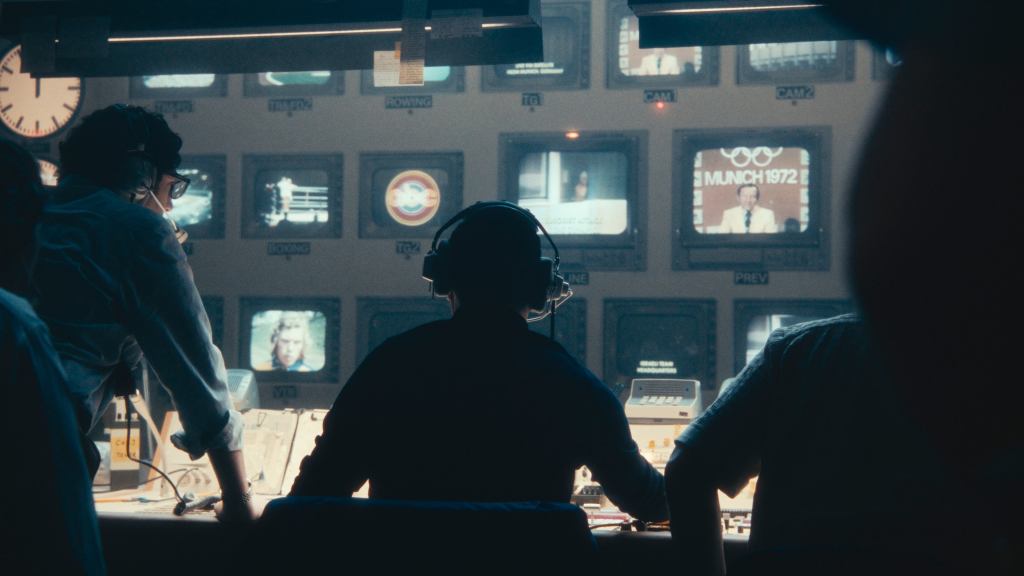
September 5 is directed by Tim Fehlbaum, who also co-wrote the film together with Moritz Binder and Alex David, and attempts to re-tell the story of the Munich 1972 massacre from an unusual angle—as an essentially single-location thriller set in the control room of the ABC sports crew who covered the crisis live from inside the Olympic village. It is a concoction of real archival newsreel footage supported by a narrative where a skeleton crew of newscasters portrayed by John Magaro, Leonie Benesch, Ben Chaplin, Peter Sarsgaard and others grapple with their responsibilities towards the public, the victims of the attack as well their own egos and careers whose mission is so easy to elude any viewer who walks into this experience with their mind made up or with their political convictions displayed on their sleeves. In fact, this is a movie that—perhaps because it so successfully blurs the hyphen between the “docu” and the “drama—openly invites the kind of critical conversations that unfortunately many politically charged documentaries tend to attract. It’s a movie many viewers may choose to analyze, and many have already, based on their thematic messaging, while completely disregarding the level of craftsmanship underpinning it.
And it’s fine because a movie is allowed to touch us in many ways. However, at this point—before delving into its thematic landscape myself—I’d do September 5 a massive disservice if I failed to acknowledge the simple reality that its artistry, direction, writing and performances are firmly behind the film’s incredible immediacy and all-enveloping authenticity. This Lumet-meets-Greengrass touch Tim Fehlbaum oversaw while putting together the film cannot be accidentally mocked up. This is something to cherish as an accomplishment that dissolves the barrier between the screen and the viewer in ways that Dog Day Afternoon, Network or Bloody Sunday did in the past. Now, I remain unsure as to how fiction interacts with fact in this story that wraps a narrative around an incredibly well documented historical event, but I do know that the movie succeeds—without a shadow of a doubt—in convincingly dragging me into the thick of things so that I could experience the doubt, the anxiety, and the impotent frustration shared by the characters as though I was there with them, perched atop their shoulders. Not every movie can do that, and September 5 does it with such incredible ease that it is simply frightening to deconvolute analytically.
Nevertheless, what interests me more than attempting to deconstruct the technical genius required to conjure such a magically authentic and compelling cinematic experience is how it ostensibly, and ironically so, stands as a movie that politically inclined viewers may find all too easy to pour vitriol onto. And that’s because we have acquiesced to a reality in which movies handling difficult subject matter must take a subjective stance. Not only that, but they must also take a stance that is in line with what the accepted consensus is. That’s one of the reasons why Alex Garland’s Civil War received a backlash from the online community and why movies like Munich, as I mentioned above, have started to receive negative reviews with a clearly antisemitic slant. In the universe of radical binaries and tribal politics, one must choose sides. And not choosing one is tantamount to choosing the opposite side.
Therefore, making a movie about the very problem of remaining unambiguously objective, non-intrusive and non-exploitative while also attempting to report on something the characters immediately identify as of incredible historical relevance and hence impossible to decouple from their own egos as driven professionals, invites people who walk into the cinema looking to either have their feelings validated or to pick a fight with whoever comes closest to them to dismiss September 5 without giving it its day in court. After all, Fehlbaum does not ask what may have driven the Black September terrorists to do what they did, just as Paul Greengrass never thought it was a good idea to interrogate what drove the hijackers in United 93. The movie takes the event at face value and grapples with it the way the characters would have in real life, not the way keyboard warriors would do so while trying to impress their online tribe.
At the end of the day, it is clear to me that the mission of the filmmakers was not to skirt whatever opportunity they might have had to take sides while indubitably using the movie as a vehicle to comment on current political events but rather embrace an opportunity to comment on the act of taking sides itself, which was perhaps their most provocative transgression. However, I find this decision not only bold and commendable, but fundamentally fascinating as it clearly denudes the current sad state of the cultural discourse. Felhbaum’s film takes on what I see as an opportunity to critique the many ways in which tragedies, nowadays immediately and ceaselessly shared with the entire world, are exploited and weaponized by factions on all ends of the political spectrum and reminds us just how difficult it is to remain impartial, objective and respectful while also trying to tell a story and, perhaps inadvertently on occasion, insert oneself into the narrative by virtue of being the one holding the camera and relaying the message to the world at large.
This conflict is the movie, which means it is not only OK for it not to take sides or to make obviously critical comments towards the current Israeli administration overseeing what is tantamount to a war crime in Gaza. If the movie is to be taken as a vehicle for current political commentary, which I think is fair to do, the commentary is not about who’s at fault and where, but about how these events are reported on, to what ends and for whose benefit. And I think this is something many viewers might not be equipped to deal with because we are all to some degree complicit in exploiting human tragedies. Every like, every click, and every retweet are de facto acts of exploitation of other people’s tragedies because—as the movie implies—the simple act of reporting interferes with the event in the most fundamentally Heisenbergian way. September 5 isn’t here to remind us about the atrocity of that event at the Munich Olympics, nor is it here to invite us to rewatch Spielberg’s masterful Munich. It is here to report on the paradoxically impossible mission to remain unbiased while relaying facts to others because the act of relaying is in itself enough to impart bias. However, refusing to report would impart bias in its own right because inaction is an action. Not making a decision is a decision we make. Which is what the movie is effectively accused of while commenting on the subject in a roundabout and incredibly nuanced way.
Unfortunately, the movie’s decision to become a canary in the coal mine is ultimately as tragic as the fate of that proverbial canary, whose purpose is to have its life extinguished and through sudden cessation of chirping alert coal miners of the invisible threat of methane lurking in the atmosphere. September 5 is an indisputably great film that tackles an immensely complex and charged subject matter and does so in a way that is perfectly set to attract ire from all fronts. At the same time, the filmmakers remain fully aware of the need to remain authentic, immediate and compelling because the message they bravely attempt to convey requires the viewer to completely enmesh with the universe of the movie. It’s a shame, though, that this incredibly accomplished piece of cinema is so easy to misunderstand and attack for doing exactly what it is designed to do. Which is to remain level-headed and objective while being swayed and pushed and prodded by forces coming from all directions, driven by their own often insidious ulterior motives.


 Flasz On Film
Leave a reply to 2025 in Review: 10 Best Films I Watched – Flasz On Film Cancel reply