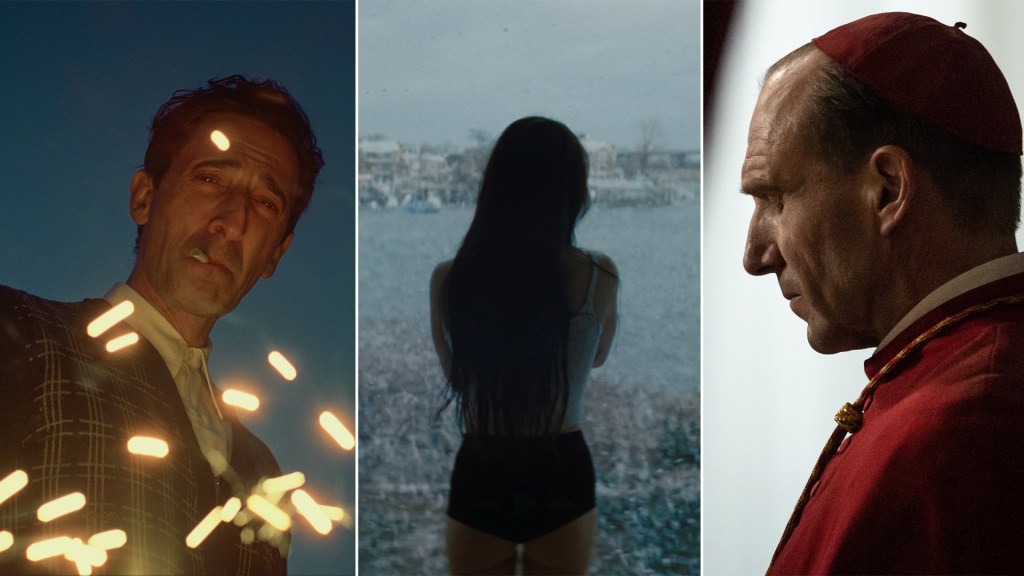
Last Sunday, 16th February 2025, the 78th BAFTA ceremony took place in London with Conclave walking away with the top award for the Best Picture and The Brutalist taking home the Best Director award, while Anora—the now odds-on favourite to win big at the Oscars in two weeks’ time, bagged just two accolades: one for Mikey Madison’s performance in the lead role and one for casting. The ceremony was broadcast with a two-hour delay so those in the know could follow the events live only via text updates on all major online news outlets and, following a handful of headlines, we all went on with our lives.
And here I am asking myself a rather fundamental question whether the concept of the BAFTA ceremony is even culturally relevant and if so, what that relevance is. Or maybe: is there any intrinsic value in anyone caring about who got the BAFTA and who got the snub that ventures beyond the one reason I think most people, who follow the awards season, may or may not care about whether Anora, Conclave or The Brutalist would walk away victorious after an afternoon of glitz and glamour in central London only because of the way it might help them predict who would win at the Oscars in due time. Which is perhaps misguided because the BAFTAs are not exactly well known for aligning well with where the attention of Academy voters would focus. In fact, if you consider just the last twenty-five years, BAFTA Best Picture Winners went on to win the Best Picture Oscar only 44% of the time, while the Best Director BAFTA winner would also collect the Best Director Oscar 58% of the time. And if you look at how accurate the correlation is between the Best Director BAFTA winner and the Best Picture Oscar winner, it’s even worse. 33%.
Therefore, if you’re an avid follower of the awards season and you like your predictions science-based, you’d be much better off if you assumed that any movie that wins at the BAFTAs is mathematically unlikely to win at the Oscars. A 44% positive correlation can be read as a 56% negative correlation, so—insofar as these two numbers are close enough to an even fifty-fifty split that you might consider the predictive power of the BAFTA to be essentially indistinguishable from a coin toss—you’d be well within your rights to assume that because Conclave won the BAFTA, it’s unlikely to take home the Best Picture Oscar. But that won’t help you a whole lot either because this year we will see ten pictures vying for the title (Anora, The Brutalist, A Complete Unknown, Conclave, Dune: Part Two, Emilia Perez, I’m Still Here, Nickel Boys, The Substance and Wicked) so eliminating one of the options (even if with a degree of uncertainty) is not going to help you place a winning bet.
If you’re truly after solid science-based predictions decoupled from insider gossip and ravenous lobbying campaigns waged by Hollywood moguls, you’d be much better off looking for correlations between the various guild awards. In fact, the Producers Guild Award (PGA) alone correlates with the Best Picture Oscar at the level of 72%. Similarly, the Directors Guild Award (DGA) correlates with the Best Picture Oscar at the exact same level of 72% while predicting the Best Director Oscar with a stunning 84% accuracy. The picture will become much more sophisticated and accurate once we lump in the SAG awards winners, the WGA and even other guilds, which all naturally makes sense because the same pool of people voting in guild awards happens to also vote in the Oscar ballot. Hence, you can safely forget about treating the BAFTA awards as a serious predictor of success at the Oscars, just as you ditch the Golden Globes, because there’s no meaningful overlap between the voting bodies or voting intention, as far as I am aware.
So, why should anyone care about BAFTAs? I suppose we could (and I think I periodically do so myself) extend this philosophical quandary further and ponder why we should care about industry awards anyway. After all, time is the best predictor of cultural relevance and oftentimes the movies that got snubbed at the Oscars or weren’t even in the conversation to begin with ended up talked about the most in the years and decades that followed. Think of The Shining, Blade Runner or Fight Club. And that’s just off the top of my head. But for the sake of conversation, let’s assume that awards do in fact matter and, in this context, let’s try to understand why BAFTAs in particular do so as well.
I suppose you could see the BAFTAs as an opportunity to glare at your favourite celebrities wearing their designer dresses and posing for red carpet photos. You could hope for a tiny bit of a scandal here and there, a few gaffes, or some gossip to boot. Or if you’re a fan of pump and circumstance surrounding the ceremony proper—together with its many musical performances and attempts at polite stand-up comedy—it’s just a show you might see as worth watching. I can surely sympathize even though I don’t personally care about it myself.
However, having scratched my head for long enough, I think I found at least one reason why I might see the BAFTA awards as culturally meaningful, despite the fact the UK Box Office is only 11% of the size of the North American one and the awards fail to meaningfully overlap with the American industry awards despite a section of the BAFTA membership also being affiliated with AMPAS. The value of BAFTAs lies exactly in the fact that they are different and that these awards often diverge from the industry consensus. This to my mind adds some much needed colour into the awards season, which often converges around a favourite and frequently results in the conversation boiling down to a frontrunner and one or two challengers. With BAFTAs in the mix, the awards conversation might include an oddball or two, like in 2023 when the industry coalesced around Everything Everywhere All at Once while BAFTAs threw their weight behind All Quiet on the Western Front, or in 2014 when Birdman ruled the roost while the BAFTAs honoured Richard Linklater’s Boyhood.
Granted, nobody ever decided to advertise their BAFTA wins on posters unless they absolutely had to and a movie is more likely to brag about a Best Makeup Oscar than a Best Cinematography BAFTA on their Blu-Ray cover, but I think the value of these awards is in their orthogonality to the consensus. While I think Anora is the movie that should have walked away with top awards last weekend (and I sincerely hope it will sweep at the Oscars), there’s something quietly reassuring about the fact that the Brits occasionally choose to highlight movies the American consensus seems to either overlook or perhaps push aside when it comes to dishing out the big awards. After all, in times when “the Oscars got it wrong,” the BAFTAs didn’t. The Aviator. Brokeback Mountain. Just to name a few. Now, I don’t think Conclave qualifies here as I have already expressed my thoughts on this de facto boomer catnip but having reflected on this subject for a little while, I’m ready to embrace the BAFTAs as an intriguing bit of colour and diversity injected into the frequently monotonous Oscar race.



 Flasz On Film
Leave a comment