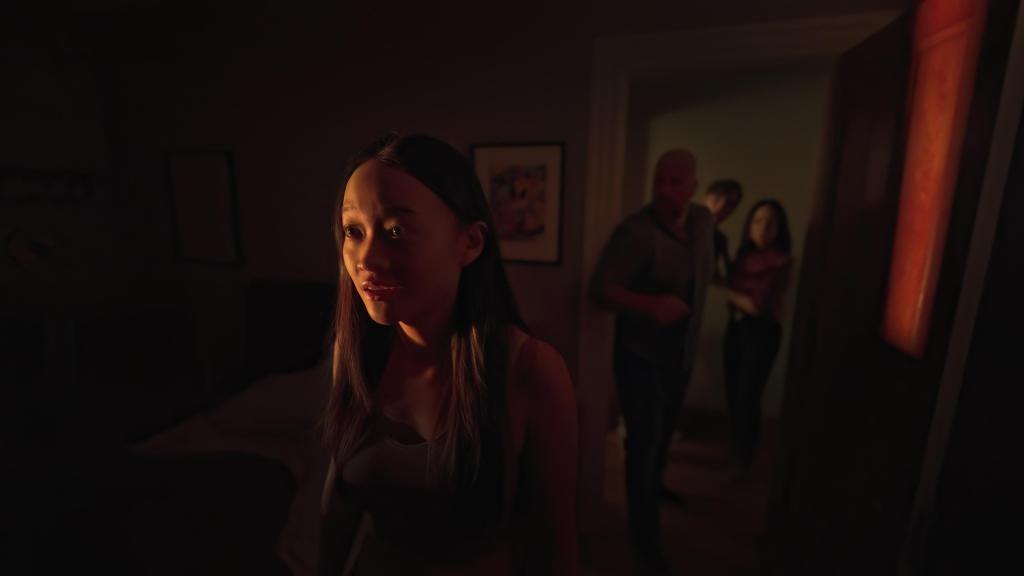

Steven Soderbergh’s filmmaking style has consistently remained hard to pinpoint because this prolific filmmaker—so prolific in fact that his brief period of artistic retirement essentially meant he’d move full-time into TV work before coming back to feature films after a few short years—has never committed to a defined “way of making movies” and instead continues to experiment with the form. He followed up his breakout debut Sex, Lies and Videotape with an experiment merging a Gilliam-esque aesthetic with a Wellesian approach to structure (Kafka); he dabbled with absurdist comedy (Schizopolis), filming like Michael Curtiz in the 1940s (The Good German) and with shooting entire movies using consumer-grade equipment (Bubble, Unsane); he made app-based interactive films (Mosaic) and web series (Command Z). And that’s on top of his more familiar exploits like Erin Brockovich, Traffic, Ocean’s Eleven or Magic Mike.
I think it’s safe to say that any idea that involves a camera and can be described with a sentence starting with “you know what would be cool to do?” is an idea Steven Soderbergh is unlikely to turn down. Therefore, it made perfect sense for him to reunite with David Koepp (who wrote one of his recent movies Kimi) to make Presence because the idea involved making a haunted house mystery movie but filming it from the point of view of the poltergeist as opposed to the cast of characters experiencing the haunting was a cool enough structural gimmick of the “hold my beer and watch this” variety already.
This concept isn’t exactly new as far as the general idea is concerned and in fact with enough volume of movies turning old genre templates on their heads (Tucker and Dale vs Evil, Maniac, Freaky, A Ghost Story or In a Violent Nature to name a few) the notion of a genre upside-down cake may eventually calcify into a microtrend of its own. And I fully support this because—even if the results may vary in quality—long-settled genre platforms do benefit from being periodically freshened up, be it within the confines of the genre itself or, as is the case with Presence and a few years ago with A Ghost Story, by taking these genre-specific ideas into other territories. But, as with everything, there are strings attached.
See, when is a gimmick more than a gimmick? How does one take a “hey this would be cool” and turns it into a “wow, that was amazing”? Make it funny (Tucker and Dale vs Evil). Make it heart-rending and poignant (A Ghost Story). Make it visceral (In a Violent Nature). Make it authentic (The Blair Witch Project). Which is usually where the story comes into play to add muscle onto the skeletal framework of the central gimmick in a way that the resulting body would become mobile. It doesn’t have to become a fully functional organism, though. It’s fine if it’s just capable of doing a few dance moves and move the viewer into a state of temporary suspension of disbelief required for the gimmick to register as successful. And this is where I have to turn around and begin explaining exactly why I don’t think Presence has what it takes to stand up to scrutiny.
The grand gimmick behind Steven Soderbergh’s Presence lies in the fact that we get to watch a movie about a haunted house from the point of view of the poltergeist. Just like we had an opportunity to see a slasher while staying on the shoulder of the Jason Voorhees-type killer in In a Violent Nature or how we saw the world through the eyes of one in Maniac, we are privy to a perspective thus far unexplored. Soderbergh’s camera hovers around the house and swiftly moves between rooms in long unbroken takes while capturing light using the same fixed wide-angle lens to suggest a degree of omnipresence on behalf of the ghost whom this perspective inhabits. As it does so, it allows us—through a series of vignettes where the titular presence presumably comes in and out of conscious existence in the physical world—to interact with a family of four who have just moved into the house and whose story becomes a de facto narrative framework upon which the gimmick is supposed to rest.
So, as the omnipresent camera roams through the suburban house, hides in closets and only occasionally manifests physical interaction with the world it observes, a multifactorial drama unfolds before its eyes. The mother (Lucy Liu) is a high-powered executive who seems to be in the middle of committing corporate fraud. Her husband (Chris Sullivan) struggles morally with this and considers divorce. The son (Eddy Maday) is a high school star athlete and a total unwashed douche-nozzle. The daughter (Callina Liang) is withdrawn as she grieves the loss of her friend who seemingly died in her sleep, but conversations the presence eavesdrops on suggest she may have overdosed on drugs.
Superficially, this setup of essentially spying on a family drama from the perspective of an unseen ghost whose reason to exist is yet to be established provides us with an opportunity to invest in the drama in interesting ways. David Koepp’s script allows for such effortless immersion that it momentarily feels inappropriate for us to hear what we hear, yet we lean in a bit further to hear more saucy details of the mom’s work drama, see how the marital spats resolve and digest just how dysfunctionally favouritist the mom is towards her douchebag son. As the presence leans out of the closet we spy in on the daughter as she cries tears of lonely mourning and how she becomes engaged in what looks like a teenage romance but is quickly unveiled as toxic case of date rape in the making.
And as we lean in closer and closer and as we get more and more invested in this familial drama made accessible to us courtesy of the movie’s central gimmick, we might find out just how fragile the suspension-of-disbelief drama really can be sometimes. This wholesale immersion upon which Presence relies turns out to be a massive gamble on behalf of the filmmaker because a single scintilla of logical thought expended towards understanding the logic underpinning the drama presented to us will immediately make the bubble go “pop.” And once a bubble pops, it’s gone. Dispersed into nothingness.
Which is where the real problem with Presence rears its ugly head. This entire experiment is essentially a giant circus act; a piece of staged showboating and cinematic trickery designed to entertain the viewer for the duration of the show and make them leave the cinema feeling glad to have been a part of this experience. But as I just outlined, a spectacle of this kind—one with a flimsy-yet-intriguing structural gimmick at its core, padded with dramatic musculature—relies on complete and unimpeded viewer immersion. That is what made The Blair Witch Project such a resounding success, though at least a part of it had to do with the viewer priming accomplished with its incredibly effective marketing campaign. That’s why Paranormal Activity worked so well on theatrical audiences. The viewer was never allowed to break the illusion and realize that what they were watching was a movie and not a found-footage document.
Unfortunately, Presence stumbles for just about long enough and slows down to low enough speeds for you to realize just how terminally braindead, manufactured and completely one-dimensional the dramatic musculature of this movie is. I was never expecting Soderbergh and Koepp to craft a Godfather-level of storytelling as a vessel for their what-if-Poltergeist-but-upside-down experiment, or for the movie to have anything meaningful to say about anything of value to the human condition. All I wanted was enough drama to carry me through the circus act of watching a ghost mystery unfold from the perspective of a ghost. But it was just not enough. Somewhere in this movie the bubble goes “pop.” And it’s not necessarily down to a single moment or a scene either. Instead, the film eventually hits a critical mass of stupidity that’s too difficult to ignore for long enough for the magic to go out the window.
And sadly, there is no returning from it. Presence just crumbles under even a milligram of scrutiny just as The Blair Witch Project would have if you had the time and the inclination to stop and question the logic of the storytelling used to propel this seminal found-footage experiment. But the filmmakers never gave me any reason to do so in contrast to Soderbergh and Koepp who tripped over their own work and made me look at the entire final act of this movie, its final twist and the attempted suspense of its climax with nothing but derision.
Sure, Soderbergh’s colour palette does its job. His use of available light sources is commendable. His management of perspective with the wide-angle lens and a completely detached mechanics of camera movement work perfectly in service of setting up the circus act of Poltergeist upside down. But I don’t think Koepp’s writing—and perhaps a few performances too—were sufficiently fine-tuned to work in service of the circus act. Somehow, the magic dissipated, and I watched the most meaningful moments of the movie knowing and feeling in my bones that what I was watching was completely fake.
I know it was. It’s a movie. I get it. But the magic of cinema, specifically in the context of an attempt like this, must make me forget that the screen exists. It must make me buy into the drama on stage. I need to forget that there is a safety net beneath the acrobat executing incredible feats while walking a tightrope. But I saw the net. I knew the screen was there. I felt the drama was fake. And I felt my enjoyment evaporate from my body in real time.
And a movie like Presence is never supposed to let you do any such thing. Which makes it, unfortunately, an out-and-out failure.

 Flasz On Film
Leave a comment