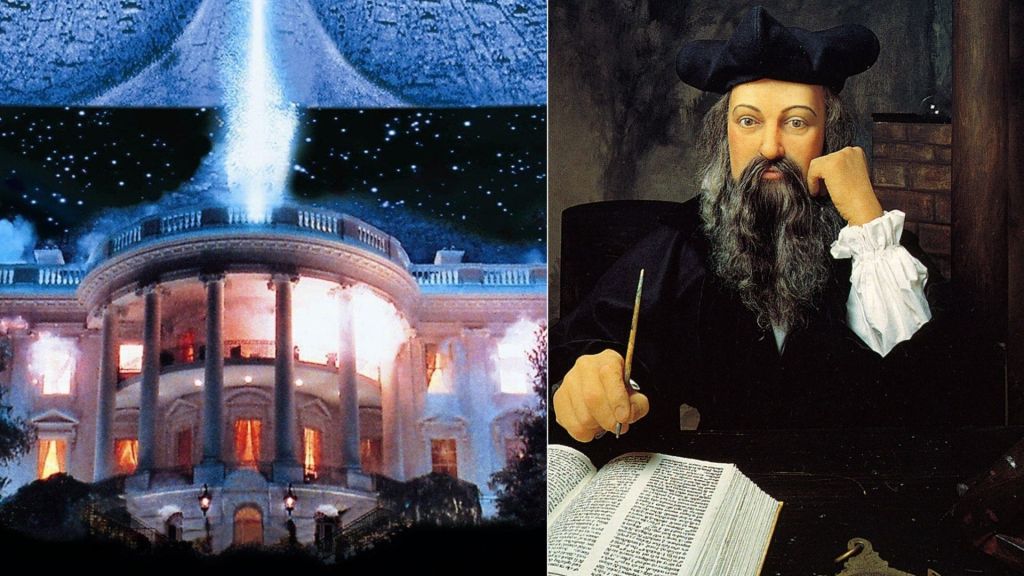
There is absolutely no debate that Roland Emmerich’s name is immediately synonymous with the concept of a large-scale disaster epic, even though his work also includes more conventional action movies (Universal Soldier), science-fiction (Moon 44), and period dramas (Anonymous). He’s known as the guy you ring when you need to freeze the planet solid (The Day After Tomorrow), get a giant lizard to trample all over New York (Godzilla), or to have the Moon itself fall from the sky like a big block of cinematic cheese (Moonfall). Thus, I don’t think there’s anyone out there who takes these massive, lush spectacles of CGI verve and bombastically ludicrous excess with even a shred of seriousness. But I believe they should.
I have previously written a few words about how Emmerich’s 2012 could be read as a de facto premonition of the chaos that engulfed the world in the wake of the COVID-19 pandemic and that perhaps it was the movie to watch while feverishly housebound instead of (or in addition to) Steven Soderbergh’s Contagion or Steven Spielberg’s Jaws. I thought it was a fun experiment to imagine just how well a seemingly innocent brainless blockbuster about the end of the world would predict the breakdown of leadership and the way the chasm between classes would widen immeasurably in the aftermath of a virus-borne catastrophe. It turns out that 2012 was a prophecy we didn’t know how to interpret at the time it was released… presumably because the best prophecies are the ones you can only interpret post hoc, once enough bias is applied as mental lubricant.
Nevertheless, I don’t think 2012 was an isolated document that you can use to have a good enough excuse to write an essay about. I am starting to believe that Roland Emmerich’s movies—perhaps his filmography but that’s a challenge for a different day—ought to be viewed in the same way we view the ancient prophecies of the Oracle of Delphi or the poems of Nostradamus. With a mixture of tinfoil-hat profundity, mystical awe and eyebrow-raising are-you-high skepticism.
Unless you subscribe to any of the myriad conspiracy-derived crackpot subcultures like 9/11 truthers, flat-Earthers, Holocaust deniers, Sasquatch-spotting weekend campers and others, you might be well attuned to seeing any and all prophecies as shrewdly written documents shrouded in poetic mysticism that are vague and cryptic enough to allow the reader to lean into their own biases and see in them exactly what they want to see. “Five and forty degrees, the sky will burn, fire approaching the great new city” means absolutely nothing to anyone unless, of course, the reader is looking in the text for a premonition anticipating the 9/11 attacks on New York and Washington. On another note, the prophecy of Croesus, dispensed by the Oracle of Delphi, stating that “if you cross the Halys River, a great empire will be destroyed” swung perfectly both ways because whatever the outcome, the Oracle’s prediction was correct. Indeed, Croesus assumed it meant his victory over the Persians led by Cyrus the Great, but it was his empire that laid in rubble shortly thereafter instead, not the one of his adversaries.
It takes a mindset adjustment to see premonitions in Nostradamus’s writings and equally, it requires the viewer to don a tiny little tinfoil hat to see what I see in a movie like Independence Day. The movie is straightforward, to say the least, and it honestly does not invite you to search for any subcutaneous thematic payload. It’s an epic spectacle about an alien invasion riding on its incredible scale and special effects. However, anyone skilled in the art of critiquing movies should be able to tell you that alien invasion as a concept was frequently used as an allegorical device, usually for a foreign threat. Men from Mars were stand-ins for the looming threat of communism hanging over the brittle post-WWII status quo. But the owners of the fleet of city-sized flying saucers positioned strategically across the globe in anticipation of unleashing wholesale destruction on humanity in the 1996 Roland Emmerich spectacle did not immediately lend themselves to being allegorically fettered to any grander concepts.
I think we needed to wait almost thirty years to connect these dots because in 1996 the so-called First World wasn’t facing an existential threat of any kind. The Ruskies had been temporarily pacified, the Middle East wasn’t particularly inflamed (at least when compared to now), the Balkan melting pot looked as though it had been taken care of, and China was quietly gaining momentum while attracting very little attention to itself. So, what was Independence Day reactionary to? The Cold War again? I don’t think so.
What Emmerich’s movie was displaying was an allegorical interpretation of events that were yet to take place, and they would only do so midway through the second decade of the following century. Independence Day is a movie about the global rise of the alt-right populism, which, at the time, peaked with the infamous Brexit vote in the UK and the election of Donald Trump as the president of the United States.
In the wake of the 2008 financial crisis and the ensuing depression that brought millions into destitution while allowing the rich and the financial institutions that caused this mess to blackmail national governments into instigating a mass upward wealth transfer, the wave of populism that slowly swelled under everyone’s noses was only noticed when it was too late. It arrived like those flying saucers, shrouded in mystery, positioned itself over global centres of political influence and hung there while the public at large tried to make sense of it all. Some welcomed this intrusion. Some feared it. Most just got on with their lives… until, when it was too late to react, the invaders unleashed hell on the unsuspecting world and wrought destruction. Just like those aliens who positioned their saucers over iconic landmarks and began reducing them to rubble in a symphony of annihilation; they weren’t interested in simply conquering the land, which they definitely had the means to achieve. They were after wholesale eradication of humanity.
The image of the glow-light green ray piercing through the White House and converting it into a fireball in a matter of seconds is a neat encapsulation in this context of political vandalism unleashed by the disruptive—perhaps fascist-adjacent—Trump administration. They weren’t interested in reforming their political institutions anywhere near as much as they were in dismantling them. Trump, his acolytes and his overseas equivalents all wanted to undermine confidence in the judicial branch, sow distrust in the media and their ability to hold governments to account and speak truth to power, and to forever alter—terraform—the landscape of politics on all levels. They dealt with pockets of resistance inaccessible to their executive order death rays by sending out swarms of internet ghouls connected to the social media hive mind with a mission to discombobulate, frustrate and divide the public reeling from the many calamitous policies instituted by the Trump regime. They seemed invincible because you couldn’t defeat them with logic, intellectual rigor or counterfactuals. Just like the humanity in Independence Day was completely ill-equipped to fight off the alien threat, we didn’t know how to counter adversaries who defer to alternative realities, dismiss criticism as “fake news” or shout down their opponents with incessant online screeching. Trumpists and populists seemed untouchable when attacked with conventional weaponry. They were cocooned in a force field of brash ignorance, bluster and wanton disregard for norms we had long seen as axiomatic.
But just as the alien invaders in Independence Day, Trumpian populists turned out to be susceptible to… a virus. Because they had thrived on their bluster masquerading as competence, whenever the COVID-19 pandemic spilled all over the world, their inadequacies were immediately laid bare for everyone to see. Combative rhetoric and chest-pumping confidence were not enough to safeguard nations from an invisible threat, and the long-cultivated disdain towards experts, their logic and facts was equally detrimental to good decision-making. But it was enough to induce the public to fight against the invasive threat. Perhaps it is also a prophetic indication that the infamous coronavirus initially thought to have originated as a zoonotic transmission from a pangolin to a bat and then to a human was indeed manufactured and leaked from a lab in Wuhan. At least Emmerich’s movie anticipates this possibility in a cryptic distant allegory because it took two humans in a spaceship to travel up to the mothership and infect their communications for long enough to allow the humanity to stage its final offensive.
However, the human victory over the alien scourge was only short-lived, just as our respite from the populist pestilence turned out to be an interlude. President Whitmore’s charismatic speech (equating to Joe Biden’s victorious “America is back”) was shown not to be enough because a second-wave attack was already underway. Humanity in the universe of Independence Day had twenty years to prepare itself to fend off a possible resurgence (sic!) of the alien threat. The alien tech left behind by the invaders allowed for their civilization to execute a quantum leap in development. The Moon got colonized. The world galvanized and built planetary defences in hopes that another attempt at sending city-sized ships with mission to seek and destroy centres of human population would be repelled with relative ease. But this time, in Independence Day: Resurgence, the scale of attack was unimaginable. What turned up on humanity’s doorstep was a vehicle so gargantuan that it covered a substantial swath of the planetary surface and was large enough to suck skyscrapers out of the ground with its gravitational pull. It turned the world upside down… literally.
Which is just what we are living through now. Despite defeats in various European elections, the second wave of Trumpian boosterish populism is unlike anything we could have expected. Trump’s arrival into the Oval Office earlier this month has pummelled the clear-thinking public and brought it into a state of perpetual dazed derangement. This time, these vandals are well-prepared and came with a plan. Their demolition work is relentless and instead of going after long-standing institutions in nicely visible attacks like last time, their work is more sinister. Just like the aliens in Resurgence who descended upon Earth and began drilling into the planetary core with an intention to literally drain the planet of its energy, I can only imagine Trump’s agenda is of equal significance. They don’t dabble with small change ideas. They’ve already begun deporting immigrants en masse. They’re already undermining the delicate nature of international relationships. They’ll go after dismantling NATO. They’re after territorial expansionism. Panama, Greenland. Canada? I know it sounds ludicrous, but so is the idea of a planet-sized saucer sucking out the molten iron-nickel core out of the centre of our home planet. If the threat to our way of life didn’t look existential during Trump’s first term in office, it sure looks that way right now.
And this is where the prophecy becomes a projection because we haven’t gotten to the part where our life maps onto the ending of Independence Day: Resurgence. It’s up to us to predict what happens next and, granted, it will most likely only become an option once the dust settles. If it settles at all. Who is the Alien Queen? Is it Trump? Is it Elon Musk? Is it someone who hasn’t revealed himself yet? How are we to interpret the piece of alien artificial intelligence sent from far away to help humanity defend itself? Is it Artificial General Intelligence? I don’t know. Should we expect our deliverance to come from Silicon Valley instead of a gain-of-function institute in China? Hard to say. Maybe it’ll be Sam Altman, who seems to be thoroughly disliked by Elon Musk these days, who will lead the resistance to the rise of populism. Impossible to tell. Or maybe it’ll be the advent of Chinese-bound AI hubs whose arrival we witnessed just a few days ago when DeepSeek wiped out a trillion dollars off the value of Nasdaq.
I don’t know. But what I do know is that based on how Independence Day: Resurgence ends, we are in for a whirlwind and not all of us might live long enough to see the light at the end of the tunnel. And then, the Moon falling on our heads or the world freezing over will look like a trifle in comparison. The world will never be the same, it seems. And Roland Emmerich movies have been telling us that for decades now. It’s impossible to shoulda-woulda-coulda at this point because we’re in this mess whether we like it or not and we owe it to our kids and grandkids to do something about this alien threat of populism driving a stake through the core of our humanity before it is too late to do anything. Who knows? Maybe the answers are in those movies already? Or maybe we desperately need the third film to arrive. Sooner rather than later. And I don’t care if it’s bad or cheesy or ridiculous. It might hold the key to our salvation.



 Flasz On Film
Leave a comment