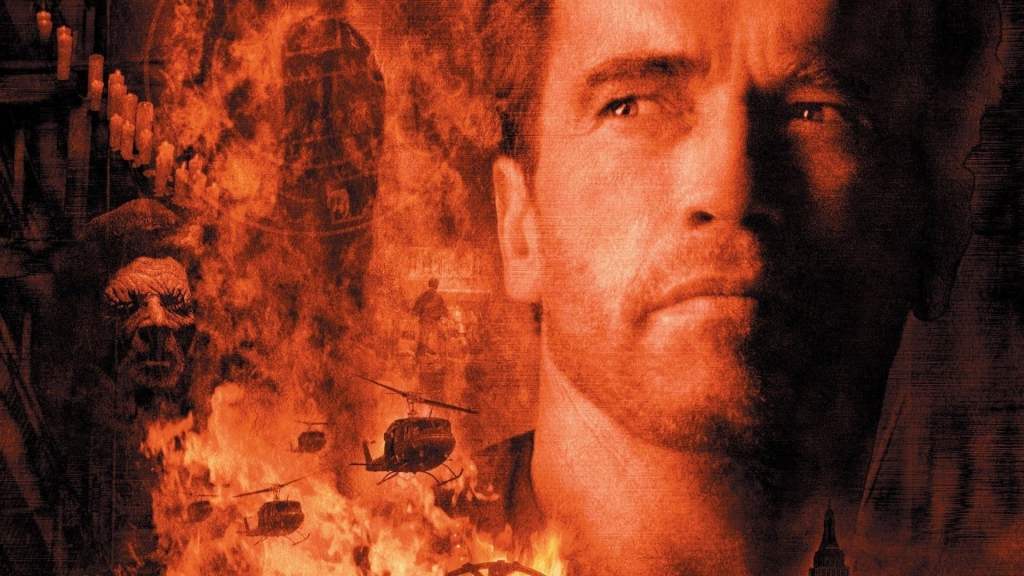
The arrival of action heroes at the forefront of mainstream cinematic entertainment is well known to everyone who ever thought of movies as their primary interest. All throughout the 1980s we saw Arnold Schwarzenegger, Sylvester Stallone, Chuck Norris and later Steven Seagal, Jean-Claude Van Damme, Dolph Lundgren and many others shape the landscape of high-octane entertainment and deploy their musculature and athleticism as indispensable tools for conjuring great movies. Between Conan the Barbarian, The Terminator, Commando, Rambo movies, Predator, Missing in Action, Delta Force and so on, the evidence supporting the notion that action heroes ruled the roost remains plentiful.
It is also well established that as the 80s drew to a close, the appetite for big muscles and even bigger guns began to wane as audiences pivoted towards more relatable leading men like John McClane in Die Hard, which opened the door for the “everyman” to become the “action man.” However, while more human action heroes portrayed by guys like Bruce Willis, Will Smith, Keanu Reeves and Nicolas Cage took hold of the box office (and I wouldn’t be myself if I hadn’t mentioned the crucial role Brandon Lee played as an evolutionary lynchpin in this process), the old guard of action heroes weren’t necessarily taken by surprise either. You can clearly see Schwarzenegger and Stallone tried to reinvent their careers in the late 80s as they saw the interest in their brand of entertainment dwindle. Schwarzenegger starred in a buddy cop movie Red Heat (because Lethal Weapon and other similar movies had been successful) and he found his second wind with Ivan Reitman-directed comedies like Twins and Kindergarten Cop. Stallone was less successful in this regard as his Stop, or My Mom Will Shoot! and Oscar fell flat on their faces.
Therefore, if you look closely at how action cinema in the 90s unfolded and which movies connected with general audiences, you’ll see that Die Hard carried out its legacy with hits like Speed and Die Hard with a Vengeance, while movies owing their existence to Commando faded into obscurity. A relatable buddy cop spectacle like Bad Boys and an over-the-top “Die Hard on a plane” that was Con Air ended up much more reliable bets, presumably because viewers chose relatability over preposterously escapist exceptionalism of Schwarzenegger’s musculature. But Arnold didn’t have a plan to disappear from the scene as far as I can imagine, nor did he choose to fade into the background and front the covers of direct-to-video titles found on the bottom shelves at Blockbuster video. I think he must have understood that his persona was (1) synonymous with the archetypal 80s action hero and (2) that audiences were tired of it and wanted other things out of movies.
He tried to poke fun at himself (Last Action Hero) and it didn’t go down very well until he was able to craft a tongue-in-cheek domesticated superman under the supervision of one James Cameron in True Lies. But I think Schwarzenegger must have known deep down that the writing was on the wall and that he was on his way out, which probably meant he became open to opportunities he’d never have agreed to at the height of his prowess just a decade before.
Schwarzenegger’s heroes (and his villains) had been consistently defined by their indestructibility, as well as their emotional invulnerability. He played guys who carried chopped down tries on their shoulders, men who shoot first and ask questions later. Guys with the biggest gun around. He famously turned down the role of John McClane in Die Hard because he didn’t like the fact McClane was wounded, bled, and cried. He did not want to appear weak and perhaps didn’t even know how to pull it off either. In fact, only in 1991 in Terminator 2: Judgment Day we saw Arnie attempt to comprehend the concept of emotional vulnerability and only from the point of view of an emotionless killing machine sent from the future to protect John Connor. “Why do you cry,” he’d ask young Edward Furlong and, upon hearing his explanation, he still wouldn’t get it. His character likely encoded it into his programming and went about his day, only to recall this scenario during the final iconic scene in which Arnie’s T-800 gave us all a thumbs-up before disintegrating in a vat of molten steel.
Inveterate, yet aware of an impending cultural shift likely to render his action hero shtick completely obsolete, Schwarzenegger refused to become a video oddity like Seagal, Lundgren and JCVD—pigeonholed as the guys with the muscles and guns from the 80s that refused to change course. In fact, as I already pointed out, Schwarzenegger was fully aware of the fact he’d have to evolve and change with time with his forays into comedy and attempts at meta-flavoured self-awareness. That’s probably why it was Schwarzenegger, not Stallone, we ended up seeing as Mr. Freeze in Joel Schumacher’s Batman & Robin. That’s probably why we saw him play a dad desperate enough to dress as Turbo-Man in Jingle All The Way or a man who got pregnant in Junior, not Dolph Lundgren or Steven Seagal, who were too serious and cool to experiment in such a bombastic and downright ridiculous manner.
However, the Schwarzenegger-branded action hero full of testosterone, loaded with quips and smelling profoundly of freshly spent cordite was not going to fade into oblivion. The muscle man needed a send-off, especially after a revival attempt with Eraser. That movie made its money back handsomely and at least numbers-wise it could have reinvigorated hope that the 80s-type action man had a place among the bleeding and fallible everymen played by Keanu Reeves (Speed), Nic Cage, Will Smith and others. But the critics didn’t see it that way and suggested that the time indeed had come for Schwarzenegger and by extension the entire concept of the invulnerable action hero to finally let it go and allow others to take over. That is why the 1999 End of Days directed by Peter Hyams is a movie I see as a pivotal data point on the trajectory of action cinema, despite its obvious and numerous flaws.
Released towards the end of 1999, at a time when The Matrix and The Mummy had already proved unquestionably that a different action hero reigned supreme at the box office and when franchise trilogies from the days of yore were about to reshape the landscape of entertainment once more, End of Days never registered on the cultural radar, despite becoming a de facto financial success at the box office. However, it was rinsed by critics who didn’t know what to make of this weird action horror movie where Schwarzenegger plays a rugged ex-cop haunted by guilt and grief and where he has to face off against Satan himself played by Gabriel Byrne. The movie was dismissed as a “head-on collision between the ludicrous and the absurd” by Roger Ebert and treated for the most part as a directionless extension of the action hero legacy that desperately tried to fit Arnie and his brand of action filmmaking into a world where Neo was bending reality and the arrival of Jason Bourne with his own flavour of everyman-superman shenanigans was just around the corner.
Who knows? Maybe Peter Hyams, a veteran director with a handful of rather interesting movies to his name (2010, Outland, Timecop, etc.), didn’t quite know what to do with a movie like End of Days. Maybe Schwarzenegger himself wasn’t sure about the role this movie was supposed to play. After all, he once commented on the fact that he was disappointed with Hyams’s direction and choices, so perhaps he was expecting this movie to be a proper revival of his shtick, almost a sign of persisting in denial about the times having moved on leaving him by the wayside. Or maybe Hyams knew what he was doing and saw in this movie an attempt at a fin du siècle commentary reflecting on the legacy of action heroes like Schwarzenegger himself.
On its surface, End of Days does not really lend itself to any sophisticated analysis, let alone a suggestion that somewhere in its thematic headspace, such as it is, one could find a conversation about the culture at large, especially if—as it is the norm for many filmgoers as well—you hold the filmmaker’s record against him. After all, what can the guy who had just directed The Relic—a movie with a face only its mother could love—tell you that you don’t already know and who is this guy anyway? This movie had clearly been written on a napkin and it had also been a bit of a hot potato with changes at the helm, rewrites, behind-the-scenes drama and so on… all of which could potentially suggest that the movie as a whole would likely make very little sense. It is true that when drama and opposing creative forces pull the project apart throughout the production, the resulting movie tends to have problems, tonal issues, scenes that don’t belong, etc.
Therefore, you’d be well within your rights to see End of Days as a bit an uninspired beast because it tries to cash in on the legacy of The Omen (and it also happened to be released in the same year as Stigmata, also starring Gabriel Byrne), while it also decidedly draws inspiration from the aesthetic that made David Fincher’s Seven a resounding success. The iconography is depressingly dark, the tone is ominous and the characters are appropriately shaded too. Which is what makes this whole thing interesting in the first place because this is stuff that Schwarzenegger just wouldn’t have agreed to do in 1989 at all. The first time we see Arnie on the screen is where his character, rugged, unshaven and filthy, is trying to blow his brains out. He’s at an end. He’s depressed. Suffering. Weak… Vulnerable. The exact opposite of what we’d typically expect a Schwarzenegger-esque action hero to be. He’s the closest he’d have come to looking like a human being in his entire career thus far.
Furthermore, he’s no longer indestructible either as in the first action scene we see him gunned down by a sniper. Sure, Arnie’s Jericho Cane is wearing a vest but this is a clear indication that we’re not dealing here with John Matrix or even Harry Tasker. Jericho Cane is older and tired. The actor himself had just gone through a heart surgery and the producers were clearly worried about his ability to make it through the shoot.
Still, we see Schwarzenegger engage in high quality stuntmanship and the movie itself (even if I believe a lot of the actual action using ropes and helicopter work was done by professional stunt performers) happens to have a distinctly Cameron-esque sheen, which is already a curiosity at a time when tightly choreographed and CGI-laden set pieces are becoming the norm. Hyams hired helicopters the way John McTiernan would have in 1988, blocked off a few sections of New York City and suspended real performers on ropes to get the action he wanted. He still opted for gun play, chases and good old fashioned close quarter combat whenever an opportunity to do so presented itself.
Further still, if we take a closer look at the motivations driving Jericho as a character, we might see a reflection of where a Schwarzenegger-type action hero might have been at this time of transition in culture. He wasn’t fading gently into that good night, enjoying his retirement or engaging in a one-last-gig-for-old-times’-sake mission to save a girl the Antichrist himself wanted to turn into his hellish bride. He’s haunted by the past and dreams only of turning back time. Jericho Cane wanted to have his wife and daughter back, while Schwarzenegger probably yearned for the time when he was the biggest game in town. I think it’s not a bad assumption to make that there’s an introspective reflection found in that crucial scene where Byrne’s devil visits Jericho in his house and taunts him with a promise he’d bring his family back in exchange for Cane’s immortal soul and the whereabouts of the girl.
This cheapo genre play on the temptation in the desert is in my opinion an interesting peek into the headspace of a fading action star who was facing a difficult decision. Sure, going back to the 80s was never on the cards and it was merely a mirage concocted by a Hollywood ego battered by years of trying to reinvent himself to fit the landscape that changed much faster than he ever could. There was no going back to the days of Predator and Conan. The choice he was facing was to either sell out and begin making direct-to-bargain-bin movies like some of his comrades whose lustre had faded a bit quicker or to lock his Glock in the drawer and flush the key down the toilet.
History now shows us that it would have taken Schwarzenegger a few more years to come to terms with his own obsolescence as an action hero as he followed up End of Days with The 6th Day, Collateral Damage and Terminator 3: Rise of the Machines before finally announcing to the world he was going to run for high office. It nonetheless stands that one of his latter movies does serve as a farewell note of sorts that Peter Hyams may have written for him. It is in this movie—not the one where he’s a fireman fighting terrorists or the one where he makes another comeback as the iconic T-800—that we see Schwarzenegger’s character in conversation with the culture about the mortality of the action hero and the fact that the services of an indestructible muscle man were no longer required.
Instead of a tireless trooper who ushers his charge to the choppa so that he would be free to face off against an enemy whose powers he wasn’t fully aware of, Schwarzenegger in End of Days was an ageing muscle man troubled by his own personal demons and who was deathly afraid of the kind of evil he was about to face. And this time, the filmmakers did not give him an opportunity to escape his fate. He wasn’t a match for Byrne’s Satan, especially having witnessed his full form in all its late 90s CGI glory. He couldn’t outflank or outmaneuver him. Satan was impervious to bullets. He didn’t bleed. And as we all know, if it bleeds, we can kill it; so if it doesn’t bleed, we probably can’t do jack.
This is where End of Days becomes a symbol in its own right because Schwarzenegger’s Jericho takes the demon into his own heart—in a genre bastardization of how Father Karras defeated Pazuzu in William Friedkin’s The Exorcist—and impales himself on a massive sword in an ultimate act of sacrifice. Look, this should have been a much bigger deal than it was and perhaps the reason why nobody picked up on the symbolic importance of this scene had to do with the fact the movie was much more fun to poke fun at and take apart than it was to take at face value. For Schwarzenegger to agree to have his character perish at the end of the film was just unheard of and the only time it happened was in 1991 when his T-800 lowered himself into that vat of molten steel.
Perhaps already at that time, when James Cameron’s sequel to The Terminator briefly became one of the biggest movies ever, the concept of the action hero had a much greater opportunity to go out on a high with that thumbs up gesture and the requisite earnest emotional treatment courtesy of Cameron’s own writing. However, opportunities like this are rarely noticed at the time when they are best acted on, specifically because nobody looks at a massively successful blockbuster and decides it’s a good time to stop, just as it is not customary to sue for peace when your army is steamrolling the enemy’s defences. It took eight years for the true last action hero to embrace his mortality and for one of his movies to become his de facto funeral.
I think—and I might be wrong, I’ll give you that much—that Peter Hyams who’s often seen as a lesser James Cameron saw End of Days as an opportunity to give Schwarzenegger a send-off and let the world embrace the twenty-first century free of its muscle man baggage. It almost worked. Schwarzenegger needed some more time. And judging by how forgotten End of Days is, the world might require a bit of a push to see things the way I do. So maybe this is going to be my own cross to bear because if I have to become a champion of this movie’s legacy, so be it. End of Days is far from perfect and it’s so damn easy to treat like a pile of 90s trash. But it also happens to be a requiem for the action man and I’m here to defend its honour.
 Flasz On Film
Leave a comment