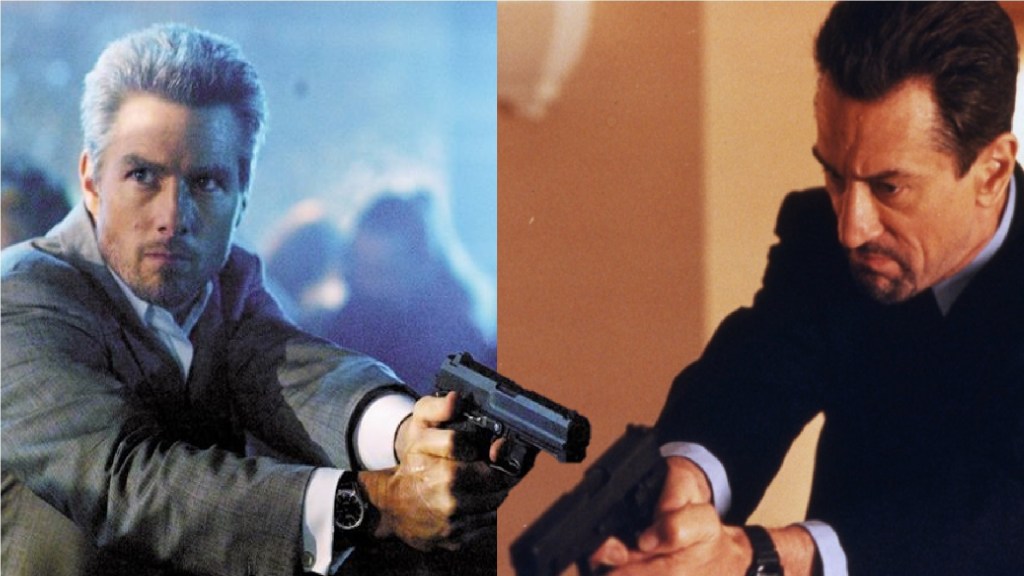
Heat was released in 1995, and it came and went largely without much ballyhoo at all. It performed great at the box office internationally, but mysteriously did not find a large audience in North America despite having a primo, late-December release that should have garnered audience attention and critical push into the 1996 awards season.
More mysteriously, though, the Michael Mann film did not get the expected technical plaudits despite its massive and detail-oriented work in its technical departments. It went completely ignored by the Academy. For that matter, aside from the Chicago Film Critics Association, which nominated the film for four awards (Best Picture, Best Cinematography, Best Score, and Best Supporting Actress, and Diane Venora for Best Supporting Actress), and the Dallas-Fort Worth Critics Association which named Heat a finalist for their Best Picture, no major group who dishes out accolades or year-end plaudits got excited at all for Michael Mann’s film. Natalie Portman got a couple of nods for a Young Star award (she was fourteen when it was released), and Val Kilmer was an MTV-Movie Award nominee for the year’s Most Desirable Male (mostly due to his playing Batman in 1995 as well), but otherwise, Heat rolled through the critical and awards communities like a tumbleweed in a John Ford western.
Yet, Heat has stood the test of time. It’s widely and wildly revered as a modern cops-and-robbers classic and one of the rare three-hour films that people look forward to sitting down and rewatching. And within the industry, its technical merit in sound, score, cinematography, urban production design, action set pieces, and editing are held on a pedestal alongside very few peers. And this doesn’t even mention the fact Heat features one of the most iconic diner conversations ever put to film.
Meanwhile, Michael Mann’s 2004 film, Collateral, despite being well regarded in its own right, was released in August as a B-tier blockbuster hopeful. All the good box office weekends from May to mid-July that year were taken up by Harry Potter, Shrek, and Spider-Man sequels along with other big-budget, effects-heavy studio tentpole hopefuls like Troy, Van Helsing, and I, Robot. At the time, Tom Cruise was still in the career mode of working with auteur directors on prestige projects—and doing so was working well enough to maintain his A-list status. Over just the few years prior to working with Michael Mann, he’d worked with John Woo, Steven Spielberg, Cameron Crowe, Paul Thomas Anderson, and Stanley Kubrick. Thus, collaborating with Mann was a reasonable and on-point career movie for Cruise. And it paid off. Collateral casually made $220 million worldwide. Furthermore, this movie did what Heat could not. Even though Collateral was a summer movie, it entered and remained in the awards conversation until year’s end. It wound up with several awards and mentions from different critics’ groups. It was recognized here and there for its editing, performances (especially Jamie Foxx), cinematography, and direction. The National Board of Review listed Collateral in its top ten films of the year and awarded Michael Mann with the Best Director prize. Meanwhile, the American Film Institute went so far as to name it Film of the Year. And yes, it went on to receive two Academy Award nominations as well. Heat did none of this. Yet, despite the critical praise scoresheet, if you ask almost anyone, Heat—not Collateral—is the film on Mann’s résumé people will remember most and probably regard as being the more prominent feature film of the two.
Maybe, despite the Pacino v De Niro showdown being the dramatically more epic and a legitimate, landmark masterpiece, just maybe it’s been the Tom Cruise hitman pic, which has bestowed a more lasting influence on the film industry over the past two decades.
Heat was very much the product of the William Friedkin philosophy of filmmaking. ‘If you want to film something special for your movie, you go do something special, and have cameras turned on to film it.’ More or less, that’s a direct Friedkin quote. And that’s precisely what Heat does along with many other Michael Mann pictures. For instance, few scenes can parallel the downtown Los Angeles shootout sequence between De Niro’s high-end team of bank robbers and Pacino’s heavily armed LAPD. To create this, Mann literally commandeered (with permits, of course) a downtown city block in broad daylight, choreographed, and shot a massive shootout with technical authenticity and dramatic immediacy. And Heat had several moments of this high-octane, realistic calibre. Christopher Nolan has taken this Friedkin-ian and Mann-ian philosophy to his films, staging huge freeway car pileups and ramming airliners into hangars for reals—and often sans CGI. However, action spectacle over the years has transitioned to greenscreen studios and visual fx houses. Consider the downtown street melee in Avengers: Endgame. Looks great, yes. Fun and exciting, sure. But computer-animated and previz all the way. Despite how impressive Heat looked, by the early 2000s, Hollywood’s business model was drifting away from real-world, practical effect marvels and towards CGI-generated Marvel marvels. Computer-drawn backgrounds and animated flying slugs offered less risky, more curated control over the imagery. In many cases, too, it was cheaper. Digitized blood and pixelated explosions are much cheaper, easier, and safer than squibs and pyrotechnics. Heat just happened to be released towards the end of an era when filmmakers did big stuff on location rather than going boom-boom in their software.
Comparatively, Collateral features much less of the jaw-dropping spectacle than its 1995 older brother. It is a much lighter-on-its-feet production, even though Mann remains fully engaged in the ‘go out and do it’ idea of filmmaking. Car wrecks still take place in downtown LA, but they take place on really quiet streets as Mann probably shot in the wee hours of a Tuesday morning. No one crashes a car quite like Michael Mann, but it’s absolutely easier to flip a car for a film in the LA business district at 3:00 a.m. than it is at 3:00 p.m. All the sequences in Heat feel as if they were the results of a hard week’s work from a massive production team. Collateral feels like much more efficient and personal a production even though they had seventeen cabs for Jamie Foxx to drive around in. The film makes the audience member feel as though they were the third member of a trio with Foxx and Cruise. Part of this aura of Collateral probably comes from shooting while the city sleeps, but in large part, Michael Mann simplifies the entire production and ramps up the intimacy by shooting it mostly digitally.
Collateral not only marks one of the first times digital cinematography is used for a bigger-budget Hollywood film but also is the first time a studio got behind using the unique look of digital to create a film’s style. Audiences of 2004 felt Collateral looked a little ‘off’. However, Michael Mann was a proponent of digital cameras because of the cost-savings, flexibility, and practical advantages they offer. He used them a little bit in Ali, but 80% or more of the footage in Collateral is captured digitally. The lighter, more manoeuvrable cameras allowed him to work in lower lighting, within cramped spaces, and with more speed. Quick camera set ups probably even permitted getting a few more takes of crashing those seventeen taxis into guardrails. Even though Mann remained the detail-oriented guru he was always known to be in preparation for the shoot—he sent Cruise to study armaments and gun-shooting techniques extensively, and he had Javier Bardem study Mexican accents for two months for his two-minute scene—once he was on set using digital cameras, he was crafting a new production manual for filmmakers and studios.
One guy who inevitably took notice of the way Mann was running the set and using the technology was Peter Berg. Berg was mostly working as an actor at the time but was simultaneously transitioning into writing and directing. He had made Very Bad Things and The Rundown by the time he was cast in his supporting role opposite Foxx and Cruise. However, following his work on Collateral, Berg immediately went off to make his football flick, Friday Night Lights. And if anyone goes back to look, they won’t find much obvious stylistic connection between Berg’s first two directorial efforts and his third. However, after working with Mann, it is very easy to trace bread crumbs from Friday Night Lights back to Collateral. Like Mann’s Cruise-Foxx film, Berg’s films from Friday Night Lights and onward would take the camera off the tripod and place it intimately onto the shoulders of their characters. Berg burst through the proscenium, so to speak, to make his characters into ‘real world’ people or his action sequences into ‘real world’ action as opposed to one-note folks in a shoot ‘em up movie. Berg has had some heightened shoot ‘em ups over the years, but he seems to have largely settled into this verité, bro-camaraderie, everyone-talks-over-one-another style of onscreen real-ish character development. Even in Hancock, Berg’s handheld, naturalistically roving camera is a significant part of his strategy in the first half of the film to humanize the irritable Will Smith protagonist before all the CGI shenanigans unfold in the movie’s second half.
It certainly wasn’t just Michael Mann doing this type of thing in the 1990s and early 2000s. Other movies and TV series of the day were doing exactly this, too. However, it seems Berg somehow found his cinematic voice from working on Collateral. In fact, Berg’s follow-up to Friday Night Lights would be The Kingdom, for which Berg sought out Michael Mann’s help to guide that production. Mann obliged, serving as a producer (plus, Mann would come back to produce Berg’s film after that too, the aforementioned Hancock). On Friday Night Lights, Berg would begin working on the teamwork, locker-room community of his character work and story while leaning into the intimate, naturalistic action of Michael Mann cinema. This would place Berg, as it turns out, onto the frontlines of Hollywood’s post-9/11 shift in the style of action films.
Following September 11, 2001, Hollywood big-budget productions found themselves veering off into new directions. New proposed action films coming down the pipe got a serious rethink. Several films that were completed before September 2001 and awaiting release got backburnered as producers gave significant consideration to whether or not these films would play well to a movie-going public, a public with a brand-new, and extremely sombre, mindset. Serious times meant for a serious shading of new entertainment. Lord of the Rings continued as a CGI spectacle, as did the Harry Potter series. But those were serious in tone, to a point. Pixar’s stuff remained escapist appeal for kids and adults like. It was the sensationalistic, heightened worlds of 1990s action that didn’t quite feel right anymore—Arnie’s latter-day action stuff like Eraser, Schumacher’s Batman universe, Brosnan’s Bond, and the wild, wild stuff like Wild Wild West. Going forward stuff like that would simply be too silly to greenlight. Following the attacks on New York, it wasn’t appropriate for films to be fun anymore.
Thus, it would be cinema like the Jason Bourne series that began forging a way forward to a new tone-appropriate, unsmiling cinemascape. With Jason Bourne, and then Nolan’s Dark Knight series, action characters and scenes were written into a world that felt offputtingly like our own. Going back to Iron Man, it’s even how the MCU got its start—in a cave in Afghanistan somewhere adjacent to the real-world War on Terror. But forgetting about the big, brand-name IP material, which would become the studio tentpole fodder of the next twenty years, the small and medium-sized action films also had to find a new style that could be palatable for investment. And it did: gritty realism. Paul Greengrass’ docu-real re-creation of Derry’s Bloody Sunday Massacre in Blood Sunday provided his calling card to do The Bourne Supremacy. Then he made United 93, which earned him all kinds of accolades including a Best Director Oscar nod. Mann’s Collateral was in there, too. Meanwhile, Berg’s work in The Kingdom, followed by Kathryn Bigelow’s revolutionary and widely celebrated work on The Hurt Locker also embraced the serious, gritty action verité.
All these filmmakers—Berg, Greengrass, Bigelow, and many others—certainly hold Michael Mann’s ‘Heat’ filmmaking ideology near and dear in their hearts. Make the thrills natural, big, and impactful on character levels. But it was Collateral that was setting the mark for how to do it on smaller, slicker productions, particularly since Hollywood was less interested in spending its biggest budgets on massive stunts with tractor trailers, heavy equipment, or complicated location shoots. None of these directors worked with digital cameras for their films in the decade following 9/11. However, they all would shoot digitally eventually. The look of digital hadn’t quite caught up to the look of film in the early 2000s, so gritty realism was often the stuff of 16-mm cameras. But in so far as digital filmmaking was on the horizon, Collateral’s lessons for creating fast-moving and chaotic action in flexible productions under difficult conditions were trailblazing the path for the likes of Patriots Day, Deepwater Horizon, Detroit, and Captain Phillips. Collateral learned how to save money on production schedules. For instance, its shooting schedule was a full month shorter than Heat’s. Further, its budget was quite a bit leaner than Heat’s was a decade earlier; plus, it was cheaper than the other summer box office blockbusters of 2004, particularly since a quarter of the $60 million budget was Cruise’s salary.
Before Collateral and Attack of the Clones and a few other digital trailblazers in the early 2000s, digital shooting was predominantly left for the low-budget arthouse scene. Attack of the Clones probably deserves a mention in here, too, for bringing digital into the mainstream. George Lucas used digital cameras to shoot Attack of the Clones. However, Lucasfilm was also shooting everything in isolated, controlled spaces with green-screened stages and heavily animated CGI post-production work. Collateral was shooting wild, in the streets of Los Angeles. Anyway, prior to Lucas and Mann, it was films like Celebration, Timecode, The Anniversary Party, Julien Donkey-Boy, or Tape using digital. The grainy aesthetic was fine for Dogma 95 experimentation, but these were the types of films Blockbuster Video would buy one copy of and place it at the very end of the New Release wall. Even though they were small films getting distribution, they certainly weren’t any type of indicator of the forthcoming digital boom. They may have inspired a generation of film students who suddenly witnessed production costs dropping significantly, but the quality of the cameras was still a bit clumsy. If you had a ginormous green-screen stage, you could do Sky Captain and the World of Tomorrow or Sin City with some help from a computer, but you were still sort of limited. Michael Mann’s work changed that. Collateral strategically asserted the digital camera, low-lighting aesthetic into the look of his film. This was decidedly game-changing for an evolving industry that didn’t want to invest in the work-intensive, harder-to-stage, and harder-to-insure films like Heat.
In addition to an immense technical influence, Collateral has had an underrated influence on some other pop culture staples since its release. It’s been well documented that The Dark Knight owes a lot to Heat, and this is certainly so. However, that’s also largely been a popularized sentiment due to the Batman film opening with a robbery. But Tom Cruise’s Collateral villain, Vincent, is even subtly entwined with Joker. Heath Ledger delivers a spiel about his Joker’s family background. The dialog has become memorable cinema in its own right. Joker says, “Do you know how I got these scars? My father was a drinker and a fiend,” and he shares the tidy little backstory, which ends up being completely fiction—and he does it to unnerve those around him. Tom Cruise’s scoundrel does precisely the same thing in Collateral. Cruise pretends to share his life story with Jamie Foxx’s cabbie only to laugh it off. He plays with Foxx the way a cat plays with a mouse—the way the Joker does with his victims in The Dark Knight. Nolan may partially owe his approach to filmmaking to Mann’s ballsy older work, but this character nod may very well be his intentional tip of the cap to Mann.
Another even bigger Collateral influence may lie in the DNA of another massive film series: John Wick. Needless to say, John Wick has plenty of creative influences from the Wachowskis to The Crow, but add Michael Mann and Collateral to the list. To begin with, in John Wick: Chapter 2, Keanu Reeves’ titular killing machine leaves his pursuer (played by Common) in precisely the same position as Jamie Foxx’s cab driver leaves Cruise’s assassin at the end of Collateral. It’s such a specific demise, it’s hard not to see as an homage. Both Common’s and Cruise’s hitmen are left for dead, sitting upright in seats on a subway. However, just as Nolan tipped the cap to Mann in The Dark Knight in appreciation of a larger influence on his films, Chad Stahelski appears to be doing the same thing, waving thanks to Collateral’s influence on his series. Not only is the character of John Wick an unshaven, well-dressed hitman like Cruise’s Vincent, but the Wick films also largely bop along to the beat of the dance club shoot out in Collateral. The scene when Vincent goes after his fourth ‘hit’ of the night at a packed dance club is masterful, vibrant, moody, and tense—all the while coupling a gun-drawn Cruise gliding through oblivious dancers while diegetic club music memorably fills the soundtrack. To a certain point, the John Wick series’ whole vibe is born out of this Michael Mann scene. Cruise had to walk through this dance floor in order for Keanu Reeves to gun-fu across it. And none of this considers the fact that Stahelski and Reeves were already stitching together action films with the fabric cut by Mann himself. In Mann-fashion, Stahelski subjected his leading man to lengthy gun and combat training—as Mann would do—and also worked within the new digital-camera landscape for action productions carved out by films like Collateral.
Collateral was one of those films which everyone seemed to see, everyone seemed to like, and everyone seems to remember well. However, when discussed in the context of Michael Mann’s films, no one readily credits it for its contributions to today’s digital filmmaking or filmmakers. As awesome and spectacular as Heat was, it might have been easy to get attached to that type of filmmaking. After all, Heat inspired a generation of filmmakers. However, in Heat’s story, De Niro’s character, Neil McCauley, had to be mindful of everything going on around him and needed to be professionally malleable, or he wouldn’t survive in his line of work. Same with Mann, who wanted to keep making A-grade action movies. “Don’t let yourself get attached to anything you are not willing to walk out on when you feel the heat around the corner.” That ‘heat’, as it turned out, was Hollywood’s digital revolution.
 Flasz On Film
Leave a comment