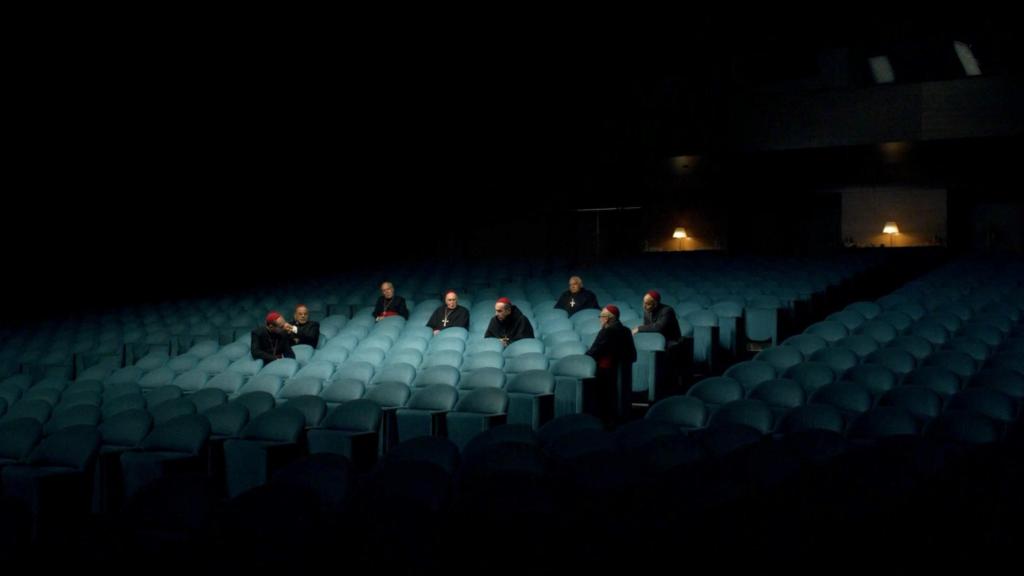

As far as I can tell, there are a number of ways I could bite into the subject of writing a thing or two about Conclave, the latest directorial effort from Edward Berger (of the most recent adaptation of All Quiet on the Western Front, which I was not the biggest fan of). As a dyed-in-the-wool atheist, I could stretch my Dawkinsian hammies and take this movie apart on the back of its key preoccupations with the matters of the Catholic Church, arcane rituals and how insular, pompous and unnecessarily secretive that particular institution is, while also being comfortingly forgetful of its many transgressions. I could take it apart on the back of its central intrigue, which is not exactly world-shatteringly Agatha-Christiean, if I may say so. Finally, I could disregard these matters altogether and focus on what seems to be the centrepiece of this movie’s critical clout, namely the performances from Ralph Fiennes, John Lithgow, Stanley Tucci and Isabella Rossellini and perch my entire review on trying to build support for their incoming for-your-consideration campaign.
I could. But I won’t. And that’s because I find myself in a strangely minuscule minority of viewers who found themselves veritably unperturbed by Conclave. Maybe I should have titled this text as “Conclave? More like Concla-meh, am I right?” or something equally crass, but even this would require me to muster enough activation energy to get over the thermodynamic hump.
In all honesty, I don’t know what to tell you about this film and perhaps I’m quietly looking for a way out of this self-imposed assignment. After all, I could just as well not write anything, eject this unspent shell and reload my pundit shotgun. But then again, my inner David Goggins keeps shouting into my ear to stay hard and just write something that makes sense instead of looking for excuses not to. Therefore, here I am pouring whatever comes out of my brain onto the page, hoping it would make sense or move you more than the movie about a bunch of irate men in crimson dresses moved me. And that’s because I don’t think I have it in me to take a swing at Conclave (using either of the angles I outlined above) because Conclave didn’t take a swing at anything either.
I suppose this is just what happens at this time of the year when blockbusters temporarily evaporate from the release ticket—before making a brief re-appearance during the holiday season—to make space for that awards-ready prestige fare. This is where a lot of the biggest and most talked about movies will typically see the light of day and it also just so happens that among those important, cerebral and societally pivotal pieces striving for that precious cultural real estate in the fleeting consciousness of our time there will always be a handful of movies like Conclave, which aren’t necessarily bad, but aren’t great either. Inoffensive, manufactured and gambling on the strength of their performances, these prestige movies pose as veritable catnip for pensioners and will make great conversation over a nice cup of hot tea with your colleagues at work, to whom you just couldn’t recommend In a Violent Nature out of fear of outing yourself as an utter weirdo.
Thus, this is where we are with Conclave, a movie that adapts a novel by Robert Harris from 2016—which I can imagine is a book you’d likely pick up at an airport during an opportunistic layover exactly because it’s bound to speak to large enough crowds. The story concerns the immediate aftermath of the Pope’s death, which demands a number of high-ranking officers of the Catholic Church to descend upon the Vatican to sequester themselves from the world and in a series of secret ballots decide who should lead the institution next. What follows is a medley of political ploys where we hear about liberal cardinals trying to win approval of the lot while the conservative ones fight to preserve the doctrine. Naturally, a central intrigue rears its ugly head, which involves unearthing dark secrets of those men of the cloth. And then an even bigger enigma unfolds that has to do with the arrival of a freshly minted cardinal who happens to be from Mexico but hails from Afghanistan and everyone wonders just how much of a disruptive force he’d become. And on top of it all, the dean of the entire affair, played by Fiennes, who serves as a conduit for the entire operation for the viewer, is suffering from a crisis of faith as all those events unfold.
So, you’d be excused if you thought that Conclave deals with a lot of stuff. But it doesn’t really. It’s a movie that only looks as though it had a lot of things to say about a lot of things—from wading into a conservative-liberal debate and the role of the Catholic Church as a spiritual leader in an increasingly fractious world to the many dark sins hidden in the depths of the institution, the arrival of new ideologies and more—but it doesn’t take a stance on anything, presumably out of fear of alienating those who may disagree with any sufficiently strong statements. Hence, it’s a film that just coasts and distracts the viewer with its theatrical shenanigans but never cuts deep enough to upset, discomfort, discombobulate or force the viewer to evaluate their own positions on any of those subjects. It’s a populist people-pleaser aiming squarely at the silver foxes in the audience who have ventured bravely into the cinemas hoping to have a good time and goddammit good time is what they’ll have because nobody goes to the cinema to think or feel.
If anything, I guess my own integrity forces me to admit that at least the Church itself seems to have been touched by the arrival of this film as actual men in gold hats and crimson dresses seemed offended by a possibility that average folk might get the wrong idea about what goes on in the corridors of the Vatican or that there’s no place for woke agenda in a movie about the Church. But… is there? Maybe. I don’t know. I’m not a seventy-something pensioner on a night out and my eyebrows remain firmly unraised whenever anyone mentions sex scandals, instances of paedophilia, homophobia or transphobia in the context of an institution as calcified, mired in infamy and divorced from the reality of a world I personally inhabit as the Catholic Church.
And to be perfectly honest, because the movie predominantly functions as a stage production with a bit of cinematic flair stitching it together, you never get to witness or feel anything this movie deals with directly. It’s all talk. No. Not talk. It’s just bullet points. Surface level conversations using easily recognizable keywords that your nan could pick out from a conversation and think herself informed on the subject because she may have read a thing or two on Facebook and she knows enough about gay folks or trans folks to be slightly afraid of them but also to consider herself open-minded enough to see Conclave as a monumentally progressive piece aiming to get under the skin of your typical pensioner.
Consequently, I would like to view Conclave as a failure because it straddles the middle of the road when it would have made sense for it to lean into at least one of its many niches. In a way, I’d rather an opportunity to joust with a movie that at least came ready for a fisticuff, but doing so is only akin to trying to have a punch-up with a water-filled mattress. I’d just get tired, and my opponent would passively absorb all my jabs without executing a single swing. After all, mattresses don’t box, now do they?
But I’m happy everyone and their mother seems to think Conclave is the best movie ever without really going any further than acknowledging its formidable performances and its many intrigues. I’m sure many viewers exit the cinema with a resounding wasn’t that nice on their lips and then proceed to have a surface-level conversation about priests and their secret children or how gay folks no longer scare them or something. I’m glad. But here I am in that infinitesimal minority of viewers who immediately identify Conclave not as a revolutionary piece of forward-thinking storytelling skewering the social mores of our time, but as a risk-averse piece of prestige schmalz designed to mildly entertain as many demographics as possible and, most of all, to galvanize the boomer vote in support of the upcoming awards season. Look, Tucci and Fiennes are rarely terrible. In fact, they are almost uniformly resplendent regardless of the movie they end up being in. But if you look past the Oscarbatory constructs this movie is built around, you will see just how hollow and catnippy it is. And as far as prestige movies go, I find thematic and narrative inoffensiveness personally offensive because movies should make me feel something. And Conclave just doesn’t do anything for me.




 Flasz On Film
Leave a comment