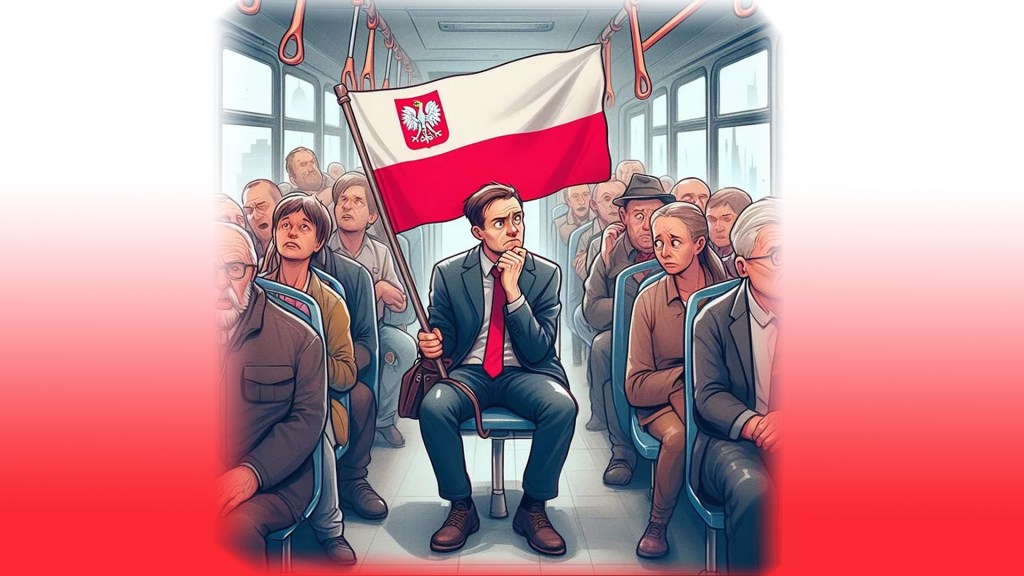
I’ve lived in the UK for long enough to consciously question where I truly belong. I left Poland in 2009, so it’s been a while, but I suppose I cannot exactly count myself among “the first-wavers” who arrived on the British shores in May of 2004 and penetrated the UK society.
And even though we have a distinct tendency towards blending in, I feel the Polish diaspora in Britain, which ballooned over the course of the last two decades to reach a peak of just over 1 million around the time the infamous Brexit referendum became a reality, has left a lasting mark on the country, be it in the form of Polish shops becoming a part of the high street landscape, the distinct melody of the Polish language heard on public transport, or Polish-sounding names frequently used in playgrounds by parents. But it may take a little while to notice us because, as I said, we are a little bit like chameleons. We blend in and we have for the most part adopted the UK as a new home. At this point, most of us who may have originally arrived with a plan to save up and move back to buy or build a house, have either done so already, or have in the meantime changed their minds. So, we’re here.
However, ever since the Brexit referendum, I have felt a growing undercurrent of anti-Polish sentiment brewing somewhere under the epidermis of what you’d call the polite society. Now, I don’t think there was ever a time when we were all 100% welcome, but in the aftermath of that fateful day when the country voted to leave the EU by a slim margin, some people who may have already harboured some animosities towards Poles have been given a licence to voice what in any other context would be seen as blatantly racist views. I think I have been personally told a good handful of times to “go home” while on the bus from work, usually by a passenger clearly irritated by the fact I had the audacity to speak Polish on the phone. As I have thick skin, I’d usually turn these clearly vitriolic statements into jokes by asking to clarify where exactly I should go because I was heading home from work, or something to that effect.
And even though I never saw anyone react to such bigoted outbursts at the time let alone stand in my defence — after all, most people are not heroes despite maybe imagining they would stand up and do something in similar hypothetical scenarios — all my friends and colleagues would always offer reassurances in addition to words of warmth and acceptance after the fact. Therefore, you could lull yourself into thinking that what you experience — if your recollections mimic mine, that is — is an anomaly. That you’re dealing with a few bad apples and that Britain as a whole is a welcoming place.
Well, it is. However, nothing’s ever easy and even the notion of being welcoming and accommodating comes with a good measure of hard work on behalf of those who diagnose themselves as open-minded and forthcoming to those of us who for one reason or another chose to move our operations from the country of our birth and bring them here into the UK.
You’ve probably heard a lot about such terms as unconscious bias, or microaggressions, many of which your friendly neighbourhood journalist at the Daily Star or The Sun would immediately want you to associate with “wokery” or “snowflakeism.” Even if you see yourself as a bleeding-heart liberal, certain little patterns of behaviour may reveal that your mindset is lagging behind your ambitions. Because it all starts with what we implicitly assume and only then may be corrected by what we consciously want our thinking to be. Therefore, it is important to note those micro-aggressive speech patterns that, while perhaps completely innocent if examined in vacuo and often completely unnoticed by their recipients, may compound over time and calcify into lasting states of background anxiety and an otherwise unexplainable distrust to the UK as a self-professed welcoming society.
“My cleaner is Polish.”
If I had a penny… you know? This is probably the most egregious example of what I define as an anti-Polish microaggression you will usually hear right after you introduce yourself to a new neighbour or a new colleague at work. Someone will pick up on your unusually sounding name or spelling thereof, or maybe they’ll notice your accent. And don’t get me wrong, this is a pattern of behaviour I honestly believe to come from a place of trying to find rapport with me as a Polish national, but nobody really pays attention to how this attempt is engineered. In many ways, the “Oh, you’re from Poland? My cleaner is Polish” or “a guy who fixed my bathroom was Polish; great guy!” are what I see as equivalent to the some-of-my-best-friends-are-black card played by self-diagnosed liberals to corroborate their well-intentioned outlook on society.
However, I feel such remarks are more intrinsically insidious because in contrast to the well-worn “my best friend is black” line, which aims to convey that your interlocutor has a positive view of other ethnicities, this one carries a different assumption. Again, at the risk of sounding like a broken record, nine out of ten times I hear such statements deployed in practice I charitably assume they come from a place of attempting to find a commonality with me as a Polish national, but they implicitly introduce a power dynamic into this relationship already. By instantly claiming to know some Polish people because they happen to clean your house or fix your toilets, you communicate to me indirectly that you see yourself as superior to me. You are better off, wealthier and better positioned than me because you can afford to have a Polish cleaner. Britain is a historically class-based society and by doing so, you are immediately ranking yourself higher than the person you’re speaking to purely on the basis of their ethnicity and heritage. Is it pertinent to the conversation to note that the reason you know a Polish person is because they fixed your shower or built your extension? You know, the shower and extension you can easily afford to be fixed or built by labourers from other countries? It does not matter one iota. Therefore, if you feel it is appropriate to mention you know a few Polish people, just do that. There’s no need to position yourself in the societal hierarchy two seconds after introducing yourself to me.
“Your English is very good.”
Another common statement I hear a lot is a remark on how great my English is. Now, this one is tricky because it almost always truly comes out of the person’s desire to compliment your language skills, especially because I find a lot of British folks I know feel insecure about the fact they struggle with learning foreign languages. Therefore, it is important to pay attention to where this sentence is placed in the conversation because it does make a difference to how you might implicitly decode it as the recipient of such a complimentary remark.
Admittedly, it’s extremely subtle but it’s not the same if you compliment my English before or after learning where I’m from. And of course, there is also a risk you might compliment the language skills of a person for whom English is their native tongue and you just have no idea they speak English where they are from, which is a whole new kind of embarrassing because you will out yourself inadvertently as someone who didn’t pay attention at school. Therefore, getting congratulated before learning where you’re from is a statement easier to decode as completely positive in spirit because it truly stays tethered to your language skills. But it’s not the same after volunteering your country of origin because then the same statement may carry an additional implicit message based on an assumption that people from where you are from are not people the person making this statement would ever expect to be good at English. In fact, they may know a few people from there whose language skills may be lagging or who have a thick accent layered over the top of their speech. Therefore, they assume it to be the norm. The norm you surprisingly breached with your own command of the English language. Do you see the difference? It’s in the implicit assumption underpinning the conversation, which is rooted in a generalization that Poles in general don’t speak English very well.
“Are you sure you’re Polish?”
Now, I’m sure not everyone may immediately sympathize with me here (and this may be a topic for a separate little rant I might devise in the future), but very often do I hear my Polish heritage questioned after revealing I do not drink alcohol. However, I feel it is important to note it because it is in a way a subtle extension of the “my cleaner is Polish” pattern, as it is rooted in a stereotypical assumption of my nationality. Would you ask a French person if they’re sure they’re French after learning they have heroically carried someone out of a burning house, all because a stereotypical assumption carried through the decades now suggests that French people are cowards? It would not only be hurtful, but terminally stupid and you’d never do that. You wouldn’t express surprise that a Jewish person is generous either, would you? It would make you look like a bigoted monster. And therefore, nobody ever does.
But it is somehow acceptable to assume that a Polish national must be a drunk in their spare time. Now, as Poles we probably don’t do anywhere near enough to combat this, especially because in general people who don’t drink alcohol for reasons other than religious constraints tend to be a minority, but it all comes back to assumptions carried by the person asking such questions. It is all rooted in the image of what a Polish person looks like in their head and the shock of learning that someone may not fit the stereotype built implicitly in their minds.
Look, we all do that. Our brains operate by way of identifying patterns, finding commonalities and bringing them together into some kind of an average. What is important, however, is that we ought to become conscious of those patterns and actively train ourselves not to express them, even if they are not immediately hurtful. They are not acutely damaging and, to be perfectly frank, it’s easy to overlook them as they happen. But having spent a long time in the UK I can tell you that such remarks and behavioural patterns when deployed over a sufficiently long period of time may amount to an equivalent of a death by a thousand cuts.
Us Poles, we do have an in-built inferiority complex, courtesy of a few centuries of struggle, wars of independence and the unfortunate positioning of our country in the centre of Europe (not East!), between other regional powers with territorial ambitions. We are so far removed historically from the times when the Polish Commonwealth was an empire one could be proud of, we don’t even recognize it as a living part of our heritage. I suppose, this is where we have our own work to do, so as to make sure our own self-image improves sufficiently.
However, I’d like to end with a call for charity and open-mindedness so many of us would like to implement in our daily lives. It’s easy for Poles to slide into a place of inferiority and naturally widen the gap separating us from our British hosts. All you get in return is (1) fostering the formation of insular bubble communities of Poles who don’t interact with the world outside and (2) reinforcing any pre-existing animosities lurking in the background of the wider society. We are great at blending in but it’s way more difficult to do so when every day brings you closer to realizing that the society you are trying to adopt as your own may not want you here. And it doesn’t have to manifest itself in the form of outright bigotry or even physical violence. It’s all in those little patterns of speech you might find completely innocuous, but I promise you they compound over time into a detectable feeling of not being welcome.
So, if you see yourself as a liberal or a progressive or simply someone with an open heart and mind, don’t tell your Polish neighbour about the fact the only other Polish person you know fixed your toilet. Instead, invite them over for tea and ask how their day was. It’s that simple.
This article was originally published on Medium.com on 14th January 2024.







Leave a comment