Politics has never been a particularly strong driving force in my writing and the closest I’d ever come to opining on politically relevant issues is when it is somehow directly related to a cultural topic I am otherwise interested in. I have always seen myself as politically ambivalent, especially in recent years when politics globally has become increasingly tribal and ideologically driven. And as an old-school atheist and a dyed-in-the-wool sceptic I have come to treat any movements underpinned by emotion and blind faith as opposed to facts and observable reality with the same suspicion I have always extended towards institutionalized religion.
However, as Americans are heading to the polling stations, or whatever it is they do across the pond with their voting machines and hanging chads and such, I decided to say a few things, specifically because a lot of the conversation surrounding the outcome of this election may involve the world of podcasting and its growing influence over the culture at large, as well as the simple fact that it might be the case that the outcome of the poll might hinge on engaging the American equivalent of someone like me, a politically disenfranchised male. And of course, another reason why I decided to write a few words on an election happening in a faraway country behind the horizon is that when America gets a cold, the world gets the shits. So, whatever happens over there will magically influence what happens elsewhere in the Western civilization, whether we like it or not.
Look, I’ve always been allergic to Donald Trump and I don’t have to really list any reasons why anyone might dislike him. The proof is in the pudding and in the written record of his achievements in office. Also, I’ve always been apprehensive of endorsing out-and-out narcissists with big mouths and a penchant for attention seeking. Maybe that’s why I always feel more comfortable around more understated people and why I feel particularly at home in the UK. But that’s neither here nor there and my personal proclivities have never interfered with my own personal curiosity because—as that old school atheist and a sceptic and a generally interested human being—I prefer not to rely on second-hand opinions and make up my own mind about anything or anyone, while remaining cognizant of the context of the information I have accumulated about them.
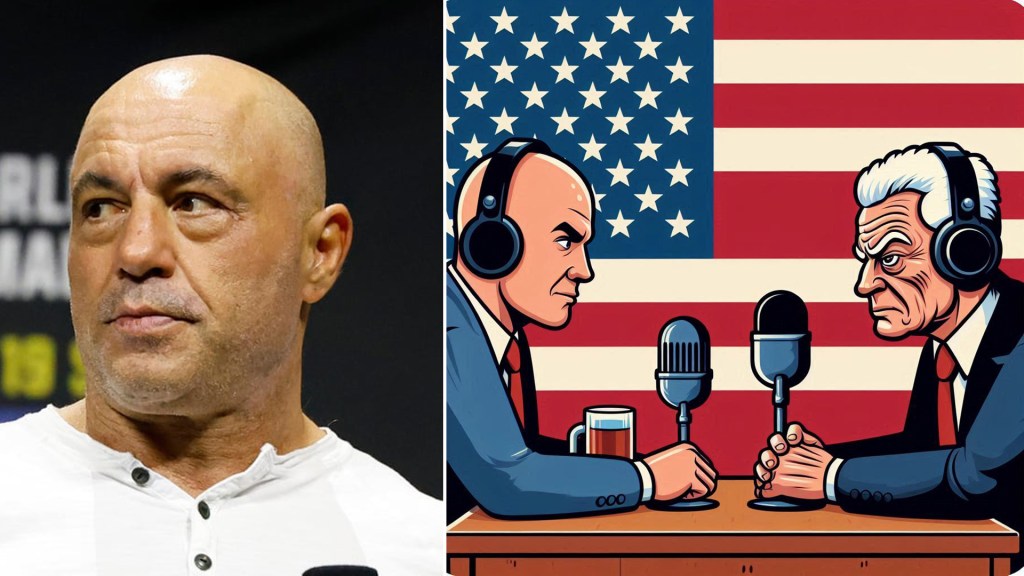
Therefore, I decided to listen to the entire three-hour-long conversation Donald Trump had with Joe Rogan, if only to contextualize further what I think about the man, or maybe to see what his deal might be. And I emerged from having listened to this interview utterly frightened, but not for the reasons I ever imagined I’d have found terrifying. I fully expected Donald Trump to launch on tirades full of bluff and bluster, just as I fully expected Joe Rogan to find it difficult to interject or stop him in his tracks. Granted, Rogan has been interviewing people professionally for a long while, but talking to politicians whose agenda is to convince the audience to join their tribe is a little bit different than talking to an author marketing his new book, a podcaster promoting his endeavour, or even an activist trying to explain why their cause is worth pursuing.
Not only did Trump run around Joe Rogan in circles while spouting untruths and outright lies with reckless abandon, Rogan either seemed happy for him to do that or felt completely unable to engage in an adversarial debate. Normally, you’d see him ask his buddy Jamie to do some hot fact-checking on the fly to correct the record, which is something he can even do when he speaks to cerebrally superior people to him like Elon Musk (even though he agrees with him more than he does not), but he never challenged Trump on any of his wild claims. Was he afraid that Trump would cancel the interview and walk out like the narcissist he is? Maybe. Was he in awe of him because he endorsed Trump’s views? As it turns out, yes.
Therefore, what the world ended up being exposed to—and a lot of people watched or listened to this conversation—was a parade of unchecked buffoonery that a good fraction of those who witnessed it might take at face value or see as confirmation of their own pre-existing beliefs. Which is quite a scary prospect because Rogan can no longer hide behind his “I’m just a comedian asking questions” shtick. He holds power and influence over many people and he’s not beholden to the same ethos as a traditionally trained journalist would be.
This is what scared me the most because we now live in a world where influential political conversations are held by people who either don’t have the necessary training or the moral backbone to conduct. I’m sure that despite her own political convictions, Emily Maitlis (formerly of the BBC Newsnight and now of The News Agents Podcast) would not shy away from asking hardball questions. She’d call out Trump on his record and question his outlandish statements regarding illegal immigration and his continuing refrain of having the last election stolen from him. Hopefully, she’d probe exactly what he’d do for those people who regularly tune in to listen to Rogan’s show. In fact, I have seen her hold the feet of people on all sides of the political ledger to the fire and deconstructing their worldview in an uncompromising way. This is what Rogan just doesn’t have and, worse yet, doesn’t think he needs. He’s just there to have a conversation and to be perfectly frank, it’s OK to hold that mindset as long as both parties to the conversation agree on this and approach the interview in good faith.
I don’t believe for a second that Trump arrived at Rogan’s studio with an earnestly held hope to have an honest conversation about what it takes to be The Leader of Free World or what his ideas for the future might be. He came there with a clearly held intent to win over the section of Rogan’s listener base that has been identified as one of the key demographics holding the key to this election—young and middle-aged men without clearly stated political convictions, many of whom might be single. People who have been told for many years that they are somehow intrinsically toxic or who don’t see themselves supporting any particular political cause because whatever they’d hitch their carts onto would invariably come with implicitly supporting a whole host of causes they might object to on principle. I don’t think Rogan realized that. And if he did, he might be complicit in selling snake oil to folks who might not have been prepared to listen to someone who can effortlessly lie to them while remaining extremely charming and likeable. Because Trump is charming and likeable in a one-on-one scenario, as it turns out. He blusters and bullshits a lot, but he comes across as candid and down-to-earth, especially when he gets sidetracked with talking about MMA, bowhunting, or Elon Musk’s re-usable rockets. But he knows it’s all a ploy to mobilize that untapped demographic.
Meanwhile, I also had a chance to listen to Alex Cooper of Call Her Daddy Podcast as she interviewed Kamala Harris, because—as I stated above—I like the idea of seeing stuff for myself rather than relying on second-hand opinions. The interview wasn’t anywhere near as exhaustive as the Rogan-Trump stint, but again it bore many similarities in that Cooper also refrained from asking Harris tough questions in the way a “real” journalist would. She managed to get the Vice-President to open up a bit better because Kamala Harris isn’t anywhere near as self-absorbed as Trump is and she happily talked about her childhood, what drives her cause and why it matters for her, and for American women, to help her win. She didn’t need to be fact-checked the way Trump clearly did, but still I think I’d have learned something more profound about the candidate to hold sway over the Western civilization for the next four years if her interlocutor had chosen to fling a few tough questions her direction.
In fact, I’d have preferred if Cooper had interviewed Trump and Rogan talked to Harris, but this is just fanciful because neither of these interviews would have taken place (and I am told Rogan was trying to get Kamala Harris to join on his terms for a long-form conversation) and if they had, they’d be just as risk-averse and hence completely redundant. This only serves to underscore that influential podcasters have a lot to learn from “real” journalists and broadcasters, most of whom they see as obsolete or politically compromised. And that’s because they don’t necessarily know how to ask tough questions or maybe they don’t want to do so because they—Rogan and Cooper—need them—Trump and Harris—more than the other way around. For those podcasters, these conversations are opportunities to inflate their platforms and to reinforce their standing as culturally relevant influencers. They’re not here to hold anyone to account. They’re not held to a standard. They don’t have to live up to any journalistic ethos. But in a world where podcasters seem able to swing elections one way or another by enabling politicians access to their listeners, perhaps they should.
But we live in a world where this would never happen, because in the universe of tribal politics, politicians don’t want to speak to those who are unlikely to agree with them and whose vote they’d have to work for to get. And sadly enough, Trump seems to be the only one of the two who at least tried to reach those untapped votes with his bluster and snake oil wares. And what’s even sadder, the men he reached out to using Rogan’s platform are probably more likely to agree with what Kamala Harris would offer them, if she dared to speak to them directly and explain why they should trust her.
Problem is, nobody really speaks to and for men these days and those who choose to do so tend to be Tyler Durdens, snake oil salesmen, agents of chaos or duplicitous actors with vile agendas. You take your pick as to which one you think Trump is today. In a world where all political actors only talk to their base and effectively preach to the choir, men tend to be left on the kerb, even though they’re perfectly happy to stand shoulder to shoulder with their female friends and co-workers in support of their reproductive rights and bodily autonomy. But instead of talking to them and speaking for them, the political establishment prefers to tell them to keep quiet. After all, they’re allegedly toxic and part of some kind of patriarchal arrangement they’ve never experienced. Because somehow, they got lumped together with a tiny sub-stratum of people who are guilty of being toxic and patriarchal, and through guilt by association stroke collective punishment, they no longer have a political home.
Therefore, I think it is important for podcasters posing as political influencers to educate themselves on journalistic integrity and learn to ask hard questions. Maybe fact-checking Trump’s diatribes would have shown him as the snake oil salesman that he is. Maybe asking Harris to say something to men, preferably on a platform where men are likely to hear it, would have helped to bring people together. As it is, whatever the result of the US vote, the integrity of the Western world is at stake because, as I said before, when America gets a cold, the world gets the runs. Currently, America is not doing too well, and men all throughout the hemisphere are being left behind by the political establishment, listless, lacking a cause to fight for, vulnerable to be swayed by insidious forces aiming to use them to advance their fascist-adjacent agendas.
Thus, I remain fearful of the future because what happens in America today is surely going to trickle down to where I live, and also because the universe of political commentary has moved to encompass voices who don’t know or don’t want to hold our prospective leaders accountable for their words and actions. They’re happy to give them a soapbox to stand on as they galvanize their base and either alienate young men further by failing to acknowledge their existence and importance or hypnotize them with undeliverable promises and a game of othering, and effectively facilitate their own brainwashing.


 Flasz On Film
Leave a comment