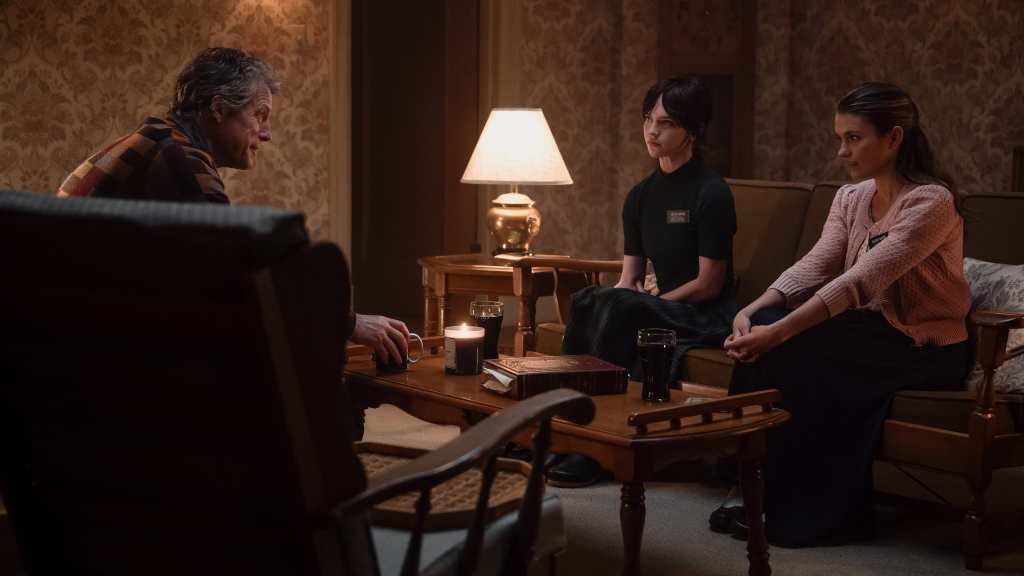

Two modestly dressed women, Sister Barnes (Sophie Thatcher) and Sister Paxton (Chloe East) are invited into the house of a gentleman who introduces himself as Mr. Reed (Hugh Grant). They only enter the house after being promised another woman would be present. Mr. Reed assures them that his wife would accompany them to tea and cake. But she never arrives. Instead, Mr. Reed asks the two young Mormon missionaries sent to his house with an intention to convert him some delicate questions about the nature of their faith. He prods and asks about the nature of free will. He jabs about the Mormon history of polygamy. The atmosphere becomes a bit too uncomfortable for the two nuns and they decide it’s a good time to leave whenever Mr. Reed retires to the kitchen for a second.
But the door is locked, and as Mr. Reed had conveniently mentioned in passing as he was inviting the women inside, there is no mobile reception in the house because of metal in the walls and roof. Sisters Barnes and Paxton end up in Mr. Reed’s study, which is a little room with a desk, a record player and loads of bookcases. Mr. Reed then sits down in his chair and announces to the nuns, “I am The Architect. I created The Matrix. I’ve been waiting for you. You have many questions, and although the process has altered your consciousness, you remain irrevocably human. Ergo, some of my answers you will understand, and some of them you will not. Concordantly, while your first question may be the most pertinent, you may or may not realize it is also the most irrelevant.”
Wait, what?
Well, no. Mr. Reed doesn’t turn into The Architect from The Matrix Reloaded and Sisters Barnes and Paxton do not morph into Neo. But they might as well because what happens in this movie is just as incongruent, pretentious and insufferable as the infamous Architect sequence in The Matrix Reloaded. Instead of outlining the nature of The Matrix, Mr. Reed proceeds to talk to the poor missionaries about how all monotheistic religions are iterations of some ancient storytelling archetypes. How the myth of Jesus and his resurrections had been told and re-told in different formats for millennia before Jesus was actually born. He does all this using the game of Monopoly as an analogy, and he goes on a lengthy diatribe about how this game was invented as The Landlord’s Game and how it has evolved into flavour variations of Monopoly. He then plays for them The Air that I Breathe by The Hollies and goes on a different rant about how they should recognize the melody and the chord progression because Radiohead appropriated it for their breakout hit Creep. He also adds that Radiohead themselves sued Lana Del Rey for plagiarizing Creep in her song Get Free. He then points to a set of two doors behind him, writes “belief” on one and “disbelief” on the other and then proceeds to ask Barnes and Paxton to choose wisely which door they want to take if they want to leave his house. What he doesn’t tell them is that both doors lead to a cellar where their horror of survival is about to begin.
However, neither Barnes nor Paxton, nor even Mr. Reed realize that the horror of survival had begun much earlier. In fact, it started the minute the movie opened with Barnes and Paxton sitting on a bench and talking about watching online pornography and feeling sorry for those poor sinners who sell their bodies online, while awkwardly hiding their curiosity about sex-related stuff. Little did they know, those two women were about to walk into a horror movie concocted by people who thought they had a good idea for a film, but they somehow got lost in talking about what this movie would be about and turned it into a genre-themed interpretative dance routine most likely based on the kind of a feature-length video essay a twenty-something would put together having read The God Delusion by Richard Dawkins and having fallen in love (against their better judgment, mind you) with the two sequels to The Matrix.
Thus, Heretic which was written and directed by Scott Beck and Bryan Woods (who previously made 65 and wrote the script to A Quiet Place) may be quite difficult to sit through if you’re no longer in your twenties and you’ve successfully outgrown the idea of being “fun at parties” by cornering religious people and oppressing them with second-hand militant atheism. Because all those talking points—from reminding you that resurrection is an iterated mythic archetype to undermining the basic tenets of any faith with cold logic and facts—are in the movie. Spelled out, in case you missed them. In fact, the great prayer study is referred to in exquisite detail and with remarkable candour by someone suffering from a grievous stab wound. Because why not? Doesn’t everyone who’s been terribly mauled develop a sudden urge to deliver a speech inspired by Richard Dawkins?
Look, I’ll be perfectly honest, Heretic doesn’t make a whole lot of sense but if you’re not aware of what it’s doing, it can easily daze you with its faux intellectualism. Hence, I predict you will either emerge totally satisfied with all those factoids if this is somehow new to you, or completely despairing because this is the kind of stuff you had known for a long time, and it no longer impresses you. Therefore, you are free to look past the pseudo-intellectual rambling coming out of the characters’ mouths and this is when you notice the movie is a poorly held together patchwork of ideas and themes ripped out wholesale from other, oftentimes more successful horror films.
We have what looks like a clever visual conceit of moving between looking at characters running between locations to seeing them as pawns in a model house, which reminds one of similar ideas Ari Aster reduced to practice in Hereditary six years ago, and which probably trace their lineage to the iconic scene in Stanley Kubrick’s The Shining where a close-up on the model hedge maze dissolves into a shot of a real one. Classically, we have dingy cellars, scary-looking female figures in dirty robes, satanic altars and women in cages, none of which are used with even a modicum of freshness. Therefore, it might offer some consolation if you’d like to indulge in the “Where’s Waldo” of horror references this movie relies upon as background noise to its incessant philosophizing. I suppose it’s fun, but with movies like Sting, Cobweb, Imaginary and even Alien: Romulus still lingering in our short-term memory banks—movies which also invited us onto such Easter egg hunts, sometimes with a welcome tongue-in-cheek attitude—such an endeavour feels ever so slightly redundant.
Therefore, I came away from watching Heretic awash in undiluted disappointment because despite the fact it was quite refreshing to see Hugh Grant in a villainous role—and he almost saves this movie with his dapper well-to-do appeal—there is nothing to find here for anyone with at least a rudimentary understanding of what this movie is attempting to achieve. It’s a festival of pop philosophy used as window dressing disguising an otherwise workaday attempt at a religious horror, reliant on scare tactics and visual ideas ripped verbatim from much more accomplished movies. And just to be clear, there’s nothing wrong with the ancient art of collage per se. But it must either serve a purpose or be intriguing or entertaining in its own right.
Sadly, none of this is true here. Heretic is a bore-fest saturated with pseudo-intellectual yapping regurgitating talking points from the many online manuals for obnoxiously aggravating practical atheism inspired by Dawkins’ seminal The God Delusion and only briefly interrupted with genre elements that are neither effective nor inventive in any appreciable capacity. Sure, it may be organically fun to look at characters trapped in dingy cellars with creepy figures looming in the background, but unless this is the first film you ever see, chances are none of it will register as interesting. Therefore, I thoroughly recommend you go back to the shelf and rewatch Hereditary instead. Might as well revisit The Witch too, while you’re at it, if you’re after a different flavour of religious horror. And actually, you could just as well refer back to William Friedkin’s The Exorcist which is much more effective at having a conversation about the nature of faith and the grinding interface between reason and religion, while delivering an experience that is way more intense than this movie could ever muster.


 Flasz On Film
Leave a comment