When James Cameron was writing The Terminator, he had absolutely no idea that it would become a worldwide phenomenon and grow into a self-sustaining franchise worth billions of dollars. All he knew was that he was working on a slasher movie where Michael Myers would be a robot from the future. In fact, John Carpenter himself, the father of Michael Myers and the Halloween franchise, most likely had no clue his movie about babysitters traumatized by a serial killer with a penchant for knives and browless William Shatner masks would go on to become an enduring series with incredible appeal.
This is just one of those ineffable aspects of the creative process because nobody ever knows if what they’re working on is going to become a viral sensation. If they do, they are either lying to you or to themselves. Or both. Maybe musicians or stand-up comedians could stand as a bit of an exception here because their creative process involves audience participation to an extent. A comedian works out their material by bouncing it off small club audiences and iterating painstakingly through that recursive feedback loop of gauging rejection of varying intensity. Equally, a band can have an idea that some of their songs work better than others because of the way people react to them when they play their gigs in smoke-filled pubs. Therefore, when the time comes to put together an EP or choose a song list for a full album, they’re not necessarily on their own and they have something they can use to rationally craft a product with a measurable potential for success.
No such luck when you’re a writer, though, because the process involves only you, the writer, and a blank page. Hence, whether it’s Cameron writing about cyborgs from the future, or Wes Craven typing a script about a burn victim invading dreams of teenage kids, there is no way of predicting which story is going to stick on people’s radars and which one will immediately disappear into the sweet embrace of oblivion. And this is true regardless of if you’re a nobody like me penning essays on a website literally nobody knows about, or if you’re one of the most successful writers of all time. Like Stephen King.
King had no idea his first draft of Carrie would become a big success. In fact, his wife had a hunch and literally fished it out of the bin and told her husband to continue working on it. He probably didn’t think The Shining would hit it big either, or that its cinematic adaptation—one he vehemently despised, by the way—would become an icon of cinema. Or that his tiny novella titled Rita Hayworth and the Shawshank Redemption would be adapted into a movie that to this day occupies the top spot on the list of 250 best movies of all time on iMDb. So, he clearly must have had absolutely no idea that a little short story he penned for Penthouse in 1977, Children of the Corn, and later added to his 1978 volume of short stories Night Shift, would be the most fertile piece of fiction he’d ever put together. After all, is there anything special about it that makes it such a perennially inviting playground for filmmakers to come back to? Is there something in the story that clearly calls upon other artists to revisit it? And if so, what is it?
On its face, Children of the Corn doesn’t necessarily fly off the page as a nugget of greatness. Don’t get me wrong, it’s a good one (but don’t take what I say too seriously because my pro-King biases are well documented here), but Night Shift is a home to a handful of much better vignettes, like Jerusalem’s Lot, Strawberry Spring or The Woman in the Room. In fact, it is an example of the now-typically Kingian what-if exercise, many of which we’ve seen before in other short stories and novels, and this one reads as “what if someone got stuck in Nebraska many miles away from civilization and had to fight for their lives against a cult of murderous children?” Perhaps he wrote it having driven through Nebraska and witnessed those cornfields stretching beyond the horizon. In fact, it must have been so, because the Nebraska setting comes back again in King’s prose, as Hemingford Home, a town neighbouring Gatlin where the events of the story take place, features most prominently in The Stand in addition to another short story titled The Last Rung on the Ladder.
I think we all have to admit that the story offers a powerful hook, and it immediately drags the reader in. In addition, the narrative is perched upon an intriguingly frayed relationship between a man and a woman who, on top of becoming stranded in the middle of nowhere surrounded by seemingly endless rows of corn, hate each other with a passion. Their car radio picks up either static or a local bible-thumping station, and suddenly, while trying not to jump at each other’s throats, their car hits and kills a child who seems to have run out on the road. They decide to report this accident, come across a deserted town of Gatlin and then they immediately become prey to a cult of children wielding farm tools as weapons, who then proceed to sacrifice them in a pagan offering to something they refer to as “He Who Walks Behind the Rows.” Roll credits.
The story, which could honestly disappear overshadowed by some stronger pieces in the Night Shift volume, ended up becoming a bit of a record holder because, as it stands today, it is the one piece of fiction King ever wrote to spark the most adaptations, sequels and remakes. It was originally adapted for the screen in 1984 (a movie which, like me, turned forty this year) and proceeded to spawn eight sequels and two more re-adaptations of the source material, one for TV in 2009 and one destined for Shudder after a brief theatrical release in 2023. And at this point it might be an interesting exercise to peek under the bonnet of this phenomenon and see what made it such an enduring cult classic that we now live in a world where at least eleven movies exist with Children of the Corn in the title.
What I find particularly intriguing is that in contrast to Carrie, which was itself re-adapted multiple times presumably thanks to the enduring relevance of what its central character stood for, Children of the Corn doesn’t quite look like franchise material. It’s not Halloween or Friday the 13th where the series could be carried by an iconic villain, or one like Hellraiser (adapted from Clive Barker’s novella The Hellbound Heart and directed by the author himself) where the culturally lasting meme of Pinhead wasn’t quite exactly placed in the source material but he organically crystallized within the films. There isn’t one here. All we have is a what-if conceit of getting stuck in the middle of nowhere and a cult of pagan children worshipping a demon we never get to see described outright. Instead, we feel its presence only in the final paragraphs of the story and most of our interactions with what could be either an ancient evil dwelling in those cornfields and, like its name suggests, walking behind the rows, or a mass hallucination perpetrated on gullible children swayed by a violent religious ideology, are relegated to the sphere of the subconscious.
Interestingly, what worked on the page so well—the fundamental uncertainty surrounding what happened in Gatlin, Nebraska where children one day culled all adults and imposed a Christian-adjacent pagan cult rule, according to which all children upon entering adulthood were to “go into the corn” in an act of self-sacrifice and where outlanders were given an utterly hostile welcome—didn’t necessarily translate to the screen. Hence, the 1984 adaptation directed by Fritz Kiersch starring Peter Horton and Linda Hamilton (where, by the way, their relationship was no longer fractured as it was in King’s prose) resorted to at least hinting at some kind of a malevolent presence the protagonists ended up fighting. The filmmakers immediately ditched the downer ending King preferred, in which both Burt and Vicky ended up sacrificed in a brutal ritual described in vivid detail by the master of horror, and opted for a more conventional approach where Burt and Vicky would end up fighting and overpowering the ancient evil and the cult leader Isaac (played by John Franklin).
Thus, it is impossible to tell, at least from the original 1984 adaptation alone, what makes Children of the Corn such an enduring narrative, where its memetic heartbeat is, or—to attempt a farm-based pun—where exactly the franchise seeds are sown here. However, this becomes a bit easier to identify once we take a look at the crop of sequels this movie spawned.
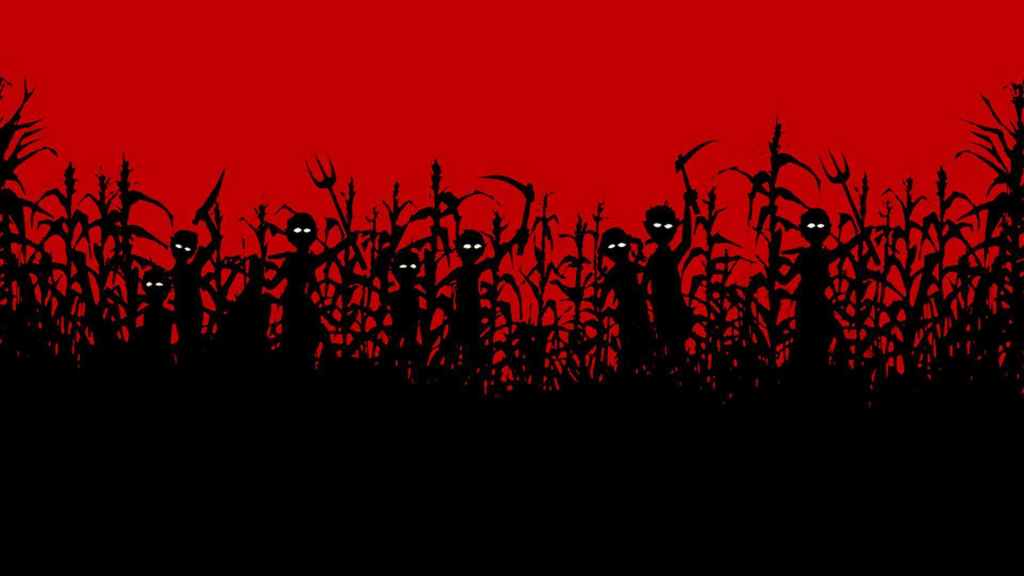
Although it was only released nine years after the original, Children of the Corn II: The Final Sacrifice connects with the original narrative immediately and takes place in the immediate aftermath of its events. And already here you can see the themes and ideas driving the potential franchise appeal, which will come to outlast any attempts at “Hollywoodification” of the sprouting series. What seems to be the key ingredient making filmmakers reconnect with King’s prose isn’t quite the mysterious figure of The One Who Walks Behind the Rows, nor any attempt at expanding whatever mythology it could sustain with such sparse foundations. It’s the idea of kids banding together under religious leadership and revolting against adults. Perhaps this is best boiled down to the memetic image of a child wielding a sickle and staring ominously through the screen at you, the viewer, in a way you might find symmetrical to The Omen. In fact, the whole concept of “creepy kids” invading horror is its own cultural meme, dating back to the adaptation of John Wyndham’s The Midwich Cuckoos from 1960 titled Village of the Damned and carried within William Friedkin’s The Exorcist, or even in The Shining adapted from King’s work too. After all, little Danny with his hoarse voice and a creepy finger sends chills down your spine, doesn’t he?
Therefore, the concept of rural kids with their dungarees, sickles and other farm weapons are what became the common denominator for the franchise, all underpinned by founding the horror in regionally-appropriate evangelical religiosity taken to the stereotypical extreme. However, this isn’t where the story ends because, as many further sequels suggest, the filmmakers do indulge in other artistic avenues while tethering their movies to King’s work through the meme of a creepy kid with a sickle in one hand and a bible in the other. As is the case with many genre franchises slowly adding chapters to their bodies and freeing themselves from rational design or even inspired ideation, Children of the Corn movies also quickly descend into idiocy as they take their creepy kids and their sickles into new territories, often sidelining them altogether in favour of more conventional concepts involving special effects, monsters and supernatural entities. We see them adopted by wealthy families in big cities in the third instalment (titled Urban Harvest), which is also where we find that The One Who Walks Behind the Rows is after all a big old corn monster capable of massacring whole throngs of people without breaking a sweat. We see the series attempt to fold back upon itself on many occasions and at some point, we even see Isaac returning in Children of the Corn 666: Isaac’s Return. Which is where logic is truly no longer applicable, and rank idiocy takes over in full.
Nevertheless, even this far deep in this franchise with surprising levels of stamina worthy of Rocky Balboa himself—and even the more recent instalments, like Runaway or Genesis could be used as proof—there is always something to behold in the series. You could say that there’s always something walking behind those rows of corny genre exploitation seemingly reminiscent of what’s currently (as of the time of these movies being produced) en vogue within the vast cornfield of horror band-wagonery. So, as you move down the list of the Children of the Corn sequels, you do find how the ones made in the late 90s were somehow capitalizing on the post-Scream meta-slasher revival, or how the one from the early 2000s (Revelation) was distantly Raimi-esque, while the one produced in 2011 (Genesis) had a James Wan vibe to it, if you squinted hard enough and lent the movie enough rope. Because let’s not forget, nearly all those unfortunate sequels were nearly unwatchable as standalone pieces of genre fiction… as is expected from a franchise this old and void of an iconic villain like Freddy or Jason to always reliably go back to and milk.
They did however have the creepy kids to fall back on when all else failed. Hence, even though Revelation is hardly The Exorcist with its apartment building standing randomly in a field of corn and a bunch of ghostly reveries haunting its corridors like the demons in Evil Dead Rise, and even though Genesis fails to capitalize on the suspense derived from a relationship between the leads that seems to pay homage to King’s work in some roundabout way, there’s always a creepy kid (either with a sickle or with a toy truck; just for freshness, I suppose) they end up calling for help… which only cements the idea that Children of the Corn movies are truly held together not by the mythos of The One Who Walks Behind the Rows but by a simple, tried-and-true idea of relying on scary-looking children and the potential for murder they might embody once you give them supernatural powers and farm tools to wield.
The one sequel in the series that truly attempts to do something fresh, while also knowing what makes it a Children of the Corn film, is one of the latest entries, namely the 2018 The Runaway, where we no longer indulge in the familiar concepts of seeing characters stranded, the pagan cult iconography or even in the frankly outlandish attempts at incorporating The One Who Walks Behind the Rows. Instead, this movie departs the mythos and the expectations of the franchise and uses the concept of a child cult in the middle of nowhere as a jumping off point and a foundation for a more psychologically driven conversation about trauma and motherhood as it deals with a character who might have escaped that unfortunate Gatlin cult of children and their field-dwelling demon god. For a good chunk of its running time, Children of the Corn: The Runaway plays like a Debra Granik or a Kelly Reichardt-directed movie, as it places more emphasis on the intersection between human drama and sociopolitical underpinnings of living off the grid in rural America than it does on executing on genre templates. At this point, King’s story is but a distant memory, a palimpsest overwritten so many times you can barely make out what the story is supposed to be about, but it is still firmly held together by the primal fear of organized cults and their sway over the malleable minds of our young.
Though, if you still wonder what it would look like if King’s story was revived in a format that holds the source material in some kind of reverence, you have to depart the franchise spawned by the 1984 adaptation (because that movie was already meddling with the story to fit its Hollywood-like conventions) and—as is often the case with King-derived adaptations—look for answers on the little TV screen. In 2009, Children of the Corn was re-adapted for Syfy by Daniel P. Borchers (who had written Vamp in 1986, by the way) together with Stephen King himself. And when the author is involved, you can at least be sure some of the elements of the original story will make an appearance.
Thus, the 2009 made-for-TV adaptation of Children of the Corn comes the closest to capturing the spirit of the short story and, in all honesty, adds a few wrinkles to it as well while cooking on all burners, all within the artistic limitations of directing for TV. Burt and Vicky hate each other, the story doesn’t attempt to make conventional detours, and it all ends the way it should – with a double sacrifice and an idea that a sinister presence looms large over this God forsaken patch of corn, as opposed seeking solace in Tinseltown familiarity. Still, the meme of a creepy kid with a sickle and a dastardly pagan cult of children who sacrifice anyone over eighteen at their earliest convenience remains the tether to all other adaptations and sequels—franchise glue of sorts—which once more reaffirms the theory that a franchise can grow without an iconic villain, so long as a culturally-significant meme is present somewhere in its midst. And as far as I can tell, the author was happy with this take on a story he probably never expected to take off as much as it did.
So, there we have it: upsettingly looking children, farm weapons, pagan mysteries. These are the key ingredients to grow Children of the Corn movies, and some will do better than others depending on other fertilizers and types of soil used to nurture them. With mostly abysmal effects spanning multiple decades we can see how those movies used the central concoction of cultural memes in addition to reliance on tried-and-true genre staples, while almost always adhering to that core theme.
However, just executing on the recipe isn’t necessarily enough and the most recent re-adaptation of King’s story, directed and written by Kurt Wimmer (who directed Ultraviolet and Equilibrium and most recently wrote The Beekeeper) serves as proof. This incarnation of King’s narrative attempts to add some meaning to the story which extends well beyond what the author would have provided for in his writing. In fact, the film tries to outsmart its own roots in some roundabout way, as it dubs The One Who Walks Behind the Rows as just “The One Who Walks” while it gives children a reason to rise against the adults in their town. All of a sudden, a Children of the Corn film becomes a vehicle for a pro-environmentalist, anti-capitalist messaging, which adds a lot of potential heft to be held together by such a lean story structure.
Therefore, something had to give and some aspects of the storytelling we could recognize as series stalwarts—manipulation of youth, the power of religious upbringing and such—ended up either removed completely or overshadowed by these other themes. And also, akin to The Urban Harvest, The One Who Walks once again becomes a physical entity, this time brought to life thanks to the magic of CGI special effects. And it just doesn’t look that good. In fact, it looks terrible.
However, what the Kurt Wimmer-directed Children of the Corn illustrates by omission is that the key to franchise longevity as far as this series was concerned was not only to identify the main ingredients, but to use them in right proportions. Sickle-wielding creepy girls are seemingly not enough to cut the mustard. Corn-dwelling evil entities do not butter any parsnips either. What made Stephen King’s Children of the Corn such a surprisingly enduring archetype was the confluence of the creepy kid phenomenon and a cultural bedrock of rank religiosity taken to utter extremes. And I’m pretty sure the author never saw this success coming, just as John Carpenter never even considered a possibility that Michael Myers would become an icon, because to him it was just Nick Castle wearing overalls and a William Shatner mask. For King, Children of the Corn was just a throwaway story about creepy kids and a pagan cult. But somehow, it took off.




 Flasz On Film
Leave a reply to Jimbo Cancel reply