
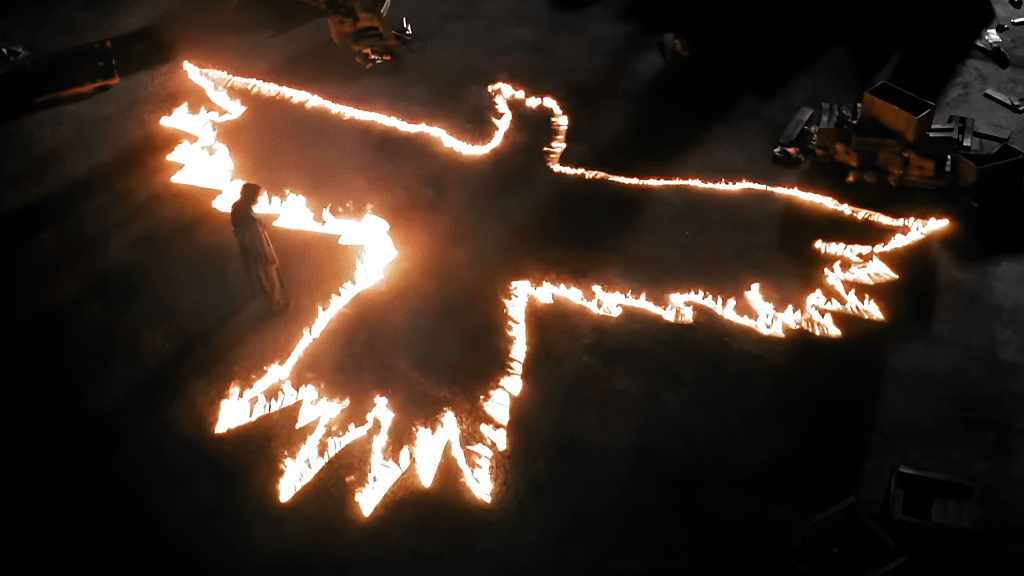
The Crow was born and re-born of pain and grief, at first when James O’Barr created the original graphic novel as a way to cope with the loss of his partner, and later on, when its film adaptation became associated with the tragic death of Brandon Lee in what was going to be his breakout role.
This often-overlooked cult classic, which nearly didn’t come to be because after Lee’s tragic passing the filmmaker Alex Proyas couldn’t bring himself to finish the project, has been given quite a lot of attention this year. This is partly because it is celebrating its own 30th anniversary, which also coincided with a release of the movie on physical media in a brand-new master, and partly because a Rupert Sanders-directed re-adaptation of James O’Barr’s story was released in cinemas this summer. Therefore, we got many opportunities to sit down and watch The Crow in 2024: on March 31st, if only to mark the anniversary of Brandon Lee’s death, or the minute we came back home with that brand new Blu-Ray or UHD of the movie. Or maybe on May 13th, to mark the 30th anniversary of the film’s cinematic premiere. Or, finally, either immediately before or directly after coming back from the cinema when the new incarnation of The Crow was being shown. Call it homework. Call it palate-cleansing. Call it… just a great time.
However, the time to watch The Crow, if there ever was a culturally appropriate date to do so that would persist throughout time, is now. October 30th. Mischief Night. Also known as Devil’s Night. The night when Eric Draven and Shelly Webster were brutally murdered… on the eve of their wedding. Because nobody gets married on Halloween. Which is also the night when Eric came back, one year after his passing, laid vengeance upon those who took his bride away from him and processed his grief in a flurry of violent retribution.
The reason to sit down and let yourself be immersed in the dark and brooding universe of this movie on the eve of Hallow’s Eve is because The Crow, contrary to what you may find on Wikipedia, and also in contrast to what you may yourself surmise based on the fact the movie spawned a brief string of unsuccessful sequels and an equally short-lived TV show, is something more than a run-of-the-mill adaptation of a comic book, let alone a conveyor belt superhero film. Even though you will easily find that Eric Draven has a dossier of superpowers listed against his name, like Superman or Thor, this movie is best regarded as something more than a comic book movie… despite the fact it probably owes its existence to the success of Tim Burton’s Batman more than anything else. The Crow is best understood as a modern-day fairy tale, a goth campfire story of love and loss that only happens to have a lot in common with what we today see as a comic book adaptation or a superhero film.
In fact, the existence of this movie and its positioning within the timescale of the popular culture, which was shifting in the mid-90s and looking for a new steady-state direction, is morbidly, circumstantially serendipitous in many respects. And that has a lot to do with the material it was based on, James O’Barr’s gothic iconography, the success of the aforementioned adaptation of Batman and its own aesthetic rooted in German expressionism, the persona of Brandon Lee (and the fact the production of the film was irreversibly marked by a real-life tragedy) and the man at the helm, Alex Proyas. All these ingredients add their own respective powerful flavours to what The Crow is, which is a true cinematic singularity. A movie that is both perfect and imperfect. A product of its time and a herald of things to come. An evolutionary lynchpin between the world of old and the brave new future. And an out-and-out iconic movie on its own terms, filled with simply unforgettable imagery, laden with resonant themes and awash with goth cool factor like nothing else.
Watching The Crow now you should immediately realize how important it is to the evolution of mainstream cinema throughout the 90s and it all begins with acknowledging the powerful influence Tim Burton’s work held over Alex Proyas, who directed the movie, and the team of other collaborators who made the film come together in the way it did. There is absolutely no debate that the opening sweep across the decrepit landscape of Detroit set ablaze is meant to look a certain way. Detroit in The Crow doesn’t look like any city you might recognize. It has more in common with Gotham City than anything else, and that’s also because Gotham City itself—as envisioned by Tim Burton, that is—is no longer a comic book incarnation of New York City, but rather a creation of hyper-stylized German expressionism. It’s a movie taken out of Fritz Lang’s Metropolis, and so is Detroit in The Crow. Dingy, dangerous and doused in ceaseless downpours, it is a place where evil thrives and love withers. It’s a reality where an immortal avenging angel with a painted face and a crow on his shoulder does not look out of place, just as Tim Burton’s Gotham City is a place where a guy dressed in a bat costume roaming streets at night doesn’t look weird either.
Similarly, the film’s final act where Eric Draven faces against Top Dollar (Michael Wincott), a katana-wielding long-haired maniac in an anachronistic suit, seems ot directly reference Batman as well with its bell tower setting flanked by gargoyles and heavy-set gothic iconography. Which is, again, expressionist by extension because Burton was looking up to Lang and Murnau. However, what’s particularly interesting here is that Proyas knowingly carries the torch for Tim Burton while the Batman series looks for inspirations elsewhere. The neo-gothic tones The Crow is suffused with will be what carries forward into Alex Proyas’ Dark City and later on into The Matrix by The Wachowskis.
In fact, there is a direct aesthetic line connecting these three films visible in the rooftop chase sequences, which we see in The Crow, then later in Dark City and then, finally, in the opening act of The Matrix. Furthermore, The Wachowskis were able to use the same rooftop built for Dark City too. Thus, The Crow is the bridge connecting the Burton-esque late 80s to the brave new world of 1999 where The Matrix uses the aesthetic amplified by Alex Proyas and moulds it to its liking so as to bring cinema into the 21st century.
And then, there’s Brandon Lee, a man whose untimely demise cut short what could have been a stunning career, and one we’d most assuredly look at now as key for the action cinema’s transition from the athlete-turned-actor muscle mania of the 80s to the everyman-heavy 90s and, beyond, into the goth superhero world ruled by Neo and John Wick. Brandon Lee was both an athlete and a skilled actor, which made him the perfect lynchpin between the two manifolds. He didn’t have to be taught how to act like Schwarzenegger or Chuck Norris. And he wouldn’t need a martial arts boot camp like Keanu Reeves. He had it all.
And in all actuality, The Crow shows Brandon Lee as a shoo-in for Neo already, specifically when we see him in that trench coat, those heavy boots and that tight long-sleeve top… which also makes him look a bit like Edward Scissorhands or the character of the Somnambulist from The Cabinet of Dr. Caligari, too. But Lee is unmistakably Neo-esque when he visits upon what looks to be a goon meeting—one you can only imagine would take place in a heightened universe of Tim Burton’s Batman, one where Joker fries a guy to death with his handshake—and takes care of business while bullets fly everywhere and pulverized concrete raises into the air to give the visuals a thick texture you’d now remember from the assault on the police station scene in The Matrix. It’s all there. In The Crow. In 1994. At the halfway mark between 1989 when Batman was released and 1999, the year of The Matrix.
And if it hadn’t been for his tragic death, Brandon Lee would have had a serious chance of taking the role that went to Keanu Reeves instead. In fact, he’d probably be John Wick right now, if you ask me. Unfortunately, The Crow and the ancillary history of what happened to Brandon Lee while the movie was in production will always remind us of the world that will never be, the roads cinema never got to take. What could have been the role to drive him into stardom ended up his farewell gift to the world and, ironically enough, it imbued the movie with energy it probably otherwise wouldn’t have had. Sure, The Crow would have always been an important lynchpin because the aesthetic choices have always been there and its cultural positioning would have always remained unchanged, but this dark fairy tale is now something more magical because of how the love and loss driving O’Barr’s narrative reflects the love and loss so many of us have in our hearts for Brandon Lee’s memory. It’s a dark memento, a faded picture of a loved one we get to hold in our hands whenever we feel the need to feel their presence.
Therefore, on the eve of Hallow’s Eve, Devil’s Night—the night when Eric Draven comes back to the world of the living to deliver his soul from grief and pain—the time is right to take The Crow off the shelf and let James O’Barr and Alex Proyas tell you their dark fairy tale of avenging angels, of love unfulfilled, of loved ones lost forever. As the movie turns thirty, let us make this a tradition to come together and make sure that the legend of The Crow, whether in O’Barr’s incarnation or as it was adapted for this iconic cinematic treatment, lives on forever.

 Flasz On Film
Leave a comment