
When I was turning thirty, a decade ago, I had just moved with my family from the UK to Germany. Our stuff was still mostly in boxes. My wife and nearly one-year-old daughter were visiting the family at the time, and I was there all by myself, having not much else to do but go to work. And my thirtieth birthday felt somewhat depressing, like an end of something rather than a beginning of something new. Maybe the culturally ingrained conviction that your youth officially ends when your twenties are put to bed somehow got the best of me and I spent that day in an atmosphere of doom and gloom.
And now, having just turned forty, I think I understand how wrong I was at the time. Therefore, here I am writing a few words for my thirty-year-old self and everyone who might be a few years younger than I am and going through what I went through at that time, because I sure would have used a few words of wisdom from an older version of myself… especially because what I know now about life I was incapable of deducing at the time without having it explained to me. I was too young.
Exactly. At the age when I thought my best years were behind me I was still too young to understand certain trends in life and know instinctively that my best years were lying ahead. In fact, As I see it now — being a freshly-minted forty-year-old — I have just entered my peak years and remain hopeful about what life has in store for me. And that’s because somewhere along the way I understood and internalized the very fundamental concept relating to life: that a human lifespan might seem short and fleeting and altogether nowhere near long enough to cram all those experiences you once dreamed of having, but it is much longer than you can comprehend and reliably plan for.
One interesting piece of trivia I once heard was that humans are terrible at planning. We overestimate our abilities in the short term and vastly underestimate them long term. We often cannot precisely estimate how long it would take us to complete a relatively simple task we are asked to perform right now. To combat this, what I do myself and what I advise others is to double whatever the estimate you come up with. That way you are more likely to produce a timeline within which the task will be completed. Equally, and this is something I sat down a few days ago to think about, we have absolutely no tools to intellectualize just how much we can accomplish in ten years. We get better at this as we get older, but in the timeframe when it matters to us — when we are young, full of vigour and driven to succeed — we frequently underestimate our abilities.
Therefore, I sat down and thought about where I was at twenty, at thirty, and where I am now to find out how much or how little an insignificant specimen of the homo sapiens can achieve.
When I was twenty, I was studying chemistry at a university. In truth, I had no idea who I wanted to be and what I wanted to do because the bulk of the reason behind my going to the university to study chemistry was because I was “seriously encouraged” by my parents, also chemists, to do so. I was doing well, though I could have done better. I had a girlfriend who would a few years later become my wife. But I had no plans. Some of my school friends knew exactly what they wanted to achieve in the university setting, just as they understood the skills they wanted to acquire, hone and bolster. They had a vision of where they wanted to be after they graduated. It took me another year to find myself in organic chemistry and to really get excited about the science of rubbing atoms together to make molecules nobody else have made before. I had no idea that at twenty I was just about beginning a decade of academic training to become an expert in the field of synthetic chemistry. As I saw it, I was just going to school. After all, going to school was the only reality I knew because, at twenty, I have just completed life’s tutorial, even though I may have seen myself as a fully formed adult human being. I wasn’t one. And if you’re twenty yourself, you aren’t one either.
At thirty, having just moved to Germany for a postdoc, that period of academic training was just about starting its final chapter. It took me a decade to complete my professional training, which at the time might have felt like eternity, but now feels like it all had just whizzed by. I didn’t have fun twenties. Didn’t party. Didn’t travel much. Didn’t gallivant. I worked my backside off. And perhaps the reason I was feeling slightly depressed had to do with questioning if the path I chose or gravitated towards by a combination of inertia and occasional grand decisions I ended up making (without necessarily appreciating their gravity) would lead me towards happiness. I didn’t know at the time that happiness wasn’t a resting state I was aiming to get to. That it wasn’t life’s final destination. Now I know that happiness is a continuously fleeting state which we may choose to inhabit once we understand what it takes to be happy as opposed to becoming happy. If you enjoy what you do, then happiness is in the work you do. If you love yourself, happiness is just being.
I’m forty now. A lot has happened between that thirty-year-old state of just becoming a postdoc and moving yet again to a different country in pursuit of an opportunity I never thought anyone would grant me and now. My daughter is just about to turn eleven. My marriage just turned fifteen. Still going strong, but I’d have lied if I had told you that staying married for fifteen years is easy. It’s not. It’s hard work. But happiness is in the work you do, not at the end of the rainbow. In the meantime, I completed my postdoc, travelled back to the UK, found a job, got promoted at that job and then left that job for a new job I have now. At thirty I was about to become a professional scientist. At forty, I have built a group, put a lab together and I am working with a stunning collection of inspired individuals towards moving the needle forward and bringing the world of synthetic chemistry into the future. I write religiously. I podcast with friends I met along the way.
I’d have never predicted I’d achieve this much in ten years, no sir.
Sure, I know people who managed to achieve way more than I did and good on them. I’ve learned, specifically in the last couple of years, to only measure my performance and achievement against myself and to ignore any externally applied yardsticks. Make sure tomorrow’s you is doing better than yesterday’s you. I have learned the power of compounding interest by organically living, paying attention to what’s happening around me and understanding just how bad I am at estimating what I could achieve within longer timeframes.
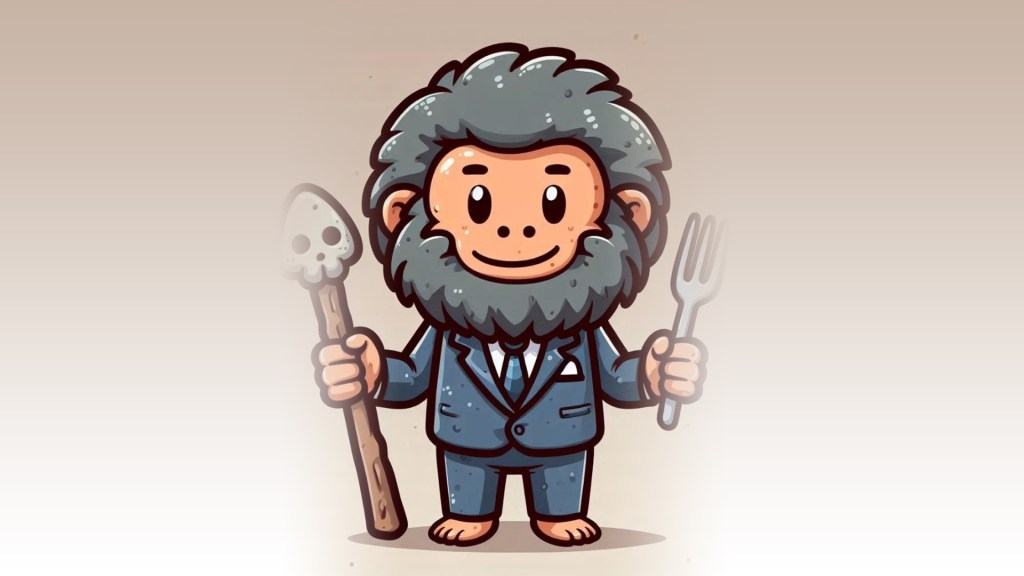
And I’m not special in this regard either. You can do it too. In fact, this is a unique human feature that allowed us to become the dominant species on the planet. Think about it. Why has homo sapiens climbed to the top of the food chain when there are way more dangerous predators around? Nobody can survive an encounter with a bear or a tiger and yet here we are, eight billion of us. Understanding what makes humans unique is the key to understanding your own potential and perhaps alleviating whatever midlife blues you may be going through. We’re not the strongest mammals out there, nor are we the fastest. We’re not the most ferocious. But we are the most resilient and relentless, we work well together and — through the same perseverance and grit — we are great at acquiring skills and learning to use new tools and instruments. We are hairless apes that do not get tired and can hurl stones and sharp objects at their prey from afar with stunning accuracy having stalked that prey for days.
We are masters of putting one foot in front of the other and putting our heads down. Therefore, it is in our interest to do just that in order to set ourselves up for success. Our ancestors threw rocks at things until their punts got lethal. They learned to run long distances and outlast their prey. We are not descendants of apex predators who overwhelmed the world with their physical prowess. We descend from bipedal hominids who didn’t get tired and never gave up. Who worked tirelessly in the absence of positive reinforcement, perhaps not knowing for sure that their persistence would bear fruit over a sufficiently long timeframe.
Therefore, I learned not to think in days or weeks. Even years. At forty, I have embraced the idea of thinking in decades. The first two I completed were a tutorial where I learned how to interact with the world at the most fundamental level. The next one, between twenty and thirty, was a decade of academic training. The last one was a decade of professional development. Now, I hope I am entering the decade of freedom and accomplishment.
Ten years ago, I didn’t have two dimes to rub together. We were inches away from bona fide destitution. Now I’m still nowhere near where I’d like to be financially, but the thirty-year-old me would have had a mental breakdown if he had to pay the car repair bill I paid two weeks ago. It was a lot of money. But now I suppose I’m wealthy enough to know I can afford it and it will not end my life. In ten years, I’d like to own my own house outright (and to put my blue-sky thinking in context, I still live in rental accommodation). It’s a tall order but I’ve learned already that I tend to seriously underestimate how much one can achieve in ten years, so why not aim high?
I’d like my own little website to be large enough that it will contribute to the household revenue. I’d want my professional career to continue on an upward trajectory. I know these are tall orders, but I have now learned that being an inveterate hairless ape comes with an evolutionary bias towards perseverance and grit… and that interest compounds over time.
So, if you have also turned forty recently, please do not fret. Your best years may still lie ahead. After all, at forty you’re merely halfway through life, but in reality, half of that time was only a tutorial. So, you have another forty years to play with at least, if you play your cards right and take care of your body and mind the way you should.
And if you look back at how much you’ve achieved in the last ten years, you will realize there is no limit to what you can do in the next decade. All it takes is perseverance, consistency and inveterate spirit, all of which have been implanted in you by your ancestors. You come from a proud line of hairless anthropoids who refused to give up and never got tired, so there’s nothing stopping you from picking up a new language, getting in shape, learning a new skill, starting a new career or developing the one you have. A decade is a long time and I’m sure you can accomplish more than you imagine in that time. All you need to do is heed the ancestral call and consistently make little improvements in the complete absence of positive reinforcement.
You can’t lose if you continue playing. Interest compounds. And as a human being, you are best equipped to capitalize on that. I cannot fathom how much I achieved in the first forty years of my life and if I could travel back to the time when I was only fifteen and tell myself about it, I’d never believe a word of it. And I’m just a normal dude, not a prodigy or a weirdly fine-tuned superhero. But I’ve learned that by not giving up and — little by little — by getting better at things in life, those improvements would eventually compound and visualize to the outside world as stunning quantum leaps. I went from a feckless student to an expert scientist. From a disorganized dreamer to a disciplined machine of productivity. With nothing but hard work and determination. I understood my superpowers vested in me and became an inveterate hairless anthropoid who puts his head down, does the work and thinks in decades, not weeks.
You can do it, too.
This piece was originally published on Medium on 4th September 2024.



 Flasz On Film
Leave a reply to Finding My Voice While Swinging the Axe and Squatting for Reps – Flasz On Film Cancel reply