Being a relentlessly prolific young tappity-tap-tap-tapper, Stephen King once wrote a short story titled Sometimes They Come Back. He had it published in the Cavalier magazine in 1974 and, once his first three novels Carrie, ‘Salem’s Lot and The Shining turned him into an overnight sensation and “The Great White Hope” of genre writing, he filed it together with nineteen other short stories in a volume he titled Night Shift.
And in consequence of King’s new-found fame, a lot of his works, many of which he squeezed out almost as an exercise in fiction writing and without thinking twice about what they added to the collective cultural discourse such as it was, were shortly optioned for cinematic adaptations. Therefore, a good chunk of the stories King tallied together in Night Shift have since been adapted into movies and TV shows. From Jerusalem’s Lot and Grey Matter to The Boogeyman, Maximum Overdrive, Children of the Corn and The Lawnmower Man (although the story of the latter one is a topic for a separate conversation), all those short stories were up for grabs. Admittedly, and I have said it before, King never struck me as particularly precious about his short stories; at least not as much as he was about his novels. Hey, as long as the cheque didn’t bounce, it was all good to him, so the way these stories ended up adapted for the screen varied. And sometimes when translated into movies, they’d come out altered thematically or completely void of the meaning they carried because the filmmakers may not have had the best idea as to what it was that made them interesting in the first place.
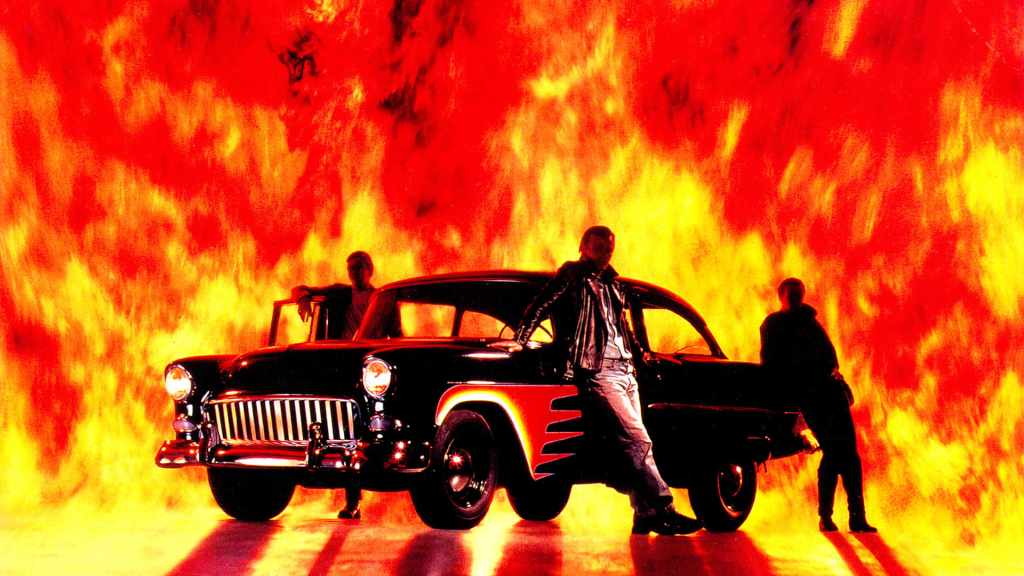
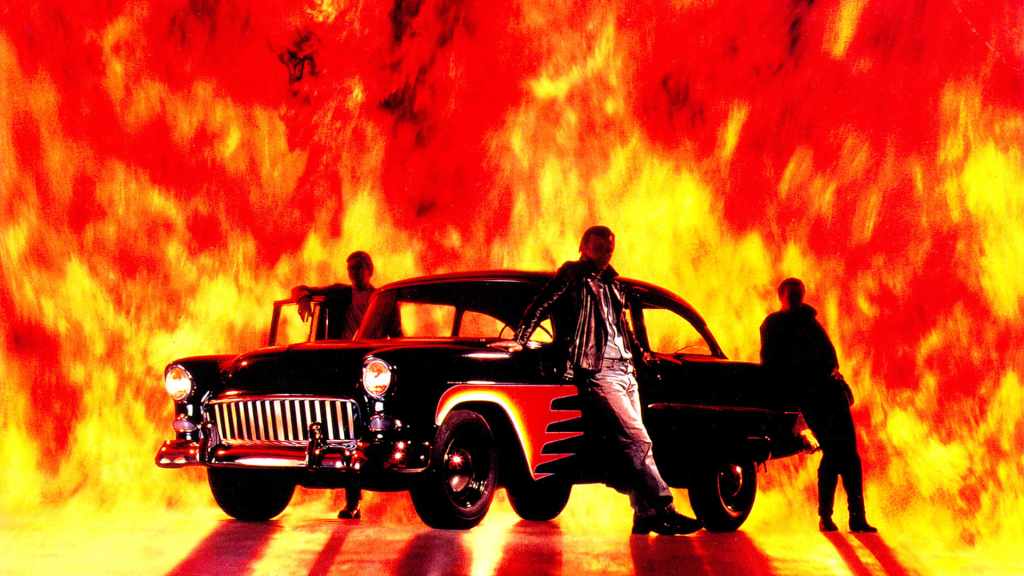
Such is the case with Sometimes They Come Back which admittedly looks as though it was one of those “trap” stories, as it looked ready-made for a cinematic treatment, but it equally required the filmmaker and/or the screenwriter to do some mental gymnastics to make sure there was a feature film to be found in the confines of its pared-down narrative. This tangential pseudo-prelude to Pet Sematary boils down to a simple story about a teacher, Jim Norman, whose past trauma comes back to haunt him. You see, when he was a young boy, his older brother was stabbed to death by a bunch of greasers when they were casually walking to the library, an experience which scarred him for life. However, one day he finds that students in a school where he teaches die under strange circumstances and end up replaced by even stranger-looking transfer students. Even though the story takes place in the 70s, present day for the writer as it were, these transfer students look as though they were transplanted straight from the set of The Wild One. And at least to Jim they look strikingly like those greasers who killed his brother and frequently feature in his nightmares.
King’s narrative develops with a few jump cuts into a scenario in which Jim figures out that these greasers are indeed the killers of his brother and that they don’t exactly belong in the world of the living. And to combat them, he learns a thing or two about the occult, chops off his index finger and summons a demon who takes shape of his dead brother and consumes these undead greasers. However, the pun of the short story is that Jim can never be sure if the demon he unleashed upon this world is going to safely revert to whatever demon dimension address he is registered at his local demon electoral roll, or if he’d prefer the world of the living instead. After all, sometimes they come back. Get it?
To a reader in 2024, or at least to me as I don’t want to come across as presumptuous, Sometimes They Come Back is a perfect little exercise in what we refer to as “elevated horror” because the familiar garb of dead people coming back to life at a remote cemetery and the protagonist lopping off his finger while summoning a demon are merely a metaphorical narrative framework upon which a thematic conversation is then laid. It doesn’t take a rocket scientist or a scholar with a specialty in obscure poetry to figure out that King’s short story is a conversation about the many dangers of holding onto unprocessed childhood trauma more than it is a vignette with a few scares and a handful of references to classic movies and novels.
Even if it’s all a product of serendipitous coincidence and King was after all only having fun at the expense of the greaser culture he most assuredly experienced when he was a youngling, it all tallies up because these dangerous minds with their slicked back hair, leather jackets, stood-up collars and hand-rolled cigarettes stuck behind their ears are clearly an evocation of an era and a reminder of horrors of the past. Their function is symbolic of Jim Norman’s inability to work through the trauma he experienced as a child. He has suppressed his disturbing past for so long that it literally seeps through the cracks in the mask of normalcy he had donned his entire adult life and materializes in the form of these demon greasers. In fact, they end up killing his wife, which is in its own way symbolic of Jim Norman’s unresolved mental health issues destroying his marriage.
Call me crazy, but I think there’s a banging film somewhere in here, provided the filmmaker looks past the primary narrative sphere, which is what the filmmakers in charge of adapting The Boogeyman ended up doing. They turned an easy-on-the-eyes vignette with a Tales From the Crypt slant into a proper elevated horror working in an adjacent thematic space to where Sometimes They Come Back should have been.
Unfortunately, because King was such a hot commodity in the 80s and he also didn’t care all that much about guarding his short stories, Sometimes They Come Back didn’t enjoy an appropriately inspired adaptation. It went like hot cakes with minimal quality control, let alone a proper vetting of whoever wanted to take it on as a project, as well as their angle for the movie they were making. Consequently, it was brought to the screen as a made-for-TV movie where the primary sphere of the narrative was the only thing that mattered. It starred Tim Matheson and stretched the forty-or-so pages King produced to fill a two-hour TV slot—roughly equivalent to ninety minutes of an actual movie. Funnily enough, it was originally intended as one of the vignettes adding up to Cat’s Eye which Dino De Laurentiis produced as part of his multi-picture deal with King in 1985, which is where I believe this story would look almost exactly the same… only snappier. But the point is that nobody peeped under the bonnet of this story to look for a deeper meaning.
Instead, all we got was a dodgy scare-fest with only minute inferences towards any metaphorical interpretations slid into the narrative—perhaps completely coincidentally—towards the end of the movie. The adaptation of Sometimes They Come Back just didn’t work very well as it failed to acknowledge the thematic substance of the story and therefore ground meta-textually the supernatural element of 1950s teenage gangsters showing up in present day to haunt a teacher with unresolved childhood traumas. It was nothing but a gimmick.
What’s even sadder, the movie—like many other Stephen King adaptations—set a precedent for an entire short-lived franchise to spawn into existence, where even less attention would have been paid to what made Stephen King’s story intriguing. Not that I’d ever recommend you check them out, but the 1996 Sometimes They Come Back… Again and the 1998 Sometimes They Come Back… For More show quite clearly that the essence of King’s original story was either completely inaccessible to those who made those movies or that they decided it was of no interest to them. Thus, one of these sequels is a weirdo rehash of the original film interested only in dead people coming back, not in what it potentially means, and the other functions as an attempt at The Thing with Satan worshippers. However, the point still stands that in stories where past trauma was supposed to be seen as pivotal to decoding the narrative metaphorically, it was always treated completely superficially, whether it worked for the story or not.
Therefore, I am hereby appealing to the powers that be to pick up Night Shift on Amazon, leaf through it and find Sometimes They Come Back because it may have been one of those stories that needed a few decades to ripen sufficiently on the vine in order to enjoy an adaptation of the right calibre and driven by sufficiently nuanced filmmaking sensibilities. In a volume of fiction exercises, Lovecraftian vignettes, genre funsies and other what-iffery, Sometimes They Come Back truly stands out as a story with great potential for an adaptation into a modern movie… fifty years after it was written. And I think it goes without saying that the thematic subject matter of dealing with unprocessed trauma resonates ever so strongly now, as we live in a world that is finally not only aware but positively inclined towards exploring concepts relating to mental health and wellbeing in general.
I don’t often say things like that, but I think someone like Jennifer Kent, Mike Flanagan or Oz Perkins probably have what it takes to flesh out the conversation this story was trying to have with its readers half a century ago while remaining scary and disconcerting at the same time. Having seen The Babadook, Longlegs or Doctor Sleep you could easily build enough trust for any of those filmmakers to know where to look for the soul of this story as they have done so already on multiple occasions, as they lodged their own contributions to the elevated horror space. Perhaps with the right approach and a key angle of embedding a fully functional metaphorical reading in an engaging character-led experience would do this story justice and remind everyone who needs to be reminded that Stephen King’s supreme reign extends firmly over the realm of short fiction as well.
 Flasz On Film
Leave a comment