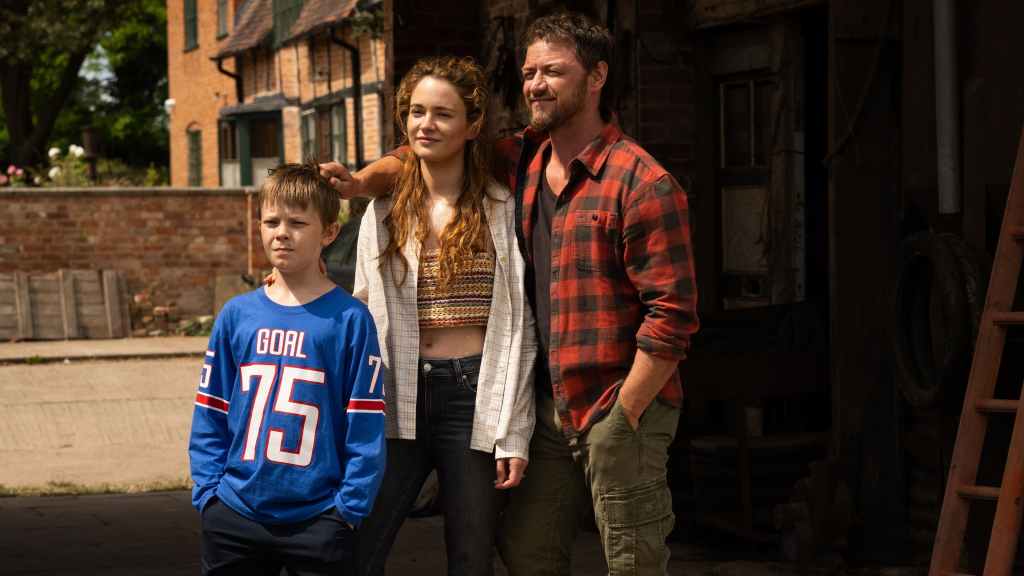

Directed by Christian Tafdrup, Speak No Evil (original title: Gaesterne, translating directly as The Guests) premiered at Sundance in 2022 where it entertained audiences and critics with its performances and a potent social commentary built into the narrative. In September 2024, not even two years later, the English-language remake opened worldwide. Given the fact it typically takes a good while to onboard a project, put a script together, cast the movie, shoot it and produce it, I can only imagine the decision to pull the trigger on domesticating that Scandinavian psychological horror was made almost immediately after the relevant parties had left the screening room at Sundance. However, the official announcement a remake was in the works did not come out until April 2023, I believe.
The perennial question at this point remains why anyone would want to remake a movie this new when the original is widely available for people to see. And there are at least a few acceptable answers to this, one of which being a cynical “because English-speaking audiences don’t like to read subtitles, dum-dum, and the movie can get a wider reach if it’s in English and comes with significant Tinseltown backing.” Now, this is where a section of the audience would pipe up and admonish such an explanation because they are OK with reading subtitles and therefore the movie should be left alone because certain ideas may not translate culturally as well as Hollywood filmmakers perhaps would imagine or that the original may be treated as inferior because studio moguls would infer a movie is only considered a serious contender when it’s made in Hollywood.
On top of the simple idea of making a movie with a wider reach you might want to consider a possibility that the original movie might have resonated better with Western audiences if some changes to the story had been made, which I suspect might be the case in here. That is because the original Speak No Evil (which is available to watch on Shudder if you feel so inclined to compare and contrast the two movies yourself), while resting on the same narrative template, differs from the remake in at least a few key places.
At this point, you might want to consider yourself warned about potential spoilers…
(What do I mean by potential spoilers? There will be spoilers. In fact, I’m going to discuss some key plot details up close, so if you have not seen either of the two films, do yourself a favour and go and watch at least one of them first before continuing with however many more paragraphs it takes me to get my message across and run out of steam.)
So, as far as the original movie was concerned, I chose to see it as a direct descendant of Michael Haneke’s Funny Games (which the filmmaker remade himself, but for a slightly different reason, I presume) which functions as an inspired cautionary tale elevating a familiar genre template, where a well-to-do family finds themselves in peril as their lives are invaded by a group of obnoxiously intrusive people whom they find impossible to turn down. Thus, they accept an invitation to join them and their mute son at a remote rural farmhouse where things escalate quickly and end in carnage.
However, this is where things get interesting because the 2022 original differs substantially from the remake in how the movie resolves. In the first-generation vision of this narrative, the couple of protagonists end up murdered while their daughter has her tongue removed, thus implying an unbroken cycle of violence and deception would continue unabated after the credits roll. The pair of serial killers with a penchant for running with scissors unsupervised and Olympic mug-throwing are alive and well and continue their hunt for unsuspecting and gullible liberals unable to say no to their successive intrusions. Which is more or less what Michael Haneke would have done with this script, too because Funny Games also strikes a similarly nihilistic tone.
The family in that film ends up dead at the hands of their two handsome and harmless-looking guests who turn out to be out-and-out sociopaths. Hence, the take-home message the original Speak No Evil seems to send out into the ether is that nothing can be done about people like that. The world is just violent and unrelenting and under such circumstances politeness will be used against you, plain and simple. The Danish movie doesn’t leave the viewer with even a hint of hope, let alone a piece of guidance on how to respond to such a powerful and demoralizing social commentary. End of story. The movie ends and leaves you to wonder about what you’d do if you found yourself in such a precarious position.
You could see it as being treated as a grown-up just as much as you’d be well within your rights to interpret the ending of the movie as nihilistic and (perhaps needlessly) edgy. Take your pick. After all, there is immense value in an ending like that and Michael Haneke has always been known as one such voice who’d never leave the viewer with a ready-made prescription.
However, it is equally interesting to see what happens when the course of events is altered and the movie concludes in a way that does break the cycle of violence perpetrated by these psychopaths hiding in plain sight as a harmless family unit with a house in the middle of nowhere. This is where the remake comes into view and basically retraces the same story before it makes a choice to veer into the unknown. Furthermore, the movie written and directed by James Watkins (who previously directed Eden Lake, The Woman in Black and Bastille Day) enables the viewer to make a few more relevant connections thanks to the way the movie was cast.
This is surely no coincidence that the main pair of protagonists are played by Mackenzie Davis and Scoot McNairy, while the psychopathic hosts from hell are played by James McAvoy and Aisling Franciosi. There is a remarkable difference in the physicality and aura cast by these people, as McNairy and Davis immediately register in the viewer’s mind as a couple of harmless liberals with their electric car, posh London living, highfalutin moral standards, weltschmerz about the environment and a crumbling marriage underpinned by passive-aggressive signalling. Meanwhile, McAvoy’s Paddy is a hulking and menacing presence undercut by his characteristic charming demeanour, while Franciosi’s Ciara comes across as domestic and warm while hiding her sinister core. These two couples are polar opposites of one another, and the filmmaker wants to make it as visible as possible, so as not to distract the viewer from what matters to him the most—the experience of being there with these characters, sharing their discomfort and understanding they may be in danger a bit quicker than they do. This is textbook Hitchcockian stuff.
Thus, when the proverbial excrement meets the air extraction unit, you—the viewer—are perfectly positioned for the ending because you may have been already brewing with some backseat-driver-type thoughts yourself. The movie is constructed in such a way that cringing at the character’s decisions is a given and even shouting “why can’t you just run away?” at the screen, which would also break the sacred covenant of silence most of us enter while agreeing to see a movie in a public setting, carries a non-zero probability of happening. In contrast to the Danish film, which holds the viewer at arm’s length, Speak No Evil (2024) counts on the viewer’s investment in the character drama underpinning the narrative and the idea of the guests mustering up the strength and courage to stand up to their oppressors. You want to see the gaunt Scoot McNairy—whom we see cowardly accepting that his wife may have wished to cheat on him and who also fails to impress on McAvoy’s Paddy that he can pull a trigger and taking a life, even if it’s just a fox—take matters into his own hands, fight for his life and protect his family. In fact, you want both of them, McNairy’s Ben and Davis’s Louise, to work together in the face of this incredible peril and save the life of their daughter Agnes (Alix West Lefler). Because you know what’s going to happen otherwise. They’ll die and Agnes will replace Paddy and Ciara’s mute not-a-son Ant (Dan Hough) as they venture out on another hunting expedition. You want the movie to end with more than just an acknowledgment that if you let people abuse you, they will. You want to see some kind of response.
And you do.
Which is where the movie may (1) elicit criticism from those in the audience who think being edgy and nihilistic is kinda cool and (2) bring the audience together in support of the characters who actually do choose to fight for their survival. Thus, the movie turns into a home invasion slasher, which immediately makes the experience even more familiar and predictable. And that’s fine because I believe it is all a part of the experiment in which both the characters and the viewers are meant to find out some truly insidious truths about the nature of the human condition.
Now, rarely do I feel it’s a good idea to quote Adolf Hitler in any context but in this particular case it might be instructive, even if it carries a remote risk of coming across as provocative. Hitler was alleged to have said that “the strength of a totalitarian state is that it forces those who fear it to imitate it.” In the context of Speak No Evil it serves to underscore that there’s no such thing as a free lunch and in the face of existential crisis, nobody is ever allowed to emerge unchanged. Just as the characters cannot politely talk themselves out of a brutal and gory confrontation with Paddy and Ciara, their lives do change in consequence, even though they emerge victorious. They had to stoop to the level of their adversaries and fight fire with fire in order to ensure their own continuing survival. And even though it is Ant who murders Paddy with a massive rock in an outburst of cathartic retribution for having his parents taken away from him and his tongue excised in an act of terrifyingly traumatic abuse, all survivors end up affected.
The movie doesn’t go as far as to show us the aftermath of what happened and only suggests that Agnes might have outgrown her anxieties… which only serves to illustrate that what happened to them made an impact. They won’t be able to have a normal life for a long while. They won’t be as naively trusting as they once were, but most importantly, they will no longer be able to socialize with their snooty liberal friends and hear about their luxury beliefs. How can they listen to their friends talk with faux conviction about their mission to end salmon farming when all they do is talk at a high-class restaurant while having an overpriced quinoa salad? They’ve been to hell and back.
This in my opinion presents a slightly different social commentary than the original Danish movie because it just doesn’t end with acknowledging that your politeness will be interpreted as weakness by those who choose to do so and if you are genuinely harmless, you may find yourself staring at the business end of a sharp object wielded by someone bent on hurting you and those you care about. James Watkins’s remake suggests that there is after all a way to fight against those who choose to invade your life, but that it will come at a price. Maybe you can even map this commentary over top of the current sociopolitical landscape more directly. After all, Paddy and Ciara are easily identifiable as rural MAGA-type radical conservatives who’d vote Republican in America or Reform in the UK. Equally, Ben and Louise are textbook champagne socialists and harmless big city liberals who have spent their lives insulated from peril by wealth.
Maybe the lesson of the remake is to remember that a day might come where your beliefs will be put to the test and the only way you can come out alive from this confrontation is by adopting the features of what you fear. It is by no means an invitation to start a civil war, I don’t think, but at least a reminder that if a civil war were to happen, you might come out alive only when you surrender your own luxury beliefs and take care of business. Which is in its own way a rather nihilistic outlook, so maybe after all, the Watkins-directed remake and the Tafdrup-directed original have more in common than I thought two thousand words ago… But I can tell that as far as experiences go, I prefer the remake. You just can’t go wrong looking at James McAvoy channeling his inner Jack Nicholson. Also, I think that two versions of Funny Games are enough for the world to carry so at least this movie looks a bit fresher, even if some would see it as unnecessarily Hollywoodized.




 Flasz On Film
Leave a reply to 2024 in Review: 8 More Solid Films I Watched – Flasz On Film Cancel reply