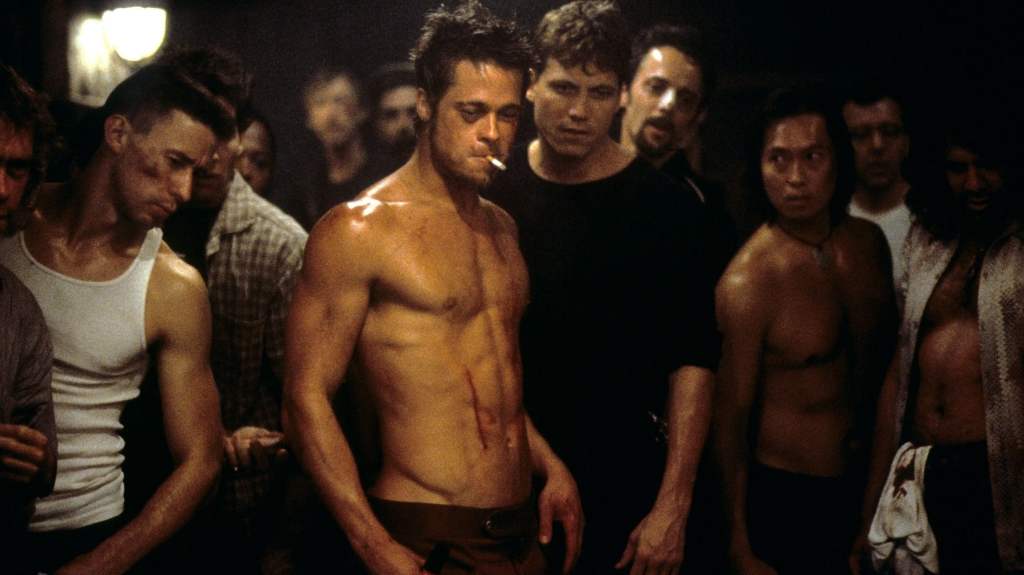
When Fight Club opened at the Venice Film Festival twenty-five years ago, it immediately divided opinions. The critical community could not coalesce around a movie which many found potentially dangerous with its portrayal of masculinity and allegedly tacit encouragement of violent tendencies in men. And it was all well before the term “toxic masculinity” was even coined.
Therefore, it was at that point an expectation that the movie would bomb at the box office, which it did. Granted, the movie didn’t do itself any favours either, what with its production budget ballooning well past any expectations from the initially agreed upon twenty-three million dollars all the way to a whopping sixty-seven big ones. I suppose there must have been many reasons why this happened, but anyone even vaguely aware of David Fincher’s directorial process will immediately connect the dots and perhaps understand that Fox and Regency may not have been appraised of what getting David Fincher to helm a project actually entails. The man is well known in the biz for his insistence on shooting multiple takes of even the simplest scenes anybody else would just shoot once and move on from. In 1998, when Fight Club was being produced, this equated to burning through miles of film stock and spending multiple days shooting on location, all of which costs an arm and a leg.
Consequently, David Fincher’s adaptation of a Chuck Palahniuk’s wildly popular book was doomed to fail from the get-go because it was the antithesis of a date movie and the critics of the time spared no expense ladling vitriol on the film’s alleged destructive power; and the movie simply needed a solid box office return to break even. Butts. Seats. The works.
Maybe critics knew what this movie would become in the future and did their level best to stop it from happening but it’s kinda-sorta like attempting to stop a landslide by organizing a rally at the bottom of the hill. It’s just a bad idea. Fight Club quickly became a cult classic as it re-emerged on home video and became an early 2000s dorm room poster movie, almost to spite the mainstream consensus bent on reporting how it inspired young men to beat each other to a pulp in dark alleyways or suggesting that disenfranchised blue-collar workers most of the world chooses not to notice at all until they convert a bulldozer into a tank and go out on a rampage (I guess you’d call them incels in the current climate, point your finger at them, throw your head back and laugh them out of the public marketplace of opinion while feeling all superior and progressive and stuff) may organize themselves and start a popular uprising.
Any alleged toxic influence notwithstanding, Fight Club spoke to a very specific demographic of late Gen-X-ers and elder Millennials who saw their woes reflected in Palahniuk’s writing adapted by Jim Uhls (whose only other feature writing credit is the 2008’s Jumper) and felt seen when Tyler Durden (played by Brad Pitt) was addressing a tight ring of shirtless men as “middle children of history.” Sure, some yobs with nothing better to do resonated with the film in a monkey-see-monkey-do kind of way and got together with their buddies to beat each other silly and probably you can find at least a handful of reports of attempted terrorist plots where the perpetrators (apprehended before anything happened in most if not all cases) were alleged to have been inspired by the movie. However, for the most part, Fight Club has remained just what it always had been: a slick cult classic running full tilt on the combined strength of its leads, the complex beauty of its writing, Fincher’s incredibly engaging and kinetic direction he most assuredly evolved from his salad days as a music video director and the prescience of its thematic focus.
Now, twenty-five years on, this movie continues to be both just as great and ever so potent but in the current political landscape, which remains incredibly polarized, it looks as though it is no longer cool to admit to liking Fight Club to your friends and family because it may be tantamount to coming out as a Republican, a Conservative or worse. Sure, it has always been divisive and looked upon by the public with at least a hint of suspicion, as the movie was predominantly popular with men, but in recent years it has become increasingly easy to demonize it altogether and bundle it with other allegedly toxic and dangerous movies. Which at least to my mind is completely unfair.
Perhaps this reflects the current milieu and stands as an acknowledgment that in the current Overton window there is no place for a discussion on the concept of masculinity or problems related specifically to men that isn’t immediately colouring these ideas negatively. It’s uncool to be a guy, plain and simple. Men are repeatedly told to shed their allegedly “toxic” tendencies, embrace their feminine side and nurture their emotions while women are told to be bold and confident in the workplace not only to be seen as equal to their male co-workers but to effectively surpass them in terms of success in life. And it’s all great because on the face of it it’s good for men to learn to process their emotional states, just as it is beneficial for the society at large if they become more collaborative and appreciative of people around them, especially women. Still, I have yet to hear a concrete and positive prescription on what advice men should follow as opposed to hearing what they shouldn’t do, or that they should just “do better.”
It’s both incredibly daft and perhaps downright irresponsible to require men to rid themselves of their natural tendencies to compete, self-improve or seek out the limits of their own capabilities. Instead, what men need is guidance, which is where—at least in my opinion—Fight Club has a few things to say. In many ways, this movie is a complex meta-experience on the very idea of men needing to be led and taught by strong and influential figures, if only to learn to control their own primal urges (which are perfectly fine to have, by the way) and to never allow their id or the Jungian shadow to take over, like what happens in the movie (and which is more readily fleshed out in the novel) to The Narrator (Edward Norton) when his consciousness is hijacked by the unfettered Tyler Durden.
Therefore, in 2024 I still believe that Fight Club is a movie men should see, maybe more so than ever. Though, I’d perhaps suggest it is a good idea to do so under the proviso of having a grown-up conversation about the movie afterwards. That’s because when viewed through the right lens, Fight Club can most assuredly be seen as a powerful reflection of male weaknesses and a call to self-improvement while grasping onto very simple stoic philosophies.
I think we can all agree that many of us could see ourselves in The Narrator who is a self-diagnosed thirty-year-old boy. Equally, the phrase “we are a generation of men raised by women” applies to the current cohort just as much (if not more) as it did to the men Palahniuk was speaking to in the mid-to-late 90s. Because a crisis of fatherlessness continues to grip many corners of the Western world, we can surely identify with seeking validation in consumerism or feeling completely abandoned by the world at large, emotionally adrift. We live meaningless lives of quiet desperation, sedated by compulsive acts of self-sabotage. Unable to leave the comfort of hedonistic dopamine-fuelled lifestyle dictated by addictions to social media, gaming, pornography, etc.
What Fight Club discusses is a male search for belonging, which eventually ends up warped and abused by a toxic influence or—because The Narrator and Tyler Durden are the same person—a lack of personal restraint acquired through self-discipline. Hard as it may be to realize, especially to those with vested interests in peddling talking therapies to men (most of whom are unlikely to respond positively to such treatments), men process their emotions differently to women. We don’t talk about what we feel with ease and doing so is unlikely to give us the same positive net result it provides women. We do stuff together. We talk shoulder-to-shoulder not face-to-face. Men need a purpose and a project, and, in many ways, Fight Club showcases one interesting avenue for men to find out something about themselves. By finding out what it feels like to get punched in the kisser.
This is where having a guide or a teacher becomes useful because this prescription isn’t simple either. The movie doesn’t explicitly invite anyone to go out and punch a guy, but rather suggests that a part of the search for the meaning of existence involves mastering our own violent tendencies and learning to keep them at bay. In fact, the movie shows us exactly what happens when they are not under control, so the lesson we should glean from it is not to embrace the life of complete opposition to conflict because we object to it on principle, but rather an opposition to conflict because we know what it feels like to have our noses busted. Being harmless isn’t a virtue, but a weakness. Learning to exact terrible violence and choosing to stay peaceful, on the other hand, is a virtuous act.
However, even this idea doesn’t need to be necessarily interpreted verbatim as an invitation for men to learn how to fight. While it offers incredible benefits, such as improving and maintaining physical fitness or teasing out our own physical limitations with regards to pain tolerance or endurance, the key aspect of the fight club idea is male companionship. The idea of doing stuff shoulder-to-shoulder. You don’t need to sign up for jiu-jitsu lessons having watched Fight Club, but you should be able to figure out that there’s something positive about the concept of men getting together to do things. Whether it’s fixing a car, building a shed or running a podcast, a male pursuit of meaning is heavily reliant on finding a purpose in what we do and the movie once more comments on this concept while taking it to the extreme and depicting what could happen when men embark on such journeys either without appropriate guidance or, worse yet, led by a toxic false prophet with his own insidious interests.
Thus, as the concept of Fight Club matures into Project Mayhem, we ought to identify that the idea of finding a purpose in what we do is commendable, but what we observe in the film is its polar opposite and perhaps better reflects what happens to young men deprived of a good moral compass installed by a positive male role model. They may not be able to discern a good influence from a malicious one and fall prey to utterly toxic figures and their charming ways. You know exactly who I have in mind, don’t you?
However, even while the movie veers decisively out of balance and sends The Narrator into a tailspin, we can still find nuggets of positive inspiration somewhere in there, provided we know what to look for, or have that guide present with us. We have to remember that neither Palahniuk nor Fincher ever intended for anyone to take direct inspiration from the many acts of anarchist terrorism depicted towards the latter half of the movie. These scenes have a purely satirical function and relate to the protagonist’s slow descent into madness, while also depicting what happens to men when they persist in a state of complete lack of self-control and discipline. So, please don’t make nitroglycerine in your house because the movie told you it’s a cool thing to do. And refrain from starting house fires in other people’s apartments or feeding laxatives to your hometown pigeons. Raiding your local liposuction clinic is also discouraged.
At the same time, you can still find a useful prescription in the Project Mayhem part of the movie, especially in one unforgettable scene where Tyler Durden threatens to kill a store clerk. Again, this is not to be read verbatim as an invitation to go out and wave a loaded gun at your local 7-11, but a metaphorical reminder of one key principle that should guide our lives as men. Memento mori. Remember you will die. Tyler Durden’s action represents the activation energy we often need and frequently fail to reach as we remain coddled by lives of easily accessible temporary satisfaction. It’s hard to get off your backside, do hard stuff or get better at something. Sometimes we need a drastic push, and the movie teaches us to think as though there was always a gun pressed against our temples. Do what you said you’d do. Yesterday you said tomorrow. Don’t let your dreams be dreams. Do the thing. That’s what this scene means.
However, I accept that many of these prescriptions may not be immediately accessible to anyone who casually sits down to watch Fight Club, even for the umpteenth time. To figure out how to read this movie as a manual for self-improvement, men (who are most likely to watch this movie anyway) need someone to help them find that meaning. Someone who would genuinely have their best interest at heart. Someone who’d want them to succeed. A positive male role model. Maybe a dad they never had, or a dad they wished their fathers had been.
Men need other men to guide them and in an age where masculinity is negatively connoted as a matter of course, it is so much more important than ever. Therefore, I view Fight Club, a movie old enough to have kids of its own, as a great tool with which to teach important aspects of self-improvement and to understand what happens when we choose not to get off our asses and let our urges run rampant. This movie isn’t toxic. It’s indispensable. But it needs to come with a manual… which I hope I’ve now written.




 Flasz On Film
Leave a reply to And What Is the Point of BAFTAs Anyway? – Flasz On Film Cancel reply