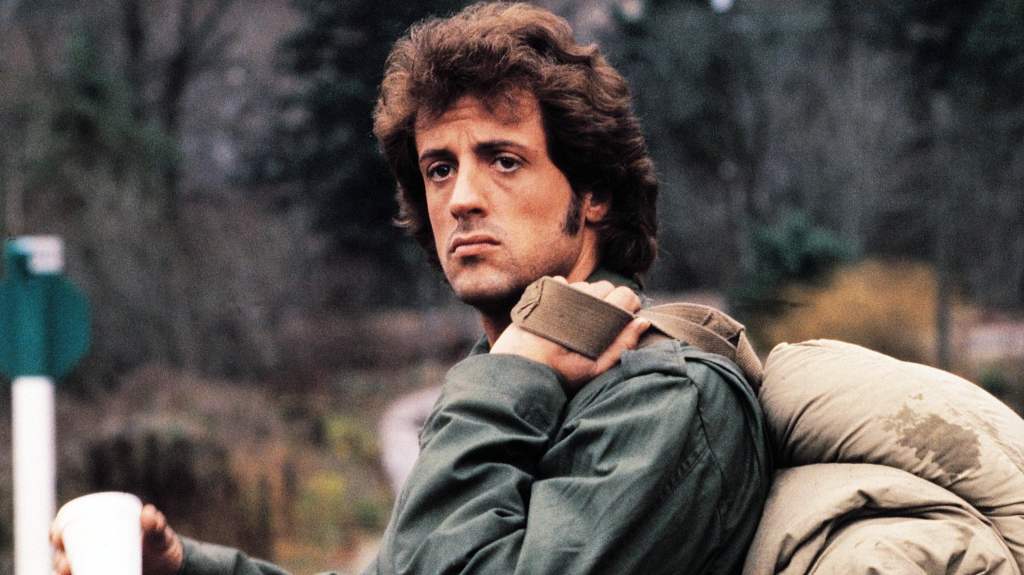
The Ted Kotcheff-directed First Blood saw the light of day in October 1982, years after the Vietnam War ended and reinvigorated the career of one Sylvester Stallone, who needed a success under his belt. Well, he needed a success that didn’t carry a Rocky Balboa brand. However, even a cursory glance at the history underpinning its creation would inform you that it hadn’t necessarily originated that way.
The book First Blood was based on was released a decade earlier and it was only natural for the Hollywood machine to capitalize on its success… which took quite a bit of work to accomplish. Now, I am not here to recount the oral history of how First Blood came together, as there are great sources out there that will allow you to do just that. Even Wikipedia is a good start, but for a deeper dive I thoroughly recommend Nick de Semlyen’s The Last Action Heroes where the author devotes some time to the idea of retracing Stallone’s humble beginnings and the fits and starts of his now illustrious filmmaking career. Equally, I am not going to spend any appreciable time describing the many differences between David Morrell’s book and the movie for its own sake; I can only point to the library and ask you to pick up the book yourself to read it. It’s great.
Instead, what I’d like to do is draw your attention to the aspect of First Blood I have always contended was its most prominent asset, and one that nearly everyone seems to overlook and it is that First Blood is both an incredibly nuanced study on male mental health and a de facto treaty on the malaise of the post-Vietnam America… disguised as a blood-curdling action thriller reliant on organic character-building and good old-fashioned survival action antics. These last three words—survival action antics—seem to have become this movie’s lasting legacy, helped in no small part by the franchise it cultivated; though, I will still go to bat for its sequels and how the rah-rah patriotism (which evolved in the case of Rambo III and Rambo: Last Blood into allegations of vehement, profoundly toxic nationalism) they have been mostly accused of are indicative more of the collective moods of the audiences at large rather than the movies themselves.
John Rambo (or just Rambo, as he is described in the novel) is not a superhero, nor even an action hero at all. Rambo is a PTSD-sufferer, an outcast and a personification of a societal problem which seems to persist this day in all evolved societies. We don’t know how to help men in need, many of whom are not equipped or capable of reintegrating into society or undergoing treatment according to established protocols. We see this in Rolling Thunder. We see this in Born on the 4th of July. In Taxi Driver. Hell, we see this in the Oscar-winning The Best Years of Our Lives and in The Deer Hunter. More recently, we can find this conversation in The Hunted and even in the wildly polarizing Todd Phillips’s Joker.
In fact, this last example interests me the most at this point and here’s why that is. In 1982 First Blood came out, became a stunning success at the box office and immediately reinforced Stallone’s stature as an icon of action filmmaking. Thus, an era of the hard and chiselled muscle man took shape, as this movie coincided with Schwarzenegger’s Conan the Barbarian making a killing at the box office too and an entire decade of such bombastic and wildly unhinged action-heroic entertainment was ushered, presumably because the world was ripe and ready to embrace it. The cynicism of the 70s thawed and crumbled under the collectively exerted force of brooding muscular sigma-types… many of whom would be identified today as toxic influences.
Point is, they weren’t. Rambo wasn’t dismissed as an emblem of toxic masculinity, a term I object to on principle as it describes a set of traits a stoic man would immediately identify as profoundly anti-masculine. He was embraced as a hero. Therefore, very little attention is paid to his emotional state, which in itself is a reflection of his being critically mentally unwell—a high-functioning catatonic almost, a walking dead of the ilk Tommy Lee Jones’s Johnny Vohden in Rolling Thunder depicts as well. He’s seen as an underdog. Mistreated by the law, tortured, beaten, brought to the brink. Hence, when he snaps, unravels and goes completely ballistic—like that proverbial loose cannon—the audience is on his side. Even when he procures weaponry and begins torching the town of Hope, Washington. Only because he has no idea how to switch himself off. He’s on self-aware autopilot leading him onto a downward spiral and I can only imagine that in 1982 there must have been many thousands of men out there who felt kinship with him and his plight.
Now, I wasn’t around then. I can only conjecture but it would boggle my mind if there weren’t throngs of completely disenfranchised, culturally homeless men out there in 1982 (and thereafter) to whom First Blood would speak the way something like Joker seems to have spoken to the sub-demographic of men colloquially referred to as incels. Yet, I don’t think John Rambo catalyzed a widespread moral panic on the scale we have witnessed in 2018 when Joker came out and seemingly captured the roiling anger of those left-behind unhuggable men so profoundly that they adopted Arthur Fleck as dominant parts of their personalities. Or at least so the mainstream and social media echo chambers wanted us to believe.
Rambo’s “Don’t push it or I’ll give you a war like you won’t believe” never crystallized into a war cry the way Joker’s “You get what you fucking deserve” did and I wonder why. As much as I see First Blood as one of my all-time favourite films that also carries incredibly deep messaging relating to subjects I care about a lot, I can see how it would have been easily described as a dangerous film by the pearl-clutching press of today. So, my question is: have we become more frazzled and anxious as a culture in the forty-odd years separating us from the release of First Blood? And if so, who or what is to blame?
To even attempt an answer to this question that’s been rolling in the back of my mind for a while now, I thought it’d help if I imagined what would happen if First Blood came out today. Forget Vietnam. Localize the story so it remains culturally relevant and imagine it otherwise seeing the light of day in an unchanged format. A guy walks through town, minds his business, gets mistaken for a stolen-valour vagrant, beaten to a pulp and forced to the brink. He snaps, goes on a rampage, takes on an entire army and nearly wins. Actually, not too dissimilar from Joker, now is it? A guy can’t catch a break, gets mistreated, struggles with his identity, is not listened to nor helped, goes to the brink, snaps and—similarly—nearly wins.
Can you imagine First Blood Mark 2024 coming out and not becoming a cultural lightning rod? Perhaps it wouldn’t make any money at the box office, because unless it’s a Marvel-adjacent piece of spandex schlock or a Pixar sequel, nothing makes decent money these days, but my assumption is that John Rambo would have become a polarizing figure on X-formerly-known-as-twitter. Maybe the Tate brothers would have claimed him as their poster boy? A new Tyler Durden? Maybe he’d supplant Arthur Fleck as an avatar of impotent inceldom? Meanwhile, he’d be denounced by others as an icon of toxic masculinity. Maybe the film as a whole would be dismissed as a work of stealth misogyny because there aren’t any women in it at all. In today’s highly tribalized cultural landscape, John Rambo would have become an infamous figure, a de facto persona non grata within the parameters of polite society, and you would have to think twice about admitting to liking First Blood in a public setting, because such admission would be tantamount to being seen as co-opting an entire constellation of beliefs and political convictions as well. Don’t believe me? Think about how your opinion changes when someone admits in a conversation to liking Sound of Freedom or Joker. It’s no longer a matter of poor taste or misaligning opinions. You immediately make assumptions about who these people vote for, what they think about abortion, gun control, women, immigrants, minorities etc.
Meanwhile, chances are they just happen to like these mediocre-to-terrible movies. But you don’t know and you don’t want to know because your mind is made up. You have made an enemy. I believe First Blood as released now would have evoked similar reactions. But it didn’t because it was released in 1982 at a time when the Internet and social media didn’t exist. Still, times were tough for many and in many corners of the world entire societies were working up the courage to revolt against the status quo. So the world wasn’t exactly rosy, if you know what I mean.
Still, John Rambo remained a proto-action hero, an indispensable part of the template upon which Hollywood painted a revival of the cultural mood. And First Blood never suffered from being accused of rampant unchecked toxicity… which leads me to believe that maybe it isn’t the movies we frequently accuse of holding certain flavours of energy or of influencing culture in toxic ways that are the core of the problem. Maybe we are the problem and we specifically look for lightning rods, for hills to die on, for flags to wave in movies we watch, books we read (who am I kidding, kids don’t read), or content we consume in other means.
Maybe if we hadn’t, Joker would have only been seen as a half-assed mediocre attempt at discussing male mental health under the guise of a comic book-adjacent fare and nothing else. Or maybe that conversation would have ended up completely overlooked, just as the conversation about similar issues has been completely side-lined in the First Blood discourse, which continues to be seen as an oddball action thriller that stands apart from its sequels: the one movie where the rah-rah patriotism doesn’t shine through that much. Meanwhile it could and should be discussed as a nuanced, under-the-radar study on PTSD, male mental health and our collective societal indifference to the plight of disenfranchised men.


 Flasz On Film
Leave a reply to JOKER: FOLIE À DEUX, Self-Indulgent Navel-Gazers and The Alluring Idea of Joaquin Out of a Quarter-Filled Cinema in Protest – Flasz On Film Cancel reply