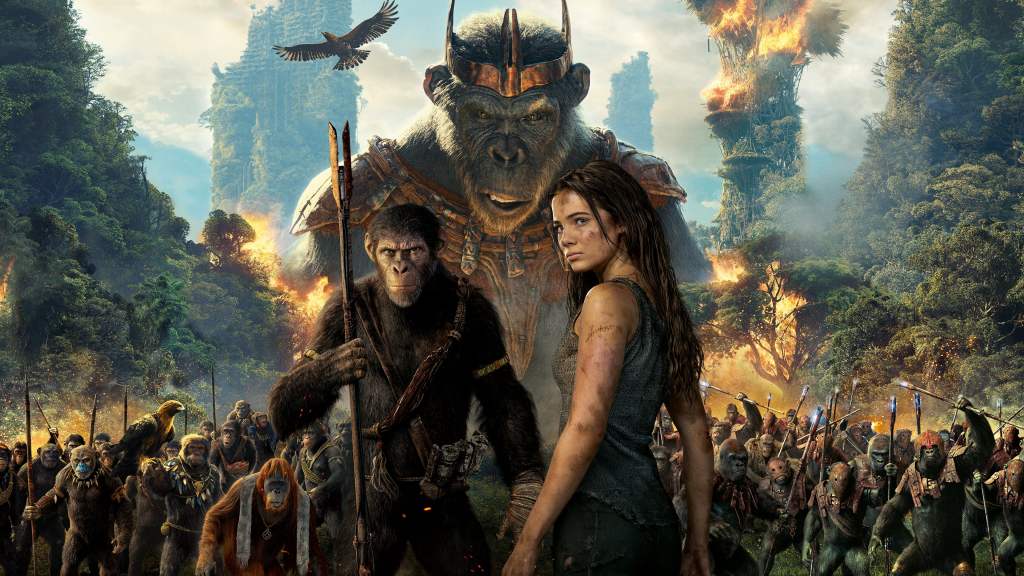
If you procured a time machine and went back to the early 1970s to ask if the Planet of the Apes series was a fertile ground for further sequels, you would probably get a different answer than today. Granted, the franchise, which immediately spawned a number of descendants, was immensely profitable with its cultural longevity propped by its staying power on the TV screen months after their theatrical runs would come to a close. However, you can’t really escape the simple fact that at least the first three films in the series – Planet of the Apes, Beneath the Planet of the Apes and Escape from The Planet of the Apes – were essentially retelling the same story three times over. They were the pre-eminent equivalent of that Chanel dress Marge Simpson reworked so many times that it fell apart eventually.
Even the later two sequels, both critically derided (and let’s be honest, for a good reason), which departed the fish-out-of-water formula in favour of a wacko dystopian prequel assuming that apes rose to power because a pandemic of a space-borne virus killed all dogs and cats, so humans adopted primates as pets and figured out they could teach them simple tasks and, hence, turn them into housebound slaves (Conquest of the Planet of the Apes) and a flashback sequel opting for a post-apocalyptic allure of a proto-Mad Max experiment (Battle for the Planet of the Apes) wouldn’t move the dial much, let alone leave a lasting cultural footprint.
Therefore, if you were to go back to the 70s and take stock of where the series was, you’d emerge of two minds, because on one hand there was some longevity organically baked into this fantasy universe, but equally there was either insufficient appetite, or a lack of a good enough hook, or both, to have this franchise survive in the cinematic format. Instead, it reverted to where it had found a lot of success – the TV screen – and concurrently kept the pilot light on for decades in the form of ever-expanding universe of tie-in novels, comic book series and other merchandise.
The Tim Burton-directed remake notwithstanding (and I will go to bat for it as a criminally underrated achievement in the field of art direction), the Hollywood machine got reminded of the potential of this long-standing franchise only when Rupert Wyatt came out with Rise of the Planet of the Apes and when Matt Reeves helmed its two sequels, Dawn of the Planet of the Apes and War for the Planet of the Apes. And although these three movies (aka the Caesar Trilogy) were immensely successful, and the current fandom holds them in high regard, I might catch some flak for pointing out that narrative originality isn’t their forte either. If you look closely, this reboot series is a redo of the two J. Lee Thompson-directed flops (Conquest and Battle), with some flourishes added in key places and much needed character development injected into the proceedings. But the point stands that as of just shy of three weeks ago, the Planet of the Apes series – at least its cinematic incarnation, that is – consisted of four instances of doing the same movie, two lo-fi sequels from the 1970s that tried to depart the formula to delve into the franchise mythos to flesh out the character of Caesar and the three instalments of the reboot series that did the job of doing just that, but correctly.
And now we’re here, in 2024, where it looks as though things might change for good. That is because Kingdom of the Planet of the Apes has made landfall and in just under three weeks has already climbed to the fourth spot at the box office (both in the US and globally). And I have to say, I am a bit worried because all signs on heaven and earth seem to point away from what I believe is a much-needed cultural shift in Hollywood that would refresh and reinvigorate the mainstream theatrical experience.
A lot is being made of poor box office numbers, kids turning their backs on cinemas and original properties (or adaptions of more obscure IPs like The Fall Guy which I liked quite a bit but somehow failed to write about… alas) and it looks to me that we may have to wait for the pendulum to swing the other direction because Fox (which is a division of the Mouse House, don’t you forget it) is keen on doubling down on the formula that brings returns, even if it means the landscape of blockbuster entertainment will become a barren wasteland of long-standing franchise fare strung together with plot gimmicks to ensure continuity, and offering nothing more than the calculation devised in Kevin Feige’s corner office fifteen years ago would allow.
Behold the age of a fully industrialized conveyor belt blockbuster industry worthy of Henry Ford’s patronage. A world where all movies pumped out by the Hollywood machine look like cars coming off a production line, all indistinguishable from one another. Differing only in the colour of their paintwork.
Therefore, it honestly doesn’t matter who directs what in this landscape. Do you even care who designed your car? You know it’s a Toyota or a Ford. And Fox/Disney know that. In fact, the formula stipulates that it is easier to hire a solid journeyman director who knows how to work with pre-visualized scene design, outsourced CGI workhouses, meet deadlines and keep things under budget, which expectedly in the case of Kingdom of the Planet of the Apes hovers around the 160 million mark (the Marvel sweet spot adjusted for inflation).
And so we get Wes Ball, the guy who directed The Maze Runner trilogy, who is clearly capable and seasoned enough in the field of doing exactly what studio executives love seeing – delivering on time, under budget and generating sustained financial revenue – to direct the newest movie in the freshly re-heated Planet of the Apes franchise. Add to that Josh Friedman who wrote the screenplay: a guy who knows his way around episodic storytelling thanks to his credits on Terminator: The Sarah Connor Chronicles and more recently Snowpiercer and Foundation (both of which he co-created) and you might have an idea of where I’m going. Did I mention he is already ensconced in writing Fantastic Four for – you guessed it – Marvel?
If Kingdom of the Planet of the Apes does well – and it is already doing well enough – it’ll spawn not one, not two, and not even nine (as touted in the press) follow-ups. It will explode into a shared universe and saturate the space where Star Wars and Marvel are slowly running out of road. You will see TV shows, miniseries, cartoons, video games. The landscape of blockbuster entertainment is about to go apeshit if this movie makes money and it won’t be an accident either. It doesn’t take a genius to notice that this movie has not been conceptualized to stand on its own two feet. Again, this is not The Terminator, Alien or Star Wars (or even The Matrix). It has been put together as a cultural contagion. A lab-designed pathogen fertile with loose plot threads, nooks and crannies for teenagers to wonder if there’s more to be told about how apes figured out that they like to carry eggs in their knapsacks or how there are other ape settlements somewhere in this world, each with their own lore and stuff. And how the movie retcons the long-standing piece of lore pertaining to the de-evolution of humans. People will fall for all of it. Hook, line and sinker. Kids will lap it up not fully realizing they are once again falling in love with an ultra-processed meal designed and engineered not to give you nutritious sustenance but to keep you coming back to spend some more money.
This movie is a McBlockbuster. Looks good on the poster. Smells like a blockbuster. Resembles one in terms of construction. Comes with all necessary condiments and sides. But it’s awful. Dire. Bland and absolutely devoid of any nutritional value. And it looks in reality just as plain as it tastes. Nobody ever took a photo of a McChicken sandwich to post on their social media hoping to elicit jealousy in their online Pokémon peers. And if they did, I can assure you that not much kudos was generated.
This more or less reflects how I feel about Kingdom of the Planet of the Apes. If I were to be charitable about it, I’d dismiss it as not worth anyone’s time with its workaday character-building and shamelessly dense plot-packing. I’m pretty sure there are people out there who see this movie as solid, or great even, as it adds depth to the franchise with its canonical inter-species romantic story, an archetypal central conceit rooted in classical storytelling. And maybe if I had been twenty years younger, I’d have fallen for this shtick. But the problem is, I am no longer a child and I can see through this ruse.
This movie honestly has very little reason to exist on its own terms. It’s a starter pack that requires however many sequels and sideshows it will undoubtedly spawn to give it the necessary context. And it’s not even that it is the first instalment in a growing trilogy. I refuse to accept this logic either. You can plan out a trilogy in advance and still have the first chapter of the three exist on its own terms. But this here is not that. It’s a very expensive TV pilot which positions its lead characters the way a TV cast is treated by a network, because someone is planning for success and anticipates another twenty-two episodes of the stuff.
Therefore, they hold back on literally everything. Nothing is fleshed out. The villain Proximus is adequately bland because we all know other baddies will follow and they can’t be overshadowed by a villain who gets dispatched in the pilot. I’m sure we’ll find out more about the intervening years between the events of the Caesar Trilogy and where the story is now. We’ll be filled in on everything left dangling by the storytellers because they have been brought onto this project exactly for that reason. To transplant the TV experience onto the big screen using the now well-tested Marvel secret recipe; the recipe that DC couldn’t successfully recreate.
As a result, I fear what’s to come because summers will become incredibly bleak as far as cinema-going experiences are concerned. Because this strategy seems to be bearing fruit and because Hollywood moguls choose to interpret their flops with original ideas as an invitation to double down on their franchise focus, we will wake up in a world where every weekend you’ll get to choose between two or three branded products to go out and support financially, while at home you’d be paralyzed by the choice between myriad ancillary products relating to those products. There will be little space for anything else. And the stuff you’d get to choose between will all be cut from the same cloth but badged differently. Just like it doesn’t matter if you drive a Cadillac, a GMC or a Chevrolet because under the hood it’s all the same GM technology, or how it matters not if you drive a Lamborghini or an Audi because they are both built using VW parts, it won’t matter if you watch Planet of the Apes or Spider-Man. It’ll feel exactly alike. Written by the same TV-derived talent. Directed by yes-men. Produced using a formula and greenlit by people who don’t care if the products they manufacture enrich your life even a little.




 Flasz On Film
Leave a reply to ALIEN: ROMULUS and the Science of Withholding Flatulence While Appearing Inspired and Cool – Flasz On Film Cancel reply