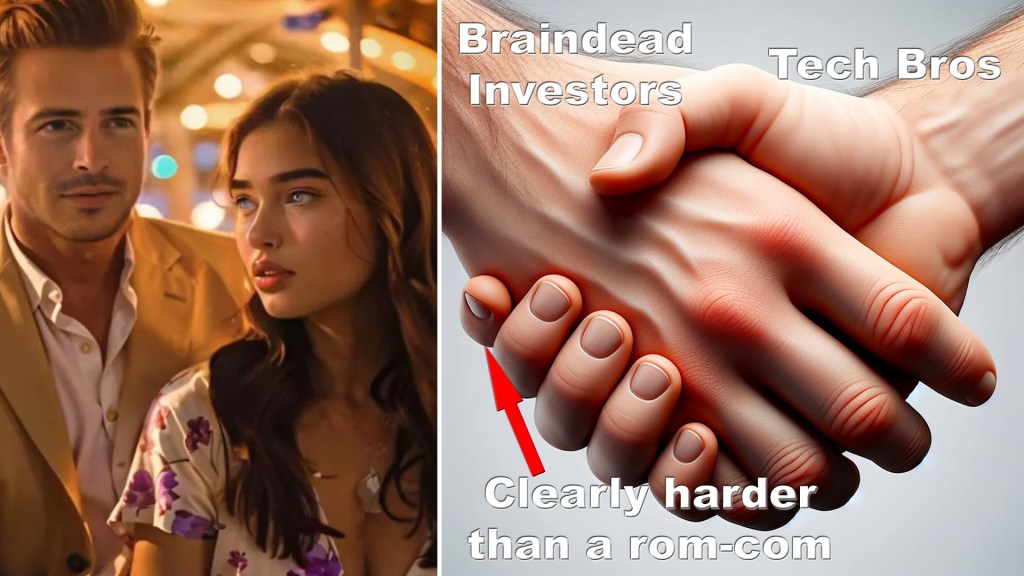
I nearly choked on my coffee while scrolling through Twitter (sorry, X) when I was alerted to the impending summer release of a little film called Next Stop Paris, which also happens to be – as touted in the trailer – allegedly the first movie fully produced using generative AI tools.
The response to this announcement is predictable. “Now THIS sucks,” writes Joe Russo, who also happens to be a filmmaker, in his post. “The first collection of moving images that has ever made me want to puke the lining of my guts”, responds Lee Cronin, the director of Evil Dead Rise. YouTube content creators pile on with videos calling Next Stop Paris “insulting”. Abomination. Disgusting. Keep artists in art. They have a hashtag even.
Meanwhile, I find it hilarious. Because the first fully AI-generated movie to be released upon the unsuspecting public is a rom-com. A conveyor belt love story. Which, come to think of it, I hardly find surprising.
Look, there is no debate about the fact that the introduction of AI-powered tools into the world has already begun reshaping the landscape of our culture, our relationship with work and many more facets of our lives, many of which we have yet to discover. It’s an industrial revolution and we are now living through its early days, which also means these new tools are being deployed by literally everyone everywhere, partly to see what sticks, partly because it’s fun to experiment with stuff and partly (and perhaps most importantly) because people in positions of power and influence see their implementation as an opportunity to make money.
Naturally, and I have already opined on this, this tumultuous time will inevitably come with changes to the way we operate. Which immediately means that whatever your ideas were about the kind of stuff you’d like to get better at or make a career out of may need to be adjusted for that “AI factor” or scrapped completely. It doesn’t necessarily mean that people will lose jobs en masse, but rather that people who refuse to adapt to this rapidly shifting landscape will be left in the lurch. You won’t be replaced by AI, but those who know how to use it.
However, and again this is something I have expressed some thoughts on as well, some aspects of our culture will become completely obsolete or irrelevant, therefore working in those sub-niches will become increasingly difficult, let alone profitable. I can only surmise that content journalism will go out the window. Clickbait blogging is already on its way out because search engines can pull out answers to many questions directly into their front pages or hallucinate acceptable answers without referring your inquisitive self to a website festooned with pop-up ads, filler nonsense and god-knows-what before allowing you to surmise that what you were looking for wasn’t available there in the first place.
All I can say is that if you are working in fields of content creation, you need to seriously consider your position, work on your voice and craft (where AI tools can also be helpful, mind you) and reinvent yourself. After all, why would anyone think in this day and age that you are owed the luxury of figuring out what you want to do in your life once and then making a decades-spanning career out of this decision? These days are long gone, and you didn’t need the advent of AI to realize that. The days of getting hired by one company, rising through its ranks and retiring from it have been over for a while. For decades now we’ve been teaching younger generations about the importance of transferrable skills and being able to move to different jobs and careers multiple times over the course of their working lives.
And don’t get me wrong, I don’t think Next Stop Paris is going to spell the end of cinema. Other forces are already hard at work to make it happen anyway. What I find hilarious is that the arrival of the first AI-generated movie denudes one of my biggest gripes with the current landscape of mass media entertainment. Over the years, we have sleepwalked into the era where content served by multinational corporations with little to no intrinsic value or personality has successfully supplanted artistic expression.
Naturally, this has been present as a byproduct (or intended product) of capitalist thinking overseeing mainstream culture. Many TV shows you may recognize have been invented and maintained exclusively as vehicles to lure prospective consumers in front of their TVs and fill the space between advertising segments. Granted, some perceptive artists have been able to use this model to express themselves within this landscape and created pieces of television that are widely recognized and acclaimed. But we have to be honest about it and admit that the vast majority of what you’ll find on the small screen is just content designed to keep you watching and to have you sit through an ad for a product, hoping a small section of the audience will end up going out to the shops to procure that product. You won’t convince me that Colombian soap operas are made by inspired artists. And you won’t convince me that formulaic rom-coms padding out the shelf space on Netflix are worth anything to our culture either.
Which is what I find hilarious because literally from the moment Large Language Models have been made available to the public together with deep learning image generation engines, I have known that art will always be fine. Human expression of thought and emotion is always going to be safe even if we train Skynet to write poems like Shelley or Dylan Thomas. We don’t write poems to pad out website space and get the reader to click on pop-up ads. We do so to express something. We also don’t read poems to learn anything. Art doesn’t need to be useful. It doesn’t have to solve a problem or answer a question. It’s there to be interacted with and appreciated.
And let me be completely honest: nobody – NOBODY! – interacts with and appreciates conveyor belt love stories made for Hallmark or Netflix. They are there only to provide background noise to people who have to get on with chores and who would blatantly object to watching an uninterrupted stream of advertising. Nobody gets into filmmaking to make formulaic rom-coms for Plex. People end up making them because they need money, or they persist in a belief that their “brief” stint in the direct-to-streaming meat grinder will allow them to transition onto greater things. Now, the arrival of AI-generated rom-coms seems to threaten this pathway to success, as littered with delusion and refusal to acknowledge basic arithmetic of the labour market as it honestly is. Or at least it looks that way to an outside observer.
What nearly all denizens of the interwebs busy fainting on their IKEA furniture whilst desperately clutching their pearls and forging the perfect thumbnails for their clickbait internet content about how AI is here to end the world fail to take into account is that the tech industry – for the most part – is a balloon full of hot air, buzzwords, and arrogant egos successfully convincing people with money thicker than their moral backbones that what they are peddling is totally going to make them even more billions than they already have. It’s an industry built on inflating expectations and deceit with just a hint of luck. It’s the epitome of fake-it-till-you-make-it. People who have no idea what to do with their money will invest in anything with “AI” written on the label. Which is why someone decided to invest in a studio, filled it with engineers, artists, designers and related ilk and asked them to generate a movie like Next Stop Paris. And they did it. Because if there’s anything tech guys are really good at, it is getting stuff done.
What’s even more hilarious is that the people who made this movie probably know it is terrible. They watch movies themselves. They can see it makes The Polar Express look photorealistic. They realize it won’t make money or put butts in seats. And it is all because they most likely accomplished it as a challenge. To see if it can be done. But in order to get money to do it, they convinced a bunch of muggles to finance what essentially is an athletic feat of strength under the guise of making something that could potentially yield financial rewards. It won’t. Because conveyor belt rom-coms padding the shelf space on Netflix do not generate views. Nobody watches this stuff unless they have literally run out of things to watch while ironing.
This movie is nothing more than a concept car. It’s an outfit designed for an avant-garde fashion show. It’s not intended to be driven. Or worn. Next Stop Paris is not to be watched. But it is here to demonstrate the direction of travel and show where we are now technology-wise. Which is exactly where you think we are. AI has long ways to go, as demonstrated in the twenty-second second of the trailer where you can clearly see the hand holding the ring has six digits. You can see it in the dead expression on the actors’ faces. The uncanny valley is unsurpassable, and I suppose some people are about to learn this lesson the hard way as they are making their transition from the tech space into the movie industry. People will rightly reject this movie on principle and money will have been forever burned with no way of recovering what was once invested in this pursuit of a movie delivered using fully generative means.
However, a day will come at some point when fully AI-generated movie production is industrialized and scaled up, and the most likely victims of this process will be movies Next Stop Paris was “inspired by” or most likely “trained on” – conveyor belt formulaic love stories, braindead soap operas and – ironically enough – bottom-shelf reality TV. Stuff nobody watches. Stuff that doesn’t add anything to the human condition. Stuff that exists only to fill the void between ad breaks. The net result will amount to not a whole lot because – as I said – nobody watches or cares about this stuff. And a few decades from now, nobody will even remember it existed. Good riddance. Once the dust settles, AI will augment movie production the way CGI special effects did. It’ll become a tool in the filmmaker’s belt. But there may be some upheaval before we arrive at this steady state. Who knows? We may have to live through a dot-com bubble Mark 2 before anything becomes permanent, as it seems that the tech space can only learn the hard way. All I will say at this point is be careful what you invest in. Some of these hot-hot stocks may not be worth a whole lot in a year’s time. Remember Pets.com? Exactly.
AI is not here to replace Martin Scorsese or Sofia Coppola. Art will always thrive. But if you are in the business of creating content, you have a simple choice in front of you: (1) adapt to the changing times and get on board with the fact you will have to use AI tools to continue existing in your niche, (2) develop and express your own artistic voice and graduate from generating filler nonsense for ad revenue to become a fully actualized creator with something to say and means to say it, or (3) perish with all those who choose to scream about the unwavering march of AI instead of preparing for its arrival.
Next Stop Paris isn’t going to revolutionize anything. If anything, it will show tech bros in Silicon Valley that they have a lot to learn, and that hot air and arrogance may hold only a limited value in the entertainment universe. The only silver lining in this entire debacle is that it took the AI industry to come along and prove once and for all that a romantic comedy is the lowest form of entertainment, so formulaic that it turns out we can generate an entire movie in this genre before we can generate images of hands that have the correct number of digits.


 Flasz On Film
Leave a reply to FRANKENSTEIN (2025), Squandered Opportunities for Timely Reflection and Packaging Cheap Chocolates into Pretty Boxes – Flasz On Film Cancel reply