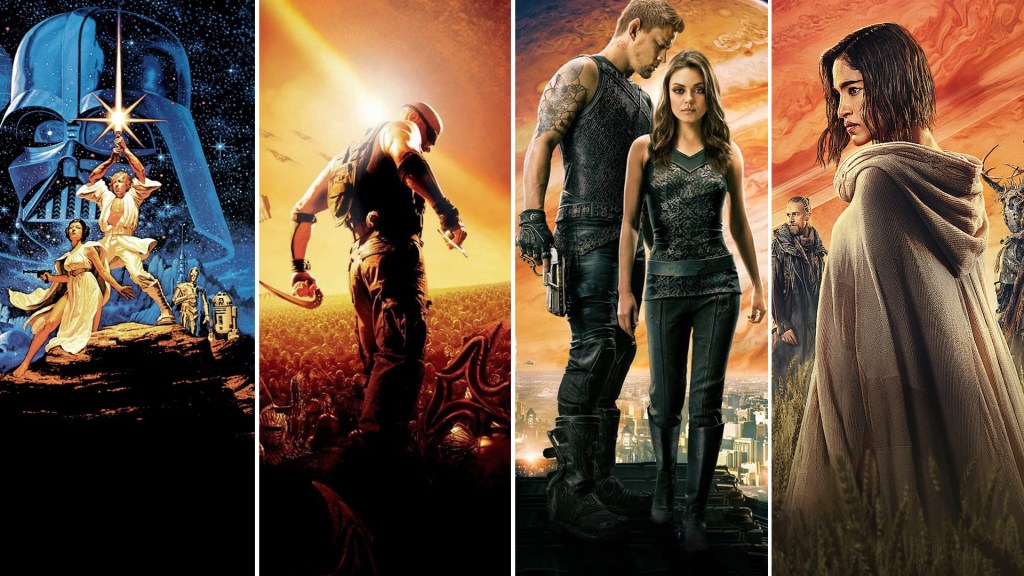
Star Wars changed the game when it was released on the 25th of May 1977, there is absolutely no debate about that. Within weeks of initial opening, Fox doubled in market value, Alan Ladd got much richer, George Lucas became such an overnight success that his close friend Francis Ford Coppola immediately started messaging him asking for money to help him finish the troubled production of Apocalypse Now.
And apparently nobody had believed in this movie. That is, if you happen to buy all those ancillary stories as gospel, suggesting that the cast thought they were making a children’s movie and didn’t care to work longer hours. However, at the same time, a tie-in comic book series was in print, ahead of the premiere. The novelization was commissioned and published months before the release. Action figures and other bits of merchandise were in production, so someone somewhere had a hunch that Star Wars had the potential to hit it big. I don’t know if George Lucas did at the time, though. He did after all concoct a plan-B low-budget sequel plan just in case the movie bombed.
But we all know how things went. It was a smash hit that also happened to capitalize on Hollywood’s recently acquired practice of expanding quickly and releasing nationwide without any delay, which definitely helped the movie become a cultural touchstone. This rag-tag combination of tropes picked out from movies and books George Lucas found formative, like Flash Gordon, Kurosawa movies or Frank Herbert’s Dune connected with audiences and forced the film’s creators to immediately consider the idea of doubling down. Even though there’s more history behind it, I think it is safe to say that it didn’t take much for Fox to agree to sponsor a sequel and stalwart Lucas apologists would often add that what we know as perhaps the most successful and culturally significant media franchise had always been conceptualized as a series, or even an entire interconnected media universe.
Baloney!
I never bought it for a second, as the evidence coming from all directions is too inconsistent to let it be true, poetic as it is. You hear hoofbeats, you think horses. Not zebras. Therefore, this variation of the Occam’s razor suggests that the most likely scenario is that Star Wars was never considered as a series in the making, but rather a standalone story set in a fertile universe. In fact, it was initially released as just Star Wars and only in 1981, in the wake of the release of The Empire Strikes Back which Lucas and the gang had already titled as Episode V, it was retroactively re-titled as A New Hope. But – and this is something most of the world is not ready to hear – it would have still become one of the most influential space operas in existence, if it had never spawned a single sequel. Perhaps it would have germinated a different cultural epoch in the process too.
Could you imagine a world where, in 2024, we do not have a Disney-owned media franchise pumping out miniseries, TV shows, animations, video games and gigatonnes of merchandise every year branded as belonging in a galaxy far, far away? I can. And even in this universe, the 1977 Star Wars would remain one of my favourite films and perhaps one of my formative childhood experiences because its power lies not in its ability to hold a whole constellation of movies, TV shows and branded products, but in the simplicity of its storytelling. It’s a movie whose worldbuilding is almost exclusively delivered through the back door. It simply doesn’t indulge in almost any exposition. Though, I am reliably informed that had it not been for Brian De Palma who rewrote the film’s opening crawl and tightened it from multiple paragraphs to just four sentences or so, things would have been different. Point is that the movie we got was so sparse in extraneous worldbuilding that you’d be well within your rights not to notice a passing reference to The Clone Wars, the Kessel Run, or even the fact Darth Vader’s woes included pacifying some kind of a Senate.
It didn’t matter because the movie thrived on its in media res narrative built upon the archetypal foundation of the hero’s journey… borrowed somewhat from Frank Herbert and bolstered by a patchwork of references lifted from other places. Still, the movie was simple and lean. It was a story of bad guys and good guys. The guy in black was a baddie. His space station was a threat to peace. The underdog rebels were good and, somewhere in there, there was this crackpot cult of monks who believed in telepathy and fought with cool-looking laser swords. That’s it. Simples. I just explained to you what Star Wars was about. No mention of tax disputes, blockades, multiple races, detailed history of the universe demanding its own Silmarillion. None of that was needed for George Lucas to succeed. In fact, the guy must have known that because his early breakout piece THX 1138 relied on the same exact principles of pared down worldbuilding. Watch that movie now and tell me what it is that Robert Duvall is doing half the time. I dare you. Nobody cared and nobody should care because this narrative ambiguity imbued the movie with depth. It gave you a perception that there is more somewhere in there. Behind the corner. Just out of sight.
However, in the wake of the film’s success and because of Lucas’s decision to turn Star Wars into Star Wars: Episode IV – A New Hope, things have changed forever. This seemingly inconsequential decision, ingenious as it may have been from a business standpoint, suddenly invalidated the notion of crafting a simple story set in an underwritten universe and letting it bloom naturally. That is because studio producers, with a few notable exceptions, understand simple business concepts and view the world of cinema through the lens of an investor looking to make a return, not a storyteller in need of getting something out of their system, or hoping to enrich the lives of the audience that came to watch his creation unfold.
Your bog-standard studio mogul will take note when his investment makes ten times the return. They’ll be happy and they’ll immediately wonder how to double down and do more of the same to generate a similar return. What is more, they will evaluate their future investments in completely new projects on the basis of this potential too. This is a fundamental tenet of capitalism – the pursuit of perpetual growth. And difficult as it may be to hear, Hollywood is a business environment, not a non-profit arthouse. Therefore, when George Lucas and his people demonstrated that their Star Wars can not only sustain an entire trilogy of films, but a whole universe of branded products and a promise of potentially never-ending revenue stream yielding multiple film and TV ventures spread across future decades, everyone took notice. And everyone wanted to replicate this incredibly successful concept.
Problem is in the simple fact that Star Wars was a unicorn. It was a simple standalone story rooted in foundational storytelling concepts. A borderline home movie made on a shoestring by a bunch of passionate mavericks and guided to greatness by virtue of being incubated in the micro-universe of the Movie Brats, a conglomerate of storytelling geniuses cheering from the sidelines and offering key pieces of advice to help this movie find perfection and balance. However, once it was retroactively re-titled and re-fashioned as a middle chapter in a larger storyline, things changed because other studios looking from the sidelines only saw the end result.
Thus, ever since Star Wars became A New Hope and The Empire Strikes Back clearly positioned the series as a trilogy in the making, the world of space operas changed. Granted, a whole slew of science-fiction and space fantasy got greenlit on the back of Lucas’s incredible success, but most were either compete failures or severely weighed down by the crushing load of ancillary worldbuilding they thought they needed to invest in to show their stories could also potentially launch similarly successful media ventures. With some exceptions.
Ridley Scott’s Alien was, similarly to Star Wars, a pared down and simplistic piece of science-fiction that kept its worldbuilding so vague that it took fans of the movie to invent the universe around some of the artistic concepts brought to the table by H.R. Giger and others. But unfortunately, a lot of space opera and fantasy spawned in the wake of Star Wars decidedly frontloaded their worldbuilding and made sure the viewer would sink under the weight of alien-sounding names, weird races, telegraphed elements of exposition and overgrown backstories for characters that simply did not matter or whose personalities didn’t extend beyond their costumes. There is a reason why Krull never spawned a massive franchise or why Willow could never sustain a series. And something tells me that it has a lot to do with the fact that people who guided these productions had very little idea about the template they were attempting to reproduce.
Before the Star Wars prequels came along and put the final nail in the coffin holding space operas as concepts for standalone pared down movies conceptualized without express desire to turn them into trilogies or shared universes at the earliest opportunity, we could still find interesting examples of just that kind of space operatic storytelling. Think The Fifth Element with its dense worldbuilding tucked to the side of an archetypal love story centred around sacrifice and devotion. Think Pitch Black – a movie nobody ever expected to sustain a series. A movie that spawned a series only because the character of Riddick played by Vin Diesel was severely underwritten and the universe of this movie was full of narrative gaps that were big enough for others to come in and fill with worldbuilding retroactively. I don’t think David Twohy could tell me with a straight face he always had an idea for a franchise when they were turning what essentially was a pile of unused ideas for Alien 3 into a pared down home invasion horror set in a science-fiction environment. And when they realized they could, the result was nowhere near as good, partly because its sequels, The Chronicles of Riddick and Riddick, overcompensated with their worldbuilding attempts… and maybe because Vin Diesel didn’t have Harrison Ford’s chops. The jury is still out on that.
Also, in the meantime, we saw The Lord of the Rings make landfall and not only reinvigorate the idea of adapting literary fantasy (which almost always carries way more expository worldbuilding than a movie could reasonably fit without looking bloated) but also reinforce the notion that a successful movie must always be pitched as a potential trilogy. Why make money once when you can do it three times? Finally, when the MCU got launched and calcified as the king of the box office in the early 2010s, original space opera as a concept was dead and buried.
You just can’t produce an original-looking piece of space fantasy without burdening it completely with elements of worldbuilding and overshadowing whatever simple storytelling it would otherwise champion. Jupiter Ascending. Valerian and the City of a Thousand Planets. Rebel Moon. If Star Wars had only been a single successful movie that never spawned multiple trilogies, TV shows, cartoons, comic books and whatnot, maybe all these movies would have been much simpler because nobody would have to pitch them as trilogies-in-the-making, leave loose threads in the narrative at every turn and drown the viewer in half-baked worldbuilding concepts even the filmmakers didn’t care enough about in the first place.
Unfortunately, this is not the world we live in. We are in Wall Street-bankrolled franchise land where a successful space opera can only see the light of day when it is adapted from a piece of seminal literature (Dune and Dune Part Two), and still, it comes with a lot of birthing pain. Nowadays, unless it is an already pre-existing intellectual property, preferably tracing back to a well-known comic book, a video game or already belonging to the Star Wars extended universe, it ain’t happening, chief. And even when it does, you can rest assured it will be bogged down with names, races, substories, micronarratives, and so much unneeded flotsam that it will make story writing in MMO games look lean and positively inspired.
Happy May the 4th.



 Flasz On Film
Leave a reply to Cultural Tardiness and Manufactured Relevance – Flasz On Film Cancel reply