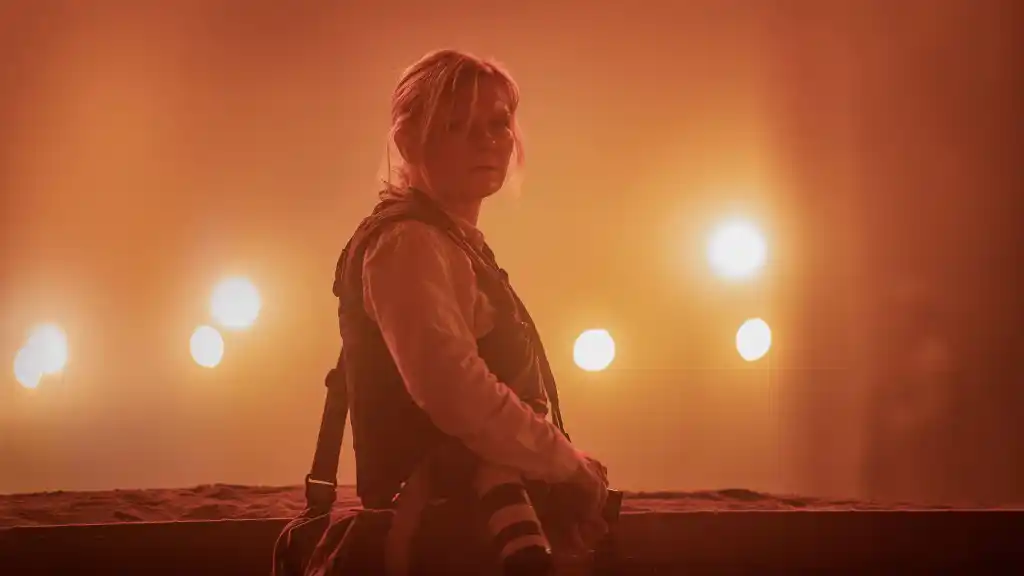

Sometimes I think we live in the end times and that Alex Garland’s new movie, Civil War, may in fact be a harbinger of things to come. Not only because the Western world has polarized beyond all repairs or that we have culturally embroiled ourselves in a constellation of discourses that is altogether detrimental to our collective survival. We now actively seek out lightning rods. We look for points of tribal contention, causes to get behind and counter-tribes to point fingers at.
It seems that uncle Quentin Tarantino was right a few years ago, perhaps during his podcast tour promoting his debut novelization of Once Upon a Time in Hollywood, when he dared an opinion that the value of cinema may have shifted in recent years. To many viewers, films are not predominantly here to tell stories, entertain or enrich our lives, but rather to espouse an ideology, champion a cause and take sides in a political debate. Now, I’m not completely deluded. Movies have always been politically, culturally and morally engaged; sometimes incidentally (vide George A. Romero’s zombie movies, which by the filmmaker’s own admission, were not purposefully imbued with any significant political meaning, they just naturally carried them), sometimes on purpose. Just in recent weeks alone we’ve seen not one, but two genre films pre-occupied with female bodily autonomy (Immaculate and The First Omen). But does it matter if a movie takes a political stance? And if it does take one, does it matter which side of the ledger it falls on?
Alex Garland’s new movie has been surrounded by what I can only describe as an insufferably toxic political discourse since the minute the first trailer heralding its arrival made landfall online. Now, I don’t know if Garland’s recent output (Men) may have had something to do with that; after all, that last movie of his was clearly and purposefully engineered as an attempt at an elevated horror with a clearly political message, adding to the cultural discourse surrounding gender dynamics. Maybe. But I chose to examine Civil War on its own terms and went into it without any outsized expectations.
I didn’t know what I wanted. But I know what I received. Which is a spectacle the likes of which we may have last witnessed when Kathryn Bigelow and Mark Boal worked together on Zero Dark Thirty. Starring Kirsten Dunst, Cailee Spaeny and Wagner Moura (with a smaller yet equally important turn from Stephen McKinley Henderson), Civil War inadvertently positions itself in the crosshairs of moviegoers expecting their entertainment to side with them politically on all fronts because it is nowadays unthinkable to even engage in a conversation with anyone who may harbour views incompatible with your own constellation of beliefs. That is because it chooses to tell its story in a way that is true to its central characters – a troupe of photojournalists traversing the roads of America torn by a fictitious and titular civil war. It is clear to me that Garland, an accomplished writer, chooses his allegiance as far away as possible from the current political climate, even though some elements of the narrative and character similarities would convince you otherwise (for instance, the character of the President played by Nick Offerman is probably purposefully modelled at least in part after Donald Trump). Garland’s Civil War, although incompletely apolitical, is completely Homeric. It is Joseph Conrad-esque. And if reading is not your forte, it is also somewhat Coppolian in that it structurally resembles, at least in part, the framework of Apocalypse Now.
In it we find a group of professionals, one young and full of conviction (Spaeny), one seasoned and cynical (Dunst), one energized and driven (Moura) and one who’s seen it all before (Henderson), as they drive into the heart of darkness of divided America in a tale composed of small episodes. Vignettes. They stop for gas to find the gas station manned by a bunch of grizzled and armed to their teeth locals, one of whom they photograph together against the backdrop of men they have been busy torturing in recent days. Men they used to go to high school with. They later happen upon a sniper on the prowl. We never learn which side the sniper is affiliated with. It does not matter one iota. We see them tag along with a strike team of some description as they engage in a heavy firefight in an urban setting. They take pictures of men bleeding to death. Of executed prisoners of war. Of children playing hopscotch in a football stadium turned into a refugee camp. We accompany them into a town where everyone seemingly pretends the war is not their business, a town out of time. They stumble upon a detachment of troops busy covering up for what clearly must have been evidence of genocide, as they dump dead bodies into a shallow mass grave and season them generously with lime. That last encounter nearly costs them their lives.
All because they decided just a few days earlier that they wished to interview the president (Nick Offerman) before his inevitable demise, as we are told an unstoppable military force is slowly advancing on Washington, which is where Garland also stages his Bigelow-esque final act. Such is the story of Civil War, a movie that assumes the optics of a war correspondent – definitionally impartial and immaterial to the outcome of what they are reporting – to tell us “quo vadis.” He is too busy to tell us what we should think or to signal as to what he may be thinking himself. He’s reminding us of General Sherman’s immortal words that “war is hell” and that “its glory is all moonshine” using these Conrad-esque Odysseuses-stroke-Marlows as conduits.
However, he is also not in the business of preaching from a pedestal. Civil War is not a political sermon it could have easily been, or one that the world seems to have desired it had been. Garland’s messaging is thoroughly embedded in the how of the story, not in the what, let alone the why. The movie is a heart-stopping spectacle rooted in fundamental idea of emotionally attaching the viewer to its characters and relentlessly pummelling them with the full force of the cinematic prowess of what Kathryn Bigelow (Zero Dark Thirty), Steven Spielberg (Saving Private Ryan), or Ridley Scott (Black Hawk Down) have previously reduced to practice with stunning effects. The power of the image reinforced with sound. Every gunshot in Civil War carries immense energy. As though it mattered more than we perhaps expected. Every little vignette carries incredible suspense and tells us something about the characters and how their journey changes them internally, as well as the world we live in now, one seemingly hurtling towards calamity.
I remain convinced that Civil War, despite (or maybe thanks to) the discourse surrounding its release, will emerge vindicated as Alex Garland’s most accomplished piece that takes the viewer on an unsettling journey into the hellscapes of a would-be dystopia that may be too close for comfort to the audiences of the here and now. But it nonetheless works. It pummels. It ensnares and captivates with the in-the-moment immediacy of its spectacle, the grandeur of its production and the ambition of is character work. It is a piece of spectacular acumen that brings Garland into the same echelons of ambitious, large-scale storytelling where the greats dwell and where in all seriousness he should remain henceforth.
Lyrical where it should be, awe-inspiring elsewhere and outright frightening on all counts, Civil War is a modern classic, a dystopia-next-door that functions both as a work of speculative fiction with a crushing message underpinning its existence and a slick spectacle carried on the shoulders of its adherence to the power of visceral theatrical experience. A blood-curdling masterpiece.

 Flasz On Film
Leave a comment