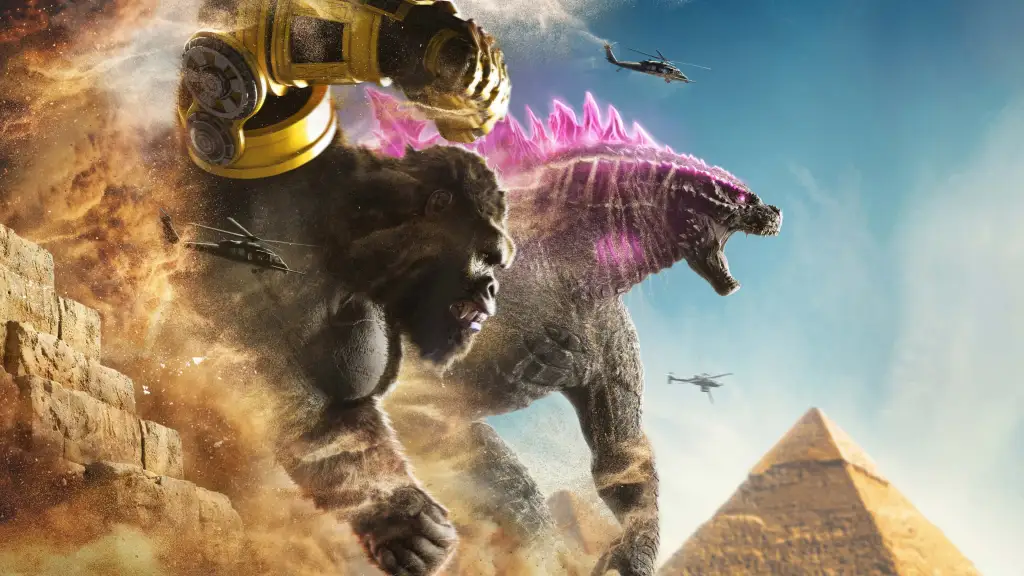

In 2014, when Gareth Edwards (The Creator) helmed Godzilla, nobody seriously considered restarting one of the oldest media franchises, especially since Toho, its rightful owner, were hard at work keeping it alive at home in Japan, as they were gearing up to launch what is now known as the Reiwa Era with Shin Godzilla (and who, most recently, wowed the world with Godzilla Minus One). However, owing to the success of the Spielbergian monster movie that recaptured the awe of the original 1954 movie directed by Ishiro Honda, heads at Legendary, WB and Toho were being scratched with incredible intensity. After all, it looked as though they might have had a cow ready to be milked on their hands. The question was, how to do it right.
Now, I am not an expert. I don’t have access to people in the know. All I have are the movies I watched, my floral imagination and unfettered access to the Internet, so I might be way off in my conspiratorial thinking. But… I think it’s way more fun to pretend I know what I’m talking about and just imagine that cultural ideas could fall into place with glee, that Hollywood producers are not at all dispossessed of wide-angle optics, that they actually communicate with each other instead of making stuff up and hoping shit flung at the wall would stick, or that it matters one iota whether movies pumped out by big studios form a cohesive trend, as opposed to being churned out because they offer best risk-to-reward ratios and translate to satisfactory yields to Wall Street investors and they just happen to cohere in a post-fact analysis.
I think it goes without saying that by mid twenty-teens everyone had a good enough understanding of the simple fact that the unparalleled success of the MCU was a fluke and could not be reproduced at scale, perhaps, at the very least, by virtue of the element of anticipation and surprise having been completely removed. Nobody wanted to gamble with nearly a decade-worth of investing to establish a de facto competitor to the MCU, while the MCU itself would have had enough time to develop further and swallow an ever-growing share of the box office real estate. After all, Marvel held the advantage of getting there “firstest with the mostest.” The blockbuster landscape had become a game of catch-up the minute Avengers scored a billion dollars and literally nobody fathomed it would be seen as a good idea to start slow, build up momentum and bring a bunch of movies together in a universe-sharing tentpole event. WB knew this already as their attempts at what has become known as the DCEU didn’t ever attempt to mimic the MCU model. They jumped straight from rebooting Superman with Man of Steel into a crossover with the rebooted Batman in Batman v Superman: Dawn of Justice and galloped towards that Justice League movie they had been dreaming of for literally decades.
We all know how that went and it is a subject for a potentially amazing book one day, one I’d read with bated breath. And I’m not here to pitch writing it either. I’d rather it be done by someone who actually knows their stuff and has access to inside sources I could only dream of having. So, what I’ll do now is point you elsewhere and suggest that just because it was impossible to launch an ersatz MCU (something Universal had to find out the hard way with their botched Dark Universe helmed by The Mummy which dive-bombed like nobody’s business), it didn’t necessarily mean it was impossible to put something together. The lukewarm reception of Pacific Rim coupled with its limited cultural footprint showed that while there was a space in the blockbuster landscape for a newcomer, audiences weren’t perhaps ready to embrace a completely original idea either. People used to love Transformers and they turned up for Godzilla so it became immediately obvious to peeps at Legendary, Warner Brothers and Toho, who came together to release the beast in the American market, that the West was ready for some monster action.
Again, this is a speculation on my behalf – and one that might be completely off-base – but I wouldn’t be surprised if someone with a good head on their shoulders sitting in a position of authority at Legendary Pictures thought they could re-apply the template DC properties were following with movies which were at the time in development (BvS, Wonder Woman and Justice League) and brought the King Kong movie which was also in development at the time under the umbrella of what would become the MonsterVerse. After all, King Kong had been leased to Toho before (King Kong vs Godzilla and King Kong Escapes, both with Ishiro Honda at the helm) and a sequel to the 2005 Peter Jackson remake of King Kong was in the process of transitioning studios. Also – fun fact – Peter Jackson wanted Adam Wingard to direct what later became Kong: Skull Island for a little while in 2013; so, there’s that.
As a result, the MonsterVerse got retroactively put together by virtue of bringing two properties into close enough proximity that – with a bunch of Easter eggs and Marvel-esque elements of minuscule side-plotting – a standalone media franchise was formed, and it needed a direction, a model. It was never going to follow in Marvel’s footsteps what with its bajillion superheroes in its stables; it would have been foolish. The idea of a Godzilla movie has historically involved the big lizard squaring off against a foe of some description and Toho didn’t necessarily have access to any vaguely recognizable brands with which one could scrape together the Justice League of Radioactive Lizards and Oversized Primates either.
However – and this may come as an insult to a section of the DC-loving fandom – DCEU wasn’t built around a vast universe of superheroes a passerby would be able to pick out of the crowd either. In fact, its cultural footprint boils down to Superman, Batman and a long tail of nobodies, with a few notable exceptions like The Flash, Green Lantern or Wonder Woman. But don’t expect a random civilian to tell you what Green Lantern’s powers are. Obscure stuff to most.
Therefore, it is my belief that the Legendary’s MonsterVerse was retroactively mapped across the DCEU and engineered in a similar manner after it became obvious that both Godzilla and Kong: Skull Island elicited a positive response in audiences craving diversity in the summer blockbuster destruction porn that extended beyond well-known comic book properties. Sure, you have to do some squinting to see how Godzilla: King of the Monsters functions as a distant cousin of Man of Steel whereby General Zod and King Ghidorah are symmetrical characters, but it is nonetheless there, at least as long as we agree that Godzilla is the Superman of this universe – a veritable personification of a force of nature capable of sowing great destruction, yet with a keen eye on keeping the planet at a fragile homeostasis.
It becomes way easier to see Godzilla vs Kong as directly inspired by Batman v Superman: Dawn of Justice, a movie with which it shares a quite a lot of narrative similarities. Once we agree that Kong is Batman and remember that Godzilla is Superman, it becomes immediately obvious, especially if you remember that a key idea in the DC film revolved around the world finding ways to curtail the Godzilla threat after learning it was impossible to control it. Furthermore, certain scenes in the film hark back specifically to memorable moments in BvS and even the concept of Mechagodzilla, an artificial creation powered by Ghidorah’s DNA, is a facsimile of what Doomsday in the DC film was. Again, obvious stuff. Batman and Superman, I mean Godzilla and Kong had to put their differences aside and dismantle the Mechagodzilla/Doomsday threat in the climactic final act of Godzilla vs Kong, which contrary to BvS didn’t take three and a half days to get there.
Which brings us to here and now. Nearly fifteen hundred words in what I originally believed was going to be a simple rant about Godzilla x Kong: The New Empire, we are finally touching base with Adam Wingard’s follow-up to Godzilla vs Kong, and it is all because I wanted to hang my entire interpretation of what this movie is to me on a comp suggesting it is the MonsterVerse’s knock-off of Justice League, but somehow delivered with a combination of Roger Corman-esque trashiness and a sheen of a nine-figure blockbuster of the A-variety. Which, quite honestly, is a bit of an oddity, if you think about it. Not every day (especially nowadays when Hollywood studios react to risk like vampires to garlic bread) do you get to see a blockbuster that is trashy, camp, self-seriously self-aware (that’s not a phrase anyone uses, Jakub; grow up!), steeped in weird nooks of 80s nostalgia and somehow still guilty of trying to be a studio product that would satisfy the requirements of what – according to big-boy investors – looks like a marketable entity that would put butts in seats.
Which – again – is how I have come to describe the pre-Wonder Woman 84 output coming out of the DC stables. Contrary to what Marvel settled on delivering, which is a conveyor belt of lookalikes rooted exclusively in plot and basic fan service, GxK seems to fit much better with tonally jarring oddities like Suicide Squad and with stylistically heightened items like Man of Steel. It offers a discombobulating concoction of stylistic grandeur, workaday blockbusterism borrowed from Transformers: Rise of the Beasts or something, and a certain flavour of tongue-in-cheek bravado that doesn’t necessarily cross over fully into the realm of self-parody like the Taika Waititi- or James Gunn-directed MCU movies but rides that fine balance more or less successfully.
The net result of this Frankenstein-esque hybrid monstrosity is the kind of fun we last witnessed eleven years ago when Pacific Rim roamed the screens for a little while. It’s a classic example of what in some quarters is referred to as switch-off-your-brain fun, but with a distinct whiff of garbage… despite looking like restaurant-quality meal. It honestly makes no sense and it probably won’t make a difference to anyone who isn’t already pre-attuned to the kind of entertainment GxK attempts, but it is the most fun this series has been since Godzilla.
But it’s not for everyone. To get the most of this experience you must come prepared to make certain concessions, sacrifices even. It’s not even enough to excuse yourself by agreeing that what you’re going to see is a bunch of CGI monsters sorting out their differences (again), while a new threat arises in the hollow Earth. You have to be on board with Godzilla sleeping in the Roman Colosseum. You have to give a nod of approval to the same Godzilla diving into the Strait of Gibraltar like an Olympian. You must not object to Kong wearing a robot suit. And you must be OK with the same Kong having his tooth removed by Dan Stevens. Among other things. Because while you OK all the above, you might as well wave through a whole bunch of other ridiculous concepts, ideas and plotting conceits that make some of the narrative solutions Pacific Rim had in spades look plausible and perfectly logical. There’s no dancing around it: the movie is dumb-dumb. Capital-Dee-Dumb.
And it’s fine because it somehow fits and thus GxK functions as a singular blockbuster unicorn. It is a descendant of the Pacific Rim school of shamelessly braindead entertainment delivered with a combination of seriousness and self-diagnosed stupidity. It continues the legacy of the original Toho philosophy which took Godzilla, having run out of what even a rabid fan would consider reasonable ideas, into a plane of downright ridiculousness. This newest entry into the MonsterVerse taps equally into the legacy of its own predecessors and into the well of accepted blockbuster consensus, while basing its entire narrative and series progression on the exploits of DCEU… which makes it look just a tiny bit as though Roger Corman directed and/or produced it. For some reason, Godzilla x Kong functions both as a serious attempt at a money-making type-A tentpole (and a successful one at that) and its Corman-esque ripoff. It is both an attempt at Star Wars and at Battle Beyond the Stars which is almost completely inexplicable. How do you explain it to someone who doesn’t know how to bend their worldview this far? You have to be a bit mad yourself.
Or you just have to be OK with Kong executing a suplex on Godzilla with a pyramid in the background. Or with Rebecca Hall finding connection with her adoptive daughter while an ice-breathing dragon on a leash held by an anti-Kong is threatening the world order. Or that somewhere in there, there is a podcaster who claims to be a big name on Reddit, but he isn’t sponsored by BetterHelp. Godzilla x Kong is ridiculous and stupid and nostalgic for trash of the kind you really have to be on board with a lot for you to love it, but it works. Predominantly because there isn’t much like it out there. And for a change, it is a living proof, together with Godzilla vs Kong and Godzilla: King of the Monsters, that maybe mimicking the MCU isn’t the best idea in the world. But aping DCEU, on the other hand, may be the way to go… so long as the movies are at least as fun as they are dumb. Or at least as stylized as they are dumb. Point is, the people putting them together must have a good enough grasp of the medium to know they must counteract the self-aware dumbassery with something and they had better take their efforts seriously.
Which, I think, they did.


 Flasz On Film
Leave a reply to GLADIATOR II and Milking Functionally Redundant Franchise Nipples – Flasz On Film Cancel reply