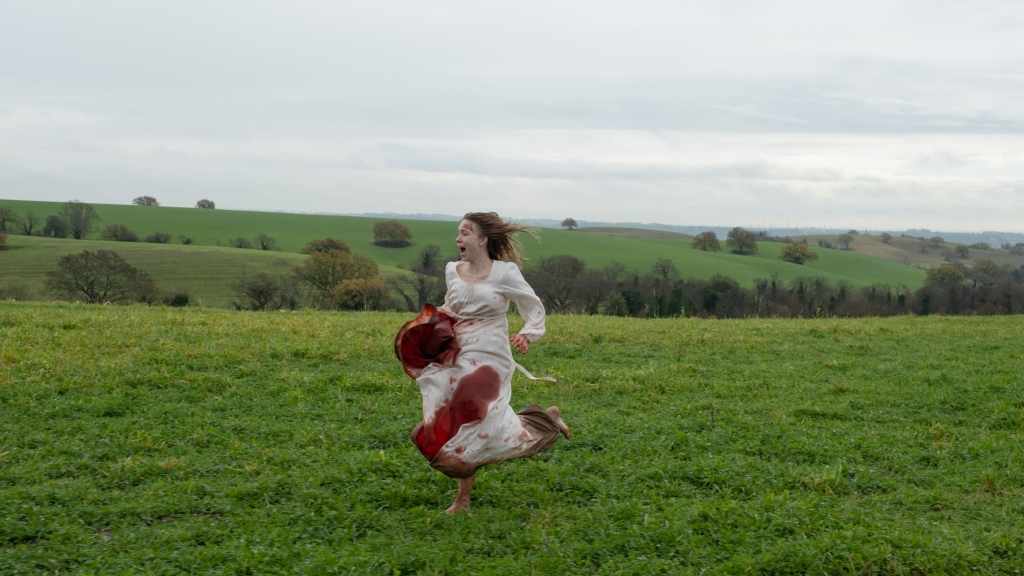

The publication of Ira Levin’s Rosemary’s Baby in 1967 came with its own, I believe, cultural upheaval, specifically because the book dealt with themes of occultism and Satanism in a matter-of-fact way that was at the time quite simply unheard of. Before Levin, and later Blatty (with his seminal The Exorcist) and, a few years on, Stephen King’s Carrie, horror genre was the stuff of campfire stories. Even though vampires, werewolves and the undead were metaphorical proxies for societally relevant issues a prepared reader would immediately recognize, horror stories were almost always separated from our world. They were about things that didn’t exist, magical beings, figments of imagination.
Meanwhile, that 1967 book about a woman pregnant with the Antichrist brought horror to the house next door, even if it still dealt with supernatural ideas. Furthermore, what people responded to was not necessarily or primarily the paranoia of its central character, the study of manipulation, denial of reality or surrender of bodily autonomy, but rather the upsetting of an agreed cultural understanding and supposing that God and Satan could wage their battles on the battlefield of a nuclear family. A family like yours or your neighbours’. I suppose this angle was explored much more readily in Polanski’s iconic adaptation starring Mia Farrow and John Cassavetes, but owing to the infamy surrounding the disgraced filmmaker (and I’m not here to explore this particular rabbit hole more than I necessarily have to), Rosemary’s Baby has become a poisoned chalice of sorts because you simply cannot explore its thematic underpinnings without acknowledging the baggage brought to the table by its director, even if the film itself was a perfect vehicle to sustain a conversation about the subject of woman’s ownership of her own body and her struggle to secure independence in a society rooted in religiosity underpinned by flagrant misogyny.
Still, this conversation continues unabated in the twenty-first century when in many countries women are not allowed to leave their house without a male chaperone. Even in Western societies, female reproductive rights remain a subject of fierce debate. Not to mention the recent overturning of the landmark Roe v Wade legislation in America, the self-diagnosed Land of the Free. Therefore, it is only logical to expect the cultural conversation to continue within the parameters of arts and entertainment. Such heightened, turbocharged emotional states with cross-population appeal need an outlet. Which is why Immaculate exists.
Although this piece of elevated genre storytelling is helmed by men (directed by Michael Mohan and written by Andrew Lobel), do not let yourself be deceived or carried away into a conversation about whose voice matters more and whether certain stories ought to be told by female artists. Sometimes it matters more that certain opinions are voiced than by whom they are voiced. It is about volume and tone, and Immaculate adds a powerful note to the growing chorus of furious discontent in just the right way – using a combination of subtly woven narrative nuances, evocative visceral immersion and intellectual treatment of the film’s delicate subject matter.
In fact, the film’s incredible effectiveness is hidden within little moments peppered throughout the running time, some of which hark back to other works of cinema; like one of the opening scenes, which inadvertently positions Immaculate in the constellation of spiritual descendants of Suspiria, as we see Sister Cecilia (Sydney Sweeney) arriving in Italy, where she is questioned by the local border agents. She doesn’t speak the language and after a brief exchange with one of her interlocutors where she reveals she is going to take her vows soon, the other makes a comment in Italian. “What a waste,” he says. As though to indicate that Cecilia’s value is somehow tied to her availability as a sexual object.
In another scene, we see Cecilia take her vows where the camera looks down upon her from the perspective of the priests carrying out the service and accepting the vows. The men tower over her, looming descendants of a patriarchal tradition, and in the final act of deference – as if to seal the deal – Cecilia must kiss the ring on the priest’s finger, right after promising publicly to choose a life of poverty and chastity in service of God.
Though, her chastity becomes questioned almost immediately when Cecilia learns she is pregnant, having never had sex with a man. In a conversation that will probably not look out of place in any society with strong Christian roots, she is frequently asked about her private life and we even find out that she had to agree to be examined medically by men in white coats who needed to make sure her hymen was intact, against which Cecilia didn’t even protest. Or maybe she didn’t even know she could. Or maybe she knew that she couldn’t. I don’t know at this point which of these options is more frightening.
Again, these ideas are repeated and repackaged on many occasions and using different tools and mechanisms geared to make the viewer question what many see as an acceptable cultural status quo. We see the nuns bathe fully clothed. We see them launch against each other and effectively keep each other in a state of permanent submission. We see Cecilia’s bodily independence completely removed from her the minute she finds out she is carrying a child. We see other people adjust for her only because she is pregnant, as though she didn’t matter half as much as the clump of cells she was growing inside her. The film makes a truly stunning display of an idea that women identify as a part of reality of their existence. That they are as valuable to others as their fertility. That they are vehicles and that they ultimately do not have a say in what happens to their bodies.
This last aspect Immaculate explores with truly powerful angst as it encapsulates the fear of surrendering one’s own bodily independence into an experience rooted in the language of elevated genre filmmaking, replete with exhilarating displays of onscreen violence and gore. It adds up to a sensory catharsis that will take you not only to the edge of your seat, or to the edge of what you think you can tolerate in the context of a horror movie, but well past it. Never gratuitous or exploitative, Immaculate descends into a carnival of horror that truly serves both its narrative and – more importantly – its rich thematic subtext, as it rakes its protagonist through the coals and takes her on a doomed journey towards freedom at all costs. Granted, it occasionally stumbles and succumbs to genre conveniences, such as what Roger Ebert called the curse of a talking villain (I believe on the occasion of his review of the vastly underrated Broken Arrow); but it is nowhere near enough to dissuade the viewer – who has already committed in full and effectively decided to live vicariously through Cecilia and embody her visceral struggle – and dispel the phantasmagoria Immaculate has so effortlessly engineered.
It is all predominantly thanks to the simple decision to – using those nuggets of nuance, elements of style and tonal control – embed you, the viewer, in the skin of Sydney Sweeney’s character and have you experience the entrapment, the gaslighting, the manipulation, the total loss of control. The all-encompassing sense of hopelessness that looms over her like a cloud pregnant with incoming torrential downpour. Which is what Rosemary’s Baby accomplished decades ago, perhaps at a time when the world wasn’t attuned to its frequency and all it could get out of it was the stuff to do with the occult.
Immaculate is in many ways a near perfect torchbearer for that conversation which other works like The Handmaid’s Tale, Never Rarely Sometimes Always, Black Christmas, Benedetta, The Witch, Suspiria (specifically Luca Guadagnino’s reimagining) and many others have kept alive. In fact, this film adds an important voice to the feminist chorus and perhaps may tip the scale, reach critical mass, precipitate that much-anticipated avalanche and denude the seemingly elusive realization that the insurmountable obstacle standing in the way of female self-determination and empowerment was our cultural leniency towards religious institution and our mind-boggling willingness to let ancient patriarchal traditions dictate how we should organize our culture.
Not every movie has what it takes to succeed in this regard. Immaculate, ironically enough, is not without sin. It has its flaws, but imperfections elevate it slightly above the crowd of recent “elevated” genre releases. It may not be as fun or viscerally entertaining as Talk to Me, but its mission is to stimulate first and entertain later. It’s not as gory as it could be and genre hounds will likely get their kicks elsewhere too. But Immaculate packs a punch and leaves you stirring. Like Rosemary’s Baby.



 Flasz On Film
Leave a reply to CIVIL WAR – an Odyssey into the Heart of Darkness of Current Political Divisions – Flasz On Film Cancel reply