
Toby Hooper’s Poltergeist was released in 1982, over four decades ago. It’s a cinematic elder millennial who’s old enough to have earned the right to go through a midlife crisis now. It spawned two sequels and an uninspired remake, which in itself is a rite of passage for any horror classic deemed old enough to be called a horror classic in the first place. Yet, despite the fact it has cultivated enormous appreciation and perhaps even pushed the age-old Hooper-vs-Spielberg debate into irrelevance, it is almost never mentioned in the same breath as Halloween, Friday the 13th, A Nightmare on Elm Street or even Tobe Hooper’s own The Texas Chain Saw Massacre as one of the all-time genre classics.
Instead, Poltergeist continues to be remixed and re-fashioned by successive generations of filmmakers. And there’s nothing canonically wrong with this phenomenon either. After all, the entire genre of horror is built upon the iterative process of aping. Imitation is the highest form of flattery. However, there’s imitation and there’s imitation. And then… there’s imitation of an imitation of an imitation… which is why we’re here after all. Because I’m not here to sell you on Poltergeist; I might do that on a different occasion if I feel frisky and I find a fun enough angle to plumb its depths for a few hours and type two thousand words on the matter. No promises. I’m here to talk about Imaginary, which is a brand-new horror movie written and directed by Jeff Wadlow (of the Fantasy Island, Kick-Ass 2 and Truth or Dare fame) you can venture out to see, if you have already seen (or prefer not to; who am I to judge?) Dune Part Two. And you can safely skip it because you’ve seen it all before and even if you like to see stuff you’ve seen before (which is why genres exist, come to think of it), the stuff you’ve seen before that Imaginary reimagines is way better. Way better.
Think about it. When you go out and see Imaginary, that is before it disappears from the screens to make space for the pre-season blockbuster push we frequently see around Easter, what you will essentially subject yourself to is – and I am being charitable here, keep that in mind – a terminally braindead TikTok dance to a sped up remix of Insidious, which is already a sped up remix of Poltergeist. So… I think the technical term for what you’d be observing on that massive screen in complete darkness is a steaming pile of cow dung in movie form. There’s no other way of calling what this movie is. Well, the fun part is – and this is actually something I tend to enjoy on many occasions – is that the movie takes itself seriously. Nobody winks at you. Ever. And I applaud such brazen bravado, to be perfectly honest because at least half the time it is enough to produce a net positive viewing experience.
Not this time, though.
Imaginary, contrary to what its title might suggest, lacks even a modicum of its own imagination.
Scratch that. Maybe I should rethink that statement.
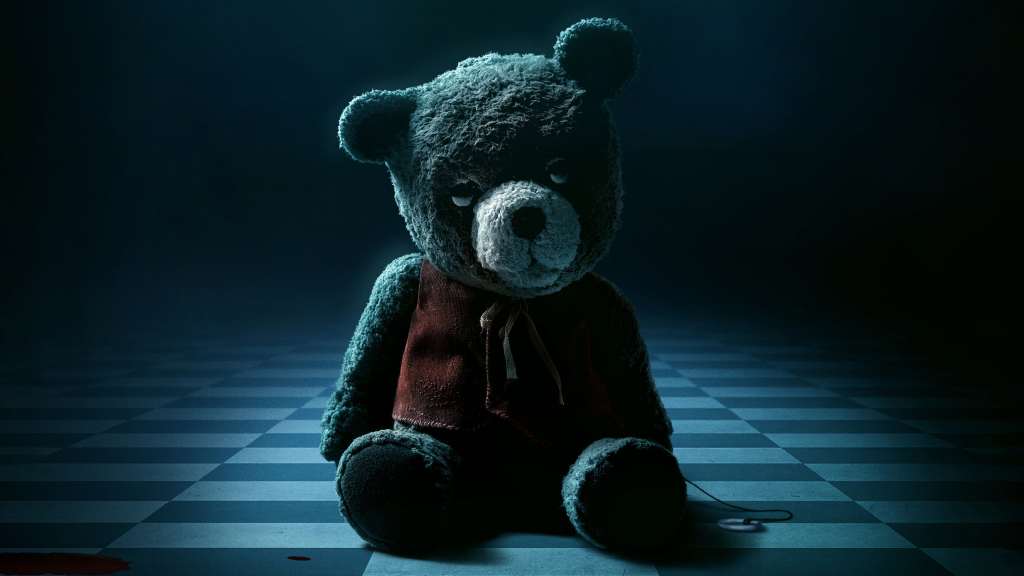
Maybe, just maybe, Imaginary thinks itself an elevated rendition of the Poltergeist archetype that Insidious already did a much better job doing. In fact, its fifth instalment eclipses what Imaginary is doing. It runs laps around it while singing nursery rhymes, all the while this movie is scrambling to keep a lid over what clearly is a web of narrative complexities it finds way too hard to control. In that spirit, we have a woman (DeWanda Wise) who suffers from nightmares and who channels (what the movie tries to keep a secret without realizing that anyone who has seen a single horror movie can see through immediately) her traumas into her art. We have her stepchildren, one of whom (Pyper Braun) finds a stuffed bear in the attic of the new house they just moved into. The bear’s name is Chauncey, but it could as well be Annabelle or Captain Howdy. We all know where this is going. Her other stepdaughter (Taegen Burns) is conveniently apprehensive towards who she sees as an intruder in her family existence. And we also have the dad (Tom Payne) who wears funny hats and plays the bass in a band we don’t see and who disappears conveniently for most of the movie. And we also have an old lady next door (Betty Buckley, who played the doctor in Split if you care to remember) who seems to know a bit more about who Chauncey is and that our protagonist in question might have suppressed her own memories of interacting with Chauncey when she was a youngling. You know the drill.
Again, this is not an issue. Horror is about a journey and not a destination. In fact, the journey is the destination when it comes to genre filmmaking. Problem is, the journey – even if occasionally viscerally effective – is mind-numbingly boring in its totality. Look, I fully appreciate if you don’t get what I am trying to articulate, but this movie is a TikTok. It’s a braindead intellectual truncation of something that could have had a beating heart and two legs to stand on if it had committed to something more than an inch-deep exploration of its own thematic interests. And it also thinks it’s smart which is both cute and annoying. Just like TikTok videos concocted by people whose prefrontal cortex still has a decade of development to go through, and yet who somehow see themselves as worldly philosophers because they grew up with tiny screens glued to their hands.
That’s what Imaginary is – a cinematic teenager who watched another cinematic teenager from a decade-and-a-half ago do a remake of a movie they actually watched and loved and decided to do a TikTok mashup about it. It. Is. Bad. It is so terrible, in fact, that when the guy who sat next to me decided to go home twenty-five minutes in, I admired his decision-making skills and an ability to avoid the pitfalls of the sunk cost fallacy. Which is something I have yet to master because I sat through this abomination in its entirety, somehow hoping it would get better. Or at least funnier. Which it didn’t.
So, let it be a lesson to you, dear Reader. It’s OK to stop watching a movie, especially if nobody is paying you to do so. It’s fine. I know you probably think it’s only ninety minutes, but I assure you these numbers add up. It’s not worth it. Movies like this, Cobweb or that movie about that Indian demon whose name has been hidden from me by what could only be early onset dementia – It Lives Inside, that’s the one; I knew I’d finally remember – are best left unwatched. Now, it doesn’t mean bad horror movies don’t deserve to be seen. But there are bad horror movies that look as though they were made by people who cared at least a little bit about what they were doing, and there are those that try to pass as smart and elevated because they memorized a few four-syllable words and decided to re-heat those post-expressionist sets that James Wan used in Insidious, but somehow with less flair.
Apologies for keeping you here so long because I fully appreciate it could have been a tweet. Imaginary is an abomination that belongs in the landfill of genre history and whose only raison d’etre is to remind you how good Insidious was at capturing the legacy of Poltergeist. Because it is clearly possible to fail at it, even though James Wan made it look so effortless way back in the day.
Steer clear. Ninety minutes with this bear is not worth it. Imaginary makes Five Nights at Freddy’s look well put together in comparison. I can’t make it any more obvious, I’m afraid.



 Flasz On Film
Leave a reply to HERETIC, Dawkinsian Pop Philosophy and the Art of Pseudo-Intellectual Horror – Flasz On Film Cancel reply