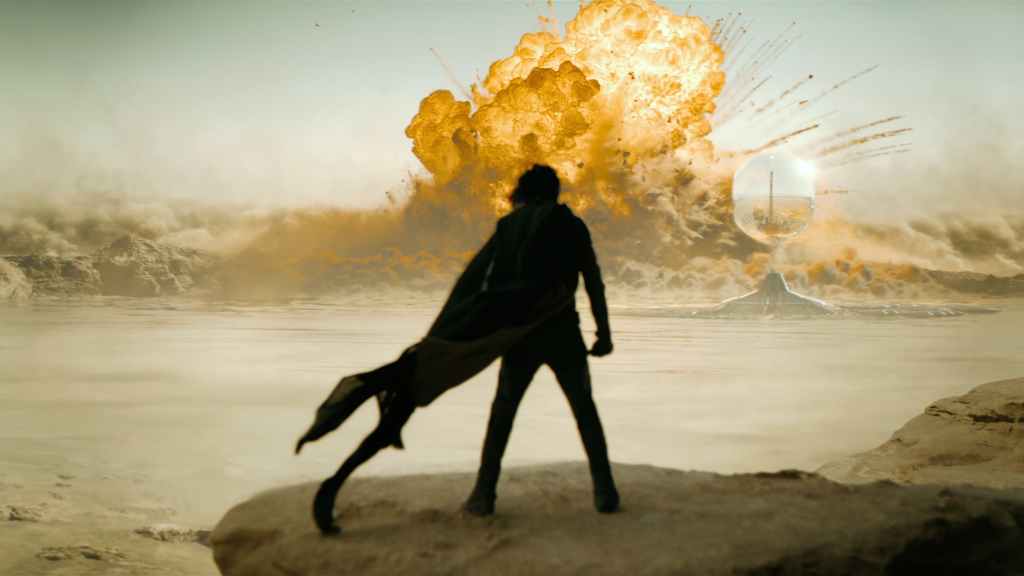

Musicians are a fun bunch, you know? Sometimes they will actively set themselves up with challenges just to mess with their listeners and briefly mystify those who think they know a thing or two about music. What I am referring to is the age-old tradition involving starting songs at a weird place and/or placing emphasis in the opening on off-beat phrases to deliberately misdirect anyone who would choose to clap or snap their fingers to what they think is the pulse of the song… only to show them they were either slightly off or totally way off when the whole band kicks in and it’s now apparent where “one” is.
Do you know what I mean? No? Listen to the opening of AC/DC’s “Highway to Hell”, or Kings of Leon’s “Sex on Fire”. Or Queens of the Stone Age “Song for the Dead.” Or literally anything by The Police. Examples are plentiful because such is the tradition of performing rock and roll on stage. Messing with the audience is a part of the experience. And having recently watched Dune: Part Two, I can say that I can see how I may have been misled by the filmmakers who deliberately and willfully embarked on a mission to do something they didn’t exactly advertise to the unsuspecting masses who bought the ticket for the part that came before it, namely Dune: Part One, at the time advertised as, simply, Dune.
As far as I am concerned, there are two types of people in this world: those who read Frank Herbert’s Dune and those who have not. And of those two demographics, one is decidedly larger than the other. You can figure out which one’s which. Therefore, as much as it may be impossible to fathom for some of the hardline sub-demographics of the I-read-Herbert-and-adopted-it-as-my-identity community, chances are that the bulk of the audience venturing out to see Dune movies directed by Denis Villenueve will at best (if at all) be familiar with David Lynch’s adaptation of the novel, starring Sting in a space nappy and Kyle MacLachlan’s menacing grin with teeth and all. And those people went to see the 2021 movie assuming it was a straight-up remake of the 1984 movie, only to find out the credits rolled just shy of the halfway point of the Lynch-directed movie. Which is as discombobulating as listening to an intro to a rock song and having it switched off two bars after finding out you’ve been tapping your foot a dotted eighth note off the downbeat.
However, nobody gets a second shot at making a first impression. So, heading out to watch Dune: Part Two not only do you implicitly prepare yourself for a nearly three-hour session enveloped by the sands of Arrakis, but also you are probably fully expecting the movie to finish on a cliffhanger, too. Because the rule of threes suggests that a trilogy is a more likely storytelling device than a diptych, or – muted barf – a duology.
I hate that word. I don’t know why. I just do.
In any case, there are no surprises baked into the mechanics of the experience that is Dune: Part Two. You know it’s going to be languid and deliberately paced. You already know its rhythm because it has been revealed to you the minute Paul Atreides’s family got wiped out by a surprise attack of the Harkonnen fleet, because – even if you have not read any of the Herbert’s novels – you could triangulate your position within the narrative by way of seeing you’re just about a third into the narrative David Lynch reduced to practice in the 1984 movie. In short, if you don’t walk into Dune: Part Two expecting a middle chapter in an unfolding trilogy (which in a not-so-surprising twist may turn into a trilogy-of-four aka – muted barf again – tetralogy, or a full-blown cinematic universe, sustaining which shouldn’t be too much of a bother given the volume of worldbuilding the series has at its disposal) , you’re doing yourself a massive disservice.
Thus, the middle part of what’s well on its way to become this generation’s The Lord of the Rings (or at least to remind the masses how another well-known space opera, namely Star Wars, pillaged Herbert’s prose mercilessly, bolted on elements of Kurosawa, WWII movies and westerns) begins almost exactly where the previous part ended and proceeds to immediately expand the scope of the narrative, while slowing down the progression of the story almost to a barely recognizable speed characteristic of glaciers or tectonic plates. But that’s not a dig. After all, you know the next three hours or so are not going to yield a decisive resolution, even if the movie reaches its climax right about where Frank Herbert intended the original book to finish. So, you might as well relax, take in the view and learn a thing or two about Frank Herbert’s Dune universe (Duniverse?), which is where Denis Villenueve visual storytelling truly comes into its own.
The movie just breathes the way Peter Jackson’s The Lord of the Ring or Star Wars did. It feels grand, epic and inspired even if exposition enclosed within is too sparse and cryptic to teach a newcomer anything remotely useful. Timothée Chalamet’s Paul Atreides grows some much-needed chest hair and fully embodies the age-old messianic narrative of “The One,” with Javier Bardem becoming his own personal Morpheus or Qui-Gon Jinn, the man convinced he has witnessed the arrival of a messiah despite the entire world telling him otherwise. In fact, even if you haven’t seen the David Lynch film, or read the Herbert book, you still have a good idea of where you are and what you can expect because the tropes enclosed in this narrative have either permeated elsewhere or have themselves been appropriated from well-known archetypal progressions. You know the destination lies in a confrontation between Paul and Feyd-Rautha (Austin Butler) and his overthrowing The Emperor (Christopher Walken) because you’ve seen it all before, but with Agent Smith or Darth Vader substituting key corresponding characters.
But it’s not about the destination as much as it is about the journey. And at least this time round you know the pulse of the story, so you won’t be caught unawares as you’re clapping on the up-beat or something. This chapter dispenses with any gentle-gentle niceties of introducing the viewer to the world or explaining the basic mechanics of the universe. It is assumed we all know what spice is, who Fremen are, what the politics of the world at large may be and who the key players are going to be as well. In fact, Villenueve employs for the most part the very basic visual language to not so much explain what’s happening on the screen – which may or may not include ritualistic infanticide of baby Shai-Hulud – but to bring you up close to Herbert’s lore in a way George Lucas would to his in THX 1138.
Thus, Dune: Part Two can only be described as appropriately immersive, deep and tonally spacious, perhaps even more so than its predecessor. However, I may have to refrain from making any such comparisons because, by my own admission, I have been clapping to the Dune song wrong for most of the first instalment; so, what the hell do I know? Perhaps it is only advisable to go and watch Part Two immediately after rewatching Part One, which is what I did; and I have to admit that my appreciation of the previous film has improved considerably as a result of knowing how this puppy is paced, where its pulse is and that in fact it is laid out as a prologue to a sprawling trilogy at the very least.
Having done so, you might then partake in what can only be described as a bold and visually luscious blockbuster of the kind we have not really experienced in at least twenty years, all thanks to the simple fact Denis Villenueve’s visual style triumphs uncompromisingly over the modern proclivity to put plotting ahead of the immersiveness of the experience. If anything, Dune: Part Two proves unequivocally that it is after all possible to impart incredible narrative density on the experience without sacrificing too much of the story’s visual glamour. It’s a truly cinematic blockbuster that overwhelms with its spectacle in a way some of the most memorable blockbusters directed by Christopher Nolan could do with glee. It is perhaps a little too brooding occasionally, though I fully expect that once the whole story has been unveiled, Dune as envisioned by Denis Villenueve will grow into an all-time classic.
Unfortunately, we live in a world where we have to wait multiple years to carry on watching what has clearly been designed as a single-sitting experience requiring the viewer to take a day off work or carve out an entire Sunday for. But it may be years before it is possible to do so. And only then will I be able to finally admit that it might be The Lord of the Rings of our time… but I am not yet ready to admit that. For now, I’m happy to have figured out this whole experience started with an off-beat pickup bar and now I am clapping to it correctly. Now, the time has come to dig deeper into its melodic structure and understand the structural beauty underpinning this spectacle of cinematic prog rock that I may one day give the five stars it perhaps deserves.
But it is not today.



 Flasz On Film
Leave a reply to How George Lucas Ruined Space Operas – Flasz On Film Cancel reply