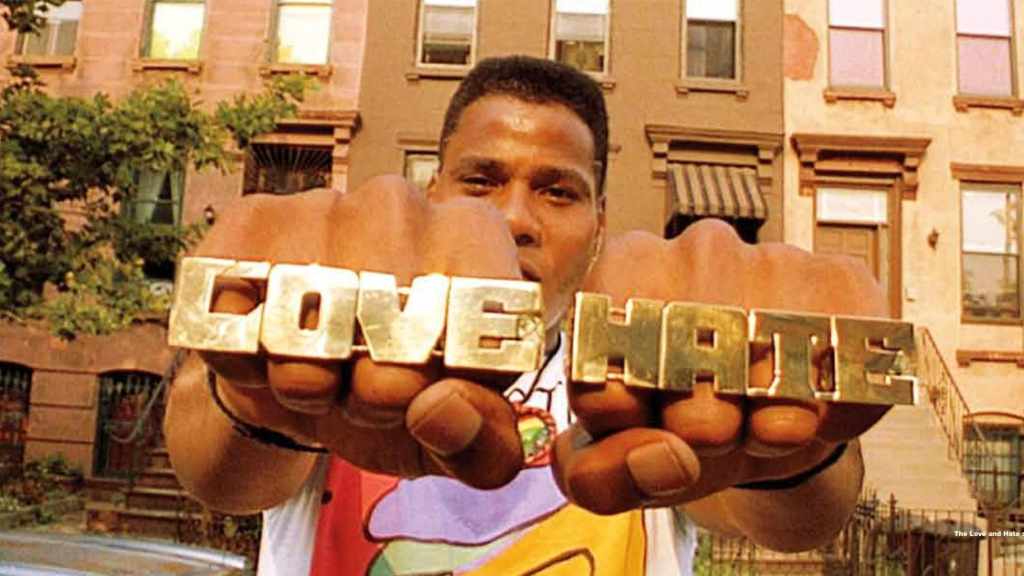
In 1989, some critics were worried that the release of Do the Right Thing would incite race riots across American cities. Spike Lee immediately hit back – and continued to be flabbergasted by this kneejerk response even decades after – in astonishment at the suggestion that black audiences could not be trusted with watching a movie like this without starting a riot.
Or…
Maybe we were all supposed to get riled up by this movie after all. And the fact that we didn’t only testifies to a possibility that – even thirty-five years after the film’s release – we never got the message that was subtly implanted in it. A message that required the viewer to look beyond the frame, into the negative space, to investigate what Spike Lee is not showing us and what is nonetheless incredibly relevant to contextualizing what I believe might be an implicit take-home message. After all, at this point, having seen a bunch of his movies, I don’t believe there are any accidents in a movie written and directed by Spike Lee, one of the most intellectually accomplished storytellers currently working within the realm of cinema.
It all starts with what Do the Right Thing shows and what it does not. As it is a narratively dense, extremely formal, heightened and theatrical piece of storytelling, it may take considerable effort to parse what Spike Lee is trying to achieve with this movie. It’s a medley of micro-dramas between which we are allowed to meander thanks to the central conduit character of Mookie (played by Spike Lee), a young guy who delivers pizza for Sal (Danny Aiello), and who interacts with the various characters the film is peppered with. We see his own micro-drama concerning his relationship with his girlfriend (Rosie Perez) and his son, we see how Sal’s son is consumed by his racist thoughts. We also witness how Sal himself holds back what he may be thinking about the people he’s serving – the very people he claims to be proud to have fed since they were little children. Lee shows us how a Korean family is attempting to find their place in this community. We see Radio Rahim (Bill Nunn) with his music and love-hate knuckle-dusters. We see other immigrants loitering in the streets. We see black kids playing with fire hydrants. We see police officers with itchy trigger fingers waiting for an opportunity to hit someone. In short, Lee paints us a renaissance-esque fresco where he encapsulates the world as he sees it.
Therefore, it is important – and this extends to many more of Lee’s movies as well – not to take anything you see in Do the Right Thing on face value. There is a reason why all those characters – Mookie, Sal, Pino (John Turturro), Radio Rahim, Buggin’ Out (Giancarlo Esposito) and others – seem as though they were written quite flat, as one-note clichés. That’s because they are supposed to represent bigger ideas and, in some cases, whole communities and elements of the larger American society. Thus, the film is an all-American diorama, a fresco capturing something profound about the country Spike Lee cares deeply about.
You can look at this fresco and interpret it as it is and what you might get is what those critics of 1989 did when they argued the movie was dangerous. Because it describes in vivid detail and full blooming colour the many toxic divisions that exist within the American society. Lee doesn’t really try to sugarcoat it either. Under the guise of a neatly theatrical and wholly manufactured narrative about an Italian family running a pizzeria in a black neighbourhood, opposite a corner shop owned by a Korean family, where a row erupts on the back of an issue involving representation – a row that eventually results in a brutal police killing of a man and a riot that sees the pizzeria burned to the ground – Lee captures a perfect little snapshot of where he thought America was at the time. He captured his home country as deeply divided and roiling with racially charged hatred.
Now, you must remember that Lee took inspiration to write this movie from a real-life incident at Howard Beach in Queens in 1986 he discussed with Robert De Niro. A real story of a black man dying because of a racially incited altercation. And you don’t have to be a historian or a scholar to realize the incident was not isolated. There were dozens, if not hundreds – maybe even thousands – of such incidents before and there were many more after, from Rodney King to George Floyd. America’s history is littered with instances of such unspeakable violence, which only goes to show that despite all the many progressive policies and attempts at bringing much needed improvements into the makeup of nearly all Western societies, these incidents keep reoccurring. There are thousands of Radio Rahims, just as there are thousands of weirdly misplaced conversations attempting to equate damage to property with a loss of life, which is irreversible. Last time I checked, bringing anyone from the dead was still not possible.
So, you’d probably be excused enough if you chose to stop there and view Do the Right Thing as a portrayal of such a fundamentally toxic division and a wholesale scathing depiction of America as a country where stuff like this happens. And where it happens regularly. Is this what those critics were worried about? That black audiences would add two and two together and realize what they most likely already knew? If that’s the case, small wonder Spike Lee felt what he felt.
But equally, we do have eyes and as a society we do have a conscience. Therefore, I can imagine we can all see and feel that as a global society – extending way past America even – we have made leaps and bounds in terms of inclusivity and progress and that the world we live in now, thirty-five years on, is way more welcoming, progressive and compassionate. And yet, Radio Rahims keep dying. Could it be because – just as we have all been focusing on what’s on display in Do the Right Thing – we’ve been busy treating symptoms as opposed to looking for what’s driving the cause of this seemingly terminally irreparable societal decline?
I think the answer is in what we never see in the film, which ironically reflects exactly what happens in real life too. Because we rarely even think about the fundamental reasons why our world looks the way it does. And when we do, we just accept it axiomatically. It’s just how it is, we think.
Who owns Sal’s pizzeria? Sal? Does he own the land? Or does he lease the building? Where does Mookie live? Do you think he owns his apartment? Do you honestly think anyone in this neighbourhood owns their own houses? I doubt it. And if this neighbourhood is a microcosm of the American society, who we don’t see in the movie are people with money. The wealthy class of landlords who live at the other end of the monthly bank transfer you make when you pay your rent. The monthly rent payment the missing of only one of which separates you from homelessness. You never see them in the film because you equally never acknowledge they exist in your own life either.
But they are the ones you can trace it all back to. The media who spin sensationalist stories are owned by people. People who are kingmakers capable of swinging elections and precipitating economic earthquakes if they so choose. People who puppeteer politicians and indirectly whisper into your ear that all your woes are because of immigrants, minorities and other easy targets. People who own not only single houses but entire neighbourhoods. People who own investment banks and insurance companies. People who have more money stashed in offshore accounts than the entire population of the world holds in current accounts. People who could easily fix the world’s problems – hunger, affordable housing, healthcare, education – but they consciously choose not to. Because it’s way more profitable to keep societies divided than to offer solutions. It’s so much easier to keep communities at each other’s throat because it deflects attention and focuses their ire on petty fighting.
I think there is a reason why Do the Right Thing ends with a succession of quotes about violence from Martin Luther King and Malcolm X, and I don’t think it might have anything to do with what you might think it is. I don’t believe Spike Lee wants us to come away wondering about philosophical ramifications of violence, even though it looks as though the movie wanted us to make a choice. Why would he? It just doesn’t make any sense to end by quoting King and reminding us about the pointlessness of violence and then rolling straight into a quote from Malcolm X who advocated there was not only a good reason to be violent in times like these, but it was essentially necessary for survival.
I don’t think he wants us to make a choice here. It’d be foolish to pick sides because it’d stoke the already existing divisions and play right into the hands of of those who claimed the movie was a powder keg. It is a powder keg, though, but a different one. I believe that King and Malcolm X’s philosophies can be married. Why do you think we often get to see them pictured together in the film? By accident? Haven’t I just told you there are no accidents in a Spike Lee joint? Everything has its place and the place of these two political figureheads pictured together is a clue – an invitation – to synthesize their philosophies. And it is only possible once you realize that racial divisions are imposed from the top by invisible forces draining money and resources from the planet and safely hiding in their superyachts in the Bahamas.
Perhaps these two quotes are meant to be read together as an invitation to set aside any racial differences and to form a cohesive societal force, a multicultural legion of people who are sick and tired of being taken advantage of and manipulated by people who never had to work a day in their lives but who somehow end up getting richer while literally everyone else is spiralling towards abject poverty, especially now in the landscape supercharged by the succession of post-pandemic calamities. Learn to live together, King said. Choose not to be violent towards one another. Love thy neighbour. And once you do, apply Malcolm X’s teachings and redirect your fury towards those who’ve been pulling on those strings all along. Could this be what Spike Lee’s magnum opus is about? I believe so.
But to see it you have to do the right thing… and zoom out.


 Flasz On Film
Leave a comment