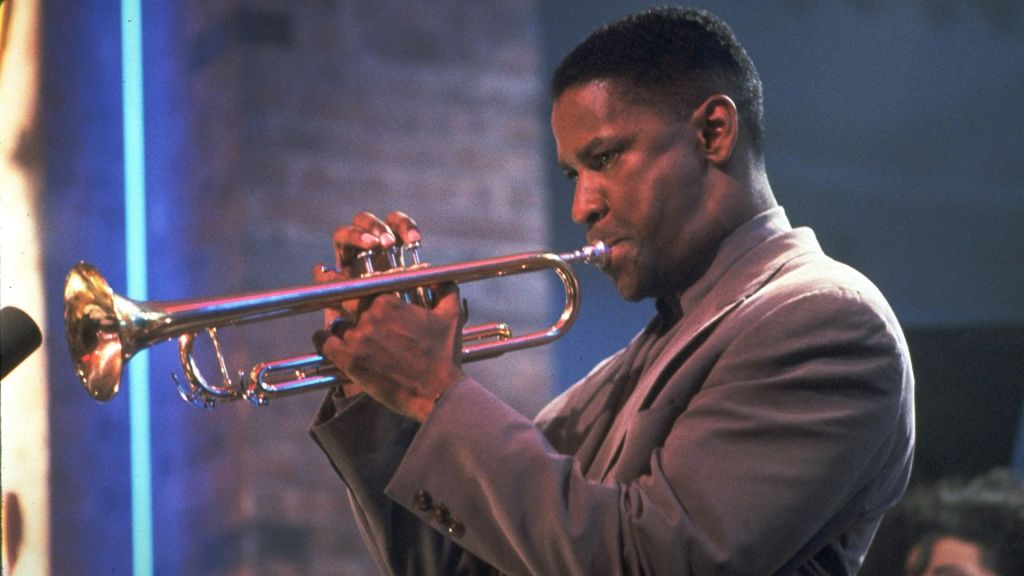
Released in 1989, Do the Right Thing is widely considered Spike Lee’s early masterpiece that came to define the early stages of his career, if not his life’s work in general. Together with Malcolm X, it is a movie everyone gravitates to when discussing Lee’s work, his style and the way his real-life political convictions informed by organic experiences have shaped his filmmaking output. Consequently, because the focus of the cultural debate surrounding Spike Lee’s work has always focused on Do the Right Thing and Malcolm X, the movies he made between these arguably titanic achievements of modern filmmaking did not get the attention they perhaps deserved. And one of those movies is Mo’ Better Blues.
Starring Denzel Washington, Wesley Snipes, Giancarlo Esposito and Spike Lee himself, Mo’ Better Blues is often summarized as a musical comedy drama about jazz musicians, creative obsessions and redemption. In continuation of Lee’s long-standing interest in imbuing his movies with strong political messaging you’d be hard pressed to find anywhere else (how feminism differs by colour in She’s Gotta Have it or how shadeism stops the Black community from speaking with one voice and becoming a formidable political force), Mo’ Better Blues is perhaps a great opportunity to talk about the roots of jazz and maybe even suggest that a lot of popular music traces back to blues. But that’s not all. In fact, it may be a topic for a completely different essay. Famous last words: watch this space.
Even though Crooklyn, which came out a few years later, is often touted as Spike Lee’s attempt at wrestling with his own personal recollections of childhood, it is my belief that Mo’ Better Blues is also subtly autobiographical.
I know, I know. Drink every time someone online tells you a movie is autobiographical. But this one is, I swear. However, it isn’t autobiographical the way Crooklyn is because it attempts a conversation about Spike Lee’s experiences as a filmmaker.
What did I just say? Drink every time someone online tells you a movie is about filmmaking. That’s two shots you now must down.
I believe the key to seeing how Mo’ Better Blues functions as a meta-autobiographical piece relating strongly to Spike Lee’s experience as a budding independent filmmaker elbowing his way into the mainstream cultural conversation is to understand the movie is a complete narrative fabrication. None of what you see is real. Everything is heightened and completely metaphorical. Some people are people, some others are emotions. Events are thoughts. It’s all a hallucination. Even jazz isn’t jazz.
Which, at least to my mind, assuages some of the criticism typically levelled at this movie, as it is frequently knocked down for being a bit too dense and unfocused… which are all perfectly valid observations, if a standard narrative is what you are after. Problem is, Mo’ Better Blues is not a straight-up movie but rather a Technicolor fairytale whose meaning is hidden within the layer of symbolic interpretation. And it shouldn’t really be a surprise because the opening alone – which looks as though it was taken out of a Disney movie or a 50s musical – informs you of a distinct possibility you might be watching something that ought not to be interpreted as-is.
However, it is equally challenging to attune yourself to what the movie may be trying to tell you either. Mo’ Better Blues is like an intricate jazz performance that you can vibe with in the moment, because it is pulsating with raw energy and smashing through with its virtuosity and technique, but it is one you can only wrestle with emotionally and critically having put enough distance between yourself and the movie to make necessary connections and to notice the artistry put into its harmonization.
Only then will you be able to acknowledge with a reasonable degree of certainty that Denzel Washington’s Bleek Gilliam is Spike Lee, and that jazz is a comp for filmmaking. Granted, Bleek’s name is an homage to Spike Lee’s father, who was a jazz musician himself; which immediately acts as a conduit leading to a slightly different interpretation of the movie. This way, you will see Mo’ Better Blues as a different shade of autobiography; however, if you don’t let this detail distract you, the movie will present itself to you as something intricately personal to the filmmaker. As a reflection on Spike Lee’s career thus far, his ambitions and the many pitfalls of auteur storytelling.
Put simply, it all begins with agreeing that music is movies and that Bleek is Spike Lee. Once you apply this filter onto the way you view the film, you’ll begin to understand how this interpretation comes together as a reflective lamentation on Spike Lee’s journey into the world of cinema.
We meet Bleek in his childhood, as he is practicing scales on the trumpet, while his friends are calling for him to come out and play. But he’s not allowed to do that because it is important to his mother – and by extension to him – to practice. To master the craft of music. Which is what he does religiously because the scene then fades into the future where Bleek is using the same musical patterns we saw him practice relentlessly and ad nauseam as his mother was watching, but this time he uses them in a solo on stage. He’s applying painstakingly acquired techniques in his own art.
Moreover, we later see Bleek as he composes new music hunched over a piano with one hand playing chords and the other “ghost”-playing passages on a trumpet while he’s humming melodies he engineers to complement the chord progressions. He’s again applying music theory to the creation of sophisticated passages as he consciously thinks about how a minor seventh would interact with the sharp eleventh. And how maybe quarter note triplets would sound more evocative instead of dotted eighth notes. Bleek is conceptualizing music completely intellectually, which is how I believe Spike Lee sees his own artistic process at the time, especially having gone through film school not too long before.
Lee looks at his movies academically and a keen observer will be able to notice this immediately. There are no accidents in a Spike Lee movie and the techniques and visual tricks you see on screen are deployed consciously with a full appreciation of how they reinforce the narrative and thematic spheres of the movies he makes. He’s not a filmmaker the way James Cameron is a filmmaker. He’s more a disciple of Kurosawa, Ozu and Bergman in the way he uses the frame and the camera to enrich the stories he’s telling. He uses cinema the way Scorsese does. Every canted angle means exactly what a film scholar would think it should mean. Every wide-angle close-up has a purpose. The deployment of colour in She’s Gotta Have It is fully accounted for and imbued with a meaning a critic should be able to decode with ease. I think Spike Lee sees his filmmaking output as equivalent to Bleek’s academically engineered jazz. It’s formally accomplished.
What is more, the way Bleek interacts with his band and how he instructs other musicians working with/for him carries this interpretation – music is film – a bit further and extends the commentary. Bleek isn’t just a trumpeter, but an auteur, which manifests in how he distributes sheet music among his band players and tells them exactly what their parts are. There’s very little room for personal interpretation of the music Bleek’s band plays. It’s totally in Bleek’s control as to how many bars in the song each player gets to do a solo, where they are able to add a personal flourish, and so on. And when they step out of line, Bleek immediately sees this as a personal attack on the art he is creating as the leader of this band, like in the opening song in the film where Wesley Snipes’ Shadow indulges in a phenomenal sax solo for way longer than Bleek intended a solo space would be. You can see Bleek looking at his watch and eventually – in a moment of pure metaphorical brilliance – joins in on the solo to play in unison with Shadow for a few seconds and brings him back down to the notes he was supposed to play, instead of improvising freely over the chords.
Bleek’s music is fully controlled, as is Spike’s moviemaking. Bleek’s band is an expression of his voice, which he believes is brilliant and that people should pay attention to it. He has stuff to say through his art. But the art he is making is not reaching the people Bleek would like his music to reach. And it is a source of his major life frustration because he believes he ought to be heard. Problem is that Bleek wants an average common man – ‘Why are my people not coming to listen to my voice’, he says at one point to Shadow – to experience his sophisticated jazz compositions, whereas that average common man wants music to be entertaining, which is Shadow’s point. It’s Shadow who insists on Bleek allowing Clarke (one of his lovers played by Cynda Williams) to give her a spot in the band as a singer. Listeners identify way better with music that has actual lyrics, songs that they can sing in the shower, you know? But Bleek believes this would meddle with his own voice, his grand vision and what the music is supposed to mean in his opinion. There is no spot for a singer in his band. There’s barely a spot for a sax solo.
If you examine Lee’s first three movies – She’s Gotta Have It, School Daze and Do The Right Thing – they are cinematic extensions of what Bleek’s music is. They are artistically accomplished, thematically dense pieces of politically charged storytelling engineered under Lee’s complete authorial control as the writer, producer and director. What they all have in common is that they were very successful with critics – with people who walk into cinemas attuned to identify techniques and interpret the films they see, as opposed to just experiencing them. They are movie equivalent of jazz enthusiasts. And a good lot of the critical community is already composed of people who don’t need convincing when it comes to Lee’s political philosophy either. They tend to be intellectuals, liberals, progressives and they are already aware of what Lee is trying to say with his movies.
But regular people don’t go to see art movies. They’d rather go and see a new blockbuster and spend the next two hours being entertained as opposed to being preached to. And I think Mo’ Better Blues is at least partially a lamentation on this phenomenon because Lee must be fully aware at this time of his place in the popular culture. People know who he is… but it is mostly critics who watch his stuff. The common man will recognize his name in an interview they see on TV, but they are unlikely to have seen School Daze. And if they do go out and see it, chances are they won’t like it because Spike Lee’s films are intricate pieces of art – movie equivalents of jazz – that take some attunement and preparation to enjoy to the fullest. He’s consciously making movies a common man will find boring or inaccessible and then expects the common man to show up because the message he has hidden in the layer of symbolism the common man is not equipped or prepared to decode is a message he wants that common man to take home and internalize.
The tragedy of Spike Lee’s career as an auteur – at least in its early stages – is that his inner fire of political conviction is completely inaccessible to people who’d benefit mostly from accessing it. The critic knows all about shadeism, violence as self-defence, the differences between Malcolm X’s philosophy and Martin Luther King’s. They are aware of the Civil Rights movement, and they are allied to its cause. But it takes a whole string of life lessons to learn that virtuosity and technique are not what brings people into a concert. Entertainment value does.
I choose to see Mo’ Better Blues as intimately personal to Spike Lee specifically on that basis, which is ironic enough because I don’t think this interpretation is immediately accessible either. It’s still a movie a critic should get a lot from and one a regular viewer might completely miss the point of, if they don’t pay enough attention. It’s easy to miss that the club owners (played by the Turturro brothers) stand in as symbolic representations of film studio producers. They are people (who also happen to be white and whose depiction was a subject of a controversy at the time of the film’s release) who make money off Bleek’s music without contributing to the artistic process. They provide the venue and skim money off the top. I don’t think it takes a genius to see this as Lee’s way of critiquing Hollywood and the studio system.
In fact, every element of the movie has its own symbolic interpretation. Giant (that’s Spike Lee’s character) has his own place in the picture. The fact that Bleek gets his mouth busted open by mob enforcers – who happen to be black by the way – has its own meaning. Lee is using this entire film, start to finish, as a metaphorical sermon about the woes of authorial filmmaking and the tragedy of having his art play to audiences who either don’t appreciate even a fraction of what he’s doing, or audiences who don’t need his art to have their worldviews adjusted because they are already on board with him.
However, Bleek learns his lesson eventually, though not without sacrifices. He loses his ability to solo after getting his mouth injured in a fight. In a beautiful scene where he is invited onto the stage to play alongside Shadow and Clarke, Bleek reconciles with the idea that he doesn’t fit there. However, alongside what seems to be the main mission of the scene – the idea of Bleek turning the corner and coming face to face with his shortcomings – runs another little nuance you might not recognize immediately. The auditorium is packed with people. They all came to listen to Shadow’s music… because – as he always reminded Bleek – his goal was to play music people would like to hear.
I think this is where Spike Lee is doing quite a lot of legwork in terms of his own mental self-reflection, which is also what I believe flies right under everybody’s radar. This scene, pivotal to Bleek’s journey towards redemption, is key to understanding whether (and to what extent) Spike Lee is prepared to adjust his authorial parameters to allow more people into his world without necessarily compromising his vision too much. I believe this is an illustration of a long-winded process wherein the filmmaker himself must have done a lot of soul-searching to figure out why exactly his work resonates with critics while also perhaps alienating the kind of viewership he’d like to see in the audience.
Lee’s vicarious journey through Bleek’s life experiences walks the viewer through the complexities of his worldview: from the perils of authorial control and the many vagaries of dealing with rich studio owners to being metaphorically torn between two “muses”, here personified by Clarke (the muse of entertainment) and Indigo (the muse of authenticity, played by Spike Lee’s sister Joie) and it all culminates in drawing a key conclusion in the end – that craft is not enough. You can deploy all your canted angles and emotional colour-coding to your hearts content and people still won’t get the half of what you say. And chances are they will leave the theatre or switch off before you even get a chance to speak to them in earnest.
A viewer needs to be taken on a journey and cared for. And as demotivating it might feel to a bona fide auteur who wishes for the world to hear him out, it is important to keep the viewer engaged. They won’t listen to your message if they choose not to hear your voice at all. Therefore, old daddy Bleek letting his own son go out and play as opposed to mindlessly practicing scales is a sign of deep personal growth. Scales are important. Craft matters. But being able to relate your message to others matters just as much, if not more. And you can’t learn human interactions from a book. You have to go out and play.

 Flasz On Film
Leave a comment