It is widely accepted that by 1970 the so-called New Hollywood has taken hold after its emergence in the late 1960s with Bonnie and Clyde, Rosemary’s Baby, The Graduate, or Easy Rider. Hollywood was in transition as the baby boomer-derived audiences have come of age and demanded to see stuff on screen they’d recognize as reflecting the world they knew. Which sent big studios into a tailspin because if there’s one thing big corporations don’t know how to do well, it is to change direction and rapidly adjust to changing circumstances.
And if you really think about it, big studio moguls had no idea what to do with the emergence of those young whippersnappers like Dennis Hopper, Mike Nichols, Arthur Penn, Bob Rafelson, John Avildsen and a little bit later with the arrival of the Movie Brats. MGM, Universal et al. knew how to do sandal epics, screwball rom-coms, westerns and war dramas. They had a rather calcified idea about what a movie should look like, who should be in it and what it should make people feel like and nobody knew how to monetize the works of Woody Allen, Robert Altman, or Roman Polanski. It was too weird, too edgy, too out there.
For Christ’s Sake, they’ve just collected their Oscars for Oliver! only a few short years earlier! Ben-Hur and Doctor Zhivago were still fresh in people’s memories and suddenly, the world shifted and audiences began demanding bikers, grit and ambiguity because the 1970s brought “revengeamatics” like Joe, Rolling Thunder and others, revisionist westerns, exploitation and all that… and still… against all odds, the 1970 Airport became a massive success and ushered in the era of disaster films. A movie that distinctly looks, smells and feels like a product of the early 60s with Cecil B. DeMille’s name guaranteeing its provenance somehow snuck into the box office and showed studio bigwigs the way out of their bind. They didn’t know how to respond to change, but they knew how to bankroll big budget spectacles, so they did just that.
How come? Haven’t we just agreed that audiences wanted different things? Well, different strokes for different folks, as I wouldn’t be surprised if the demographics who showed up to relish in Airport with its Brady Bunch-esque split screen shenanigans, stowaway squabbles, and its myriad microdramas crisis-managed by Burt Lancaster as a sheriff in a double-breasted suit weren’t the same people who went to see Easy Rider or Five Easy Pieces. Airport was a movie for the silver foxes and impending retirees who, similarly to those studio fat cats, had no idea how to internalize the massive cultural seismic shift that was taking place in the screening room down the aisle from where Airport was showing.
The disaster movie genre for which Airport blazed the trail became a crucial tether for big studios to hold onto and bought them enough time to figure out how to monetize New Hollywood in the mid 1970s in a cold-blooded and rational way. Movies like The Towering Inferno and The Poseidon Adventure made obscene amounts of money and it didn’t matter that The Godfather, The Exorcist and The French Connection were making a killing as well. In honesty, it helped that they did because their successes provided useful precedence for the Studio System to use as they were executing their course corrections.
Disaster movies existed in a world of their own… or if you prefer an aviation analogy, they flew at altitudes inaccessible to others. By mid-70s studios got the hang of what to do with their money and how to rob people blind at the box office, as they disrobed from their sword-and-sandal tunics, donned airliner captain uniforms and spoke over the intercom to their sheepish audiences with the confidence of a pilot informing their passengers of an incoming minor turbulence on their way to Salt Lake City.
In fact, I see Airport 1975, the inevitable sequel to the obnoxiously successful Airport that raked in over 100 million dollars during its theatrical run (which amounts to nearly 800 million adjusted for inflation), as a metaphorical statement that through the movie itself relays to the world that big studios are not to be messed with. Again, how come?
Well, imagine that studios are like those big airliners. In the world of Airport movies, Universal/MGM/WB (take your pick) is a jumbo jet, a majestic and absurdly expensive machine capable of traversing incredible distances at ludicrous speeds and altitudes inaccessible to anybody else, all the while offering its passengers a luxurious experience. What, don’t believe me? What if I told you that the movie itself makes it all too easy to make this connection. After all, Gloria Swanson (of the Sunset Boulevard persuasion) is on board as a passenger. Look, Linda Blair is in there too. She’s aptly bedridden and pyjama-clad just like Regan in The Exorcist. And a nun sings her a song. I’m not making this up. Watch the movie and you shall see what I saw. The jumbo jet in Airport 1975 is a Hollywood studio traversing the skies of cinema.
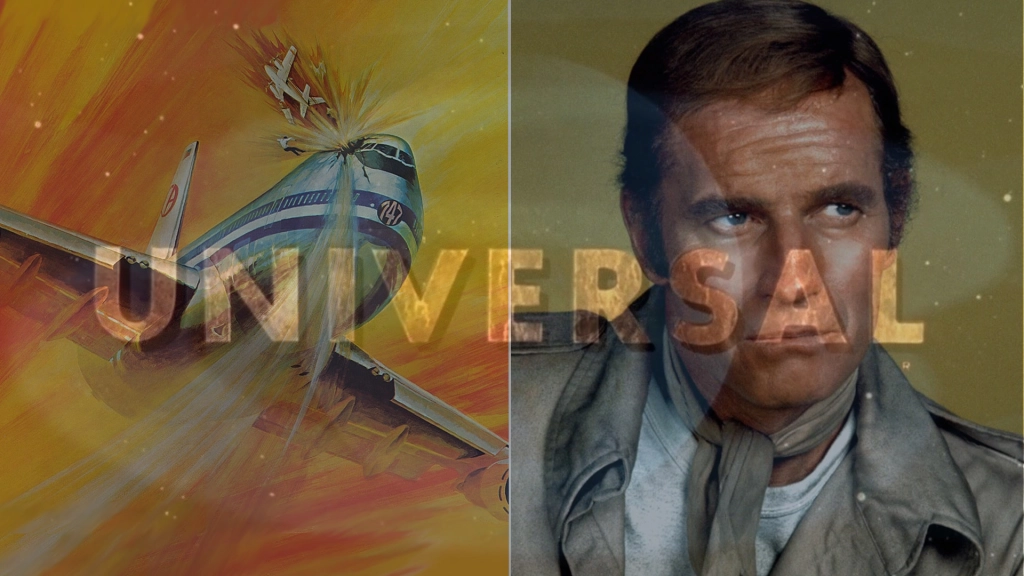
Anyways… just like that 747 carrying Hollywood archetypes in the film, the studio system got smashed into head-on by a small plane that came out of nowhere, incapacitated its pilot crew and left a gash in the cockpit. That small plane? that’s New Hollywood. Piloted by Dennis Hopper, Arthur Penn and Mike Nichols. They smashed into the Studio System Airways jumbo jet and left it drifting on autopilot with limited fuel and slowly losing altitude. Couldn’t they have course corrected and averted disaster? Highly unlikely. Jumbo jets are not built for manoeuvrability. A big studio can’t just make a sudden change of direction. Its colossal corporate structure burdens it intrinsically with incredible inertia, and if it tries to do anything radical, it will stall and fall out of the sky like a massive brick that it is. However, it is after all… a brick with wings. A brick that can fly if you know how to pilot it.
Therefore, what happens in the movie in the aftermath of the tragic collision where a small plane smashes into that jumbo jet also reflects what happened in the wake of New Hollywood arriving on the scene with their grit and palpable determination to pierce the epidermis of societal mores with their dirty little revenge flicks, biker porn and naturalistic procedurals. The studios got their act together and acted on multiple fronts having spent a little time on autopilot, drifting.
On one hand, they put their trust in some of those young up-and-comers by giving them money to do their thing. Look, is this an accident that Karen Black – the same Karen Black who starred opposite Jack Nicholson in Bob Rafelson’s Five Easy Pieces, and who lost her Oscar to Helen Hayes, who won for her stupid little 50s-esque role as the stowaway lady in Airport – becomes a crucial character in the narrative? She’s the flight attendant who takes on the massive responsibility of piloting the barely functioning plane and stabilizing its flight while a legion of pros on the ground scramble to concoct a rescue operation. She’s the reason the jumbo jet doesn’t crash into a mountain. She maintains its air speed, turns it gently from left to right and from right to left.
But she’s not the one to land it.
It is as though the movie itself was telling us that Hollywood studio system had only limited trust in the capabilities of those young guns like Milius and Coppola, who were deemed “good enough” to pilot at altitude but they couldn’t be trusted with landing a jumbo jet and leading an entire corporation with its many thousands on payroll to complete safety in port. The studio system needed to innovate but they could only place enough trust in people who had the necessary track record. People like…
Charlton Heston.
Mister Ben-Hur himself. That incapacitated jumbo jet could not be saved without a professional on board, so Joe Patroni (George Kennedy) and his people figured out they needed to send a pilot into the plane through the hole in the fuselage. So, they sent a jet helicopter into the air, tethered it to the plane and (after wasting one guy who accidentally fell to his death), airdropped Charlton Heston into the cockpit. And as luck would have it, they also decided to commit to the realism ushered by New Hollywood mavericks and filmed a lot of this sequence on location with a real helicopter and a plane… and naturally with a hefty dose of Hollywood movie magic. But it looked real enough to pass the sniff test and looked momentarily indistinguishable from a New Hollywood product (at least in that last act) certified with a Hurricane Billy Friedkin Stamp of Approval.
Point is, Karen Black could only stabilize the plane in flight, but Charlton Heston had to come to the rescue. The Studio System Airways did not see another way out of this bind. They had to catapult a guy into the thick of things who had already piloted a Skyjacked flight and who could be trusted with impossible missions. He was The Omega Man. He solved the Soylent Green riddle. He was the boss, as far as studio bigwigs could tell.
And just like that, the studio system adjusted to the changing times and navigated out of the turbulent New Hollywood catastrophe because it chose to rely on those youngsters to keep things steady while they did what they knew how to do best – which is to deploy Charlton Heston like a Superman Commando Marine Mega-Spy who just swooped in, saved the day and told us, the viewers, we did great, baby.
Charlton’s daredevil rescue mission thus became an instrumental part in buying Hollywood enough time to vet these blood-hungry New-Hollywooders and to make sure their antics could bring in the dough. That’s because by the time the incapacitated 747 in Airport 1975 landed safely close to the top of the box office in 1974, Universal was ready to refuel and set out to make history with Jaws. New Hollywood was about to become Hollywood. And Charlton Heston was finally allowed to relax and stand down because his services were no longer needed.



 Flasz On Film
Leave a comment