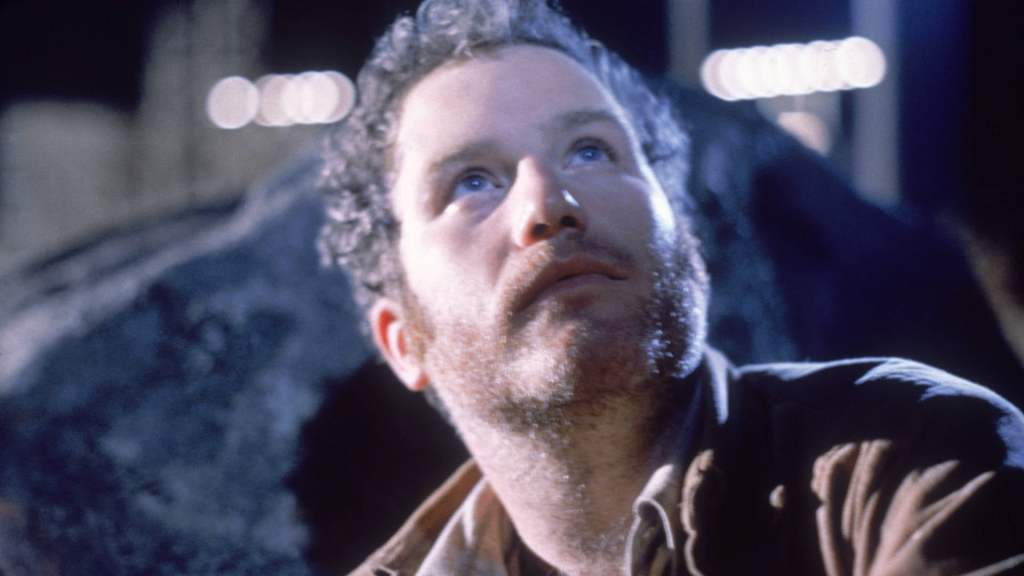
Steven Spielberg is not known as a writer-director. Much of his work was penned by collaborators; however, a select few scripts remain that carry his name after a “written and directed by” credit: The Fabelmans, A.I. – Artificial Intelligence, and Close Encounters of the Third Kind. And Firelight, his amateur debut effort he DIY-ed as a youngster. Well, there’s also the age-old case of Poltergeist, a movie where Spielberg owns the story credit in addition to a screenplay credit, not to mention the contentious subject of whether he effectively sidelined Tobe Hooper on set and directed chunks of the movie himself. I’m not here to prosecute this particular can of worms and there’s plenty of sources to help you with your hand-waving on the subject.
What interests me is not necessarily that Spielberg, a filmmaker with a portfolio counting nearly forty features stretched across seven decades, wrote so few of his movies, but why he wrote the ones that he did. And the simple answer to this question is that they all meant something to him. Some are easier to figure out than others, especially given the fact Spielberg has never been fond of recording audio commentary tracks for his movies, where some personal motivations are often found, and therefore it doesn’t take a genius to connect the dots and see The Fabelmans as his de facto autobiography, or that A.I. resonates at thematic frequencies found often in his other movies.
Now, when it comes to Close Encounters, it is also a bit of an open secret that Spielberg views this movie as incredibly personal and for the longest time the established knowledge surrounding this subject suggested it had a lot to do with a theme of paternal abandonment. In fact, it’s easy for this interpretation to crystallize even upon a single sitting, especially if you keep in mind that Spielberg – not being a writer-director – has always returned to these ideas, be it in War of the Worlds, E.T., Indiana Jones and the Last Crusade or The Kingdom of Crystal Skull. Add to that the themes of wonder, communication, the Pinocchio archetype and you could convince yourself that through Close Encounters of the Third Kind, the filmmaker was working out some deeply seated traumas relating to his familial bonds.
And it’s probably true. In fact, Spielberg corroborates a lot of those thematic assumptions by laying out what essentially is the story of his youth in The Fabelmans. What’s interesting in this respect, at least to me, is that I have always implicitly assumed that Spielberg’s obsession with coming back to the theme of an absentee father epitomized by Roy Neary’s arc in Close Encounters and the fact that the character of E.T. traces back to his memories of developing an imaginary friend after his parents’ divorce, were all tied to his personal yearning for a father-son connection. Again, it’s most likely to be true, especially because we know now just a bit more about how consumed by his work his dad was and that family life in the Spielberg household was – let’s just say – unorthodox.
But The Fabelmans suggests equally that the basis for Roy Neary as a character consumed by a drive to go to the Devil’s Tower and answer what he knew was a call from heavens could have been his mother, whom he painted as a tortured artistic soul trapped in a life of mundanity and domesticated almost against her will. What am I supposed to do with this information now? Which is it? Is Roy Spielberg’s dad? Or is it his mum? Or is it both?
Or… is it neither?
I think it may be possible – if you ever needed any new reasons to give Close Encounters five stars on Letterboxd – that Spielberg has either ingeniously misdirected audiences or that he is a way more nuanced writer than everyone thinks he is. And quite frankly, I’d be happy to assume it is the latter because the more I think about Close Encounters as a multilateral puzzle box capable of holding several functional metaphorical interpretations (some of which enabled only when decoded using The Fabelmans or other pieces Spielberg wrote), the more in awe I am of his screenwriting prowess. You’d be more than excused if you simply agreed that Close Encounters of the Third Kind, in addition to the well-established breadth of thematic interpretations layered upon the movie by many generations of film critics periodically writing opinion pieces about it, particularly when a round anniversary of the film’s release comes around, functions as an outlet for Spielberg’s familial trauma. If anything, it’s a beautifully personal lens to see this movie through, whereby depending on slightly shifting the angle of observation, you’d be able to see both his father and his mother slotting into the character of Roy Neary and where the potato mash mountain functions as either unrealized dreams or an inner call to sacrifice family life for a professional career.
However, that’s not all because this interpretation simply allows you to forget about a handful of seemingly key elements of the movie that should really count for something. And one of them involves the idea of casting Francois Truffaut in one of the lead roles in the film. Look, I’m well aware of how intricate and haphazard moviemaking can be, especially in Hollywood and that there must have been a list of people Spielberg wanted for the role. And I don’t know if Truffaut was at the top of the list. Point is that he is in the film and his mere presence adds another angle to the many ways you can interpret Close Encounters. After all, it’s the only role he played in a movie he did not direct… if you forget an uncredited role as a party guest in Jacques Rivette’s Fool’s Mate. But let’s not let facts get in the way of the narrative we’re building, shall we? It’s still relevant enough to realize that Truffaut didn’t just go out of his way to act in other people’s movies.
But he ended up in this one and I finally understood why he’s there.
Truffaut’s presence in Close Encounters of the Third Kind only begins to make sense when you remove the familial tethers from Roy’s character and instead assume Spielberg sees himself in the character. It’s not his dad or his mum who builds a replica of the Devil’s Tower in the living room. Spielberg is the one doing the compulsive sculpting here. And the reason why I think it’s the case has to do with the simple fact that if you already agree that nothing is what it seems and that everything may carry a symbolic interpretation, then why not extend the same courtesy to the alien visitors? After all, in most cases the extra-terrestrials are seen as just what they are – an external presence willing to whisk Spielberg’s parents away.
However, the entire movie becomes a different beast if you imagine the flying saucers can be allegorically interpreted as a stand-in for Spielberg’s dream to leave his family house and go to Hollywood. They are the embodiment of his desire to make movies and Roy Neary is a de facto avatar for Spielberg himself. In fact, The Fabelmans comes once more to corroborate some of those wild ideas with its insistence on teaching us that what germinated the dream of becoming a filmmaker for Spielberg was that time when his parents took him to see Cecil B. DeMille’s The Greatest Show on Earth and that he was particularly taken aback by the magic of cinema when he witnessed the train crash… so much so that he ended up re-enacting it a number of times at home and filming it on his dad’s Super8 camera.
Now, take this knowledge to Close Encounters and pay attention to what happens in the scene where we meet Roy. Who is playing with trains and re-enacting a crash? Roy is. Not his son. Roy. His son doesn’t care. He’s bored and uninterested in anything his father is up to and it’s Roy who sees magic where everyone else fails to notice anything of worth. Roy is a filmmaker! He is Spielberg. He sees wonder in the world that other people just cannot process, which is exactly why the world has come to embrace Spielberg as one of the most prominent Hollywood filmmakers of our time, perhaps of all time. He has a gift and begins to understand after first encountering aliens – which could in its own way be a stand-in for Spielberg’s seminal viewing of The Greatest Show on Earth – that he has now been put on a mission. He must follow the call he constantly hears in his head and see where it takes him. He doesn’t know why and how, but he’s going to meet those Hollywood aliens and make some great movies.
Which is where Truffaut comes back into the picture. Tell me: what is he? What’s his role in the movie? Is he here just because he was available and because Depardieu and others turned Spielberg down? I choose to believe Truffaut is in this movie for a reason and this is because he fits perfectly as a key to interpreting Close Encounters as a fully functional allegory for Spielberg following his dream of becoming a Hollywood director.
Spielberg chose to cast Truffaut as a UFO expert Lacombe because UFOs are movies. And Truffaut – a maverick pioneer of the French New Wave – speaks the language of cinema like nobody else. His role in the film, externalized by a mission to understand the way humans ought to communicate with aliens, is to become Spielberg’s guide to following his dreams of becoming a filmmaker. In a way Truffaut is who gives Spielberg permission to become a film director, which is illustrated in the very finale of the film where Roy and Lacombe stand shoulder to shoulder and, having understood that Roy is going to join the extra-terrestrials on a journey to Christ-only-knows-where, Lacombe utters that he envies him.
In an emotionally complicated way, this little statement is enough to convince me that the scene and even the whole film stands as equivalent to a tender moment between Spielberg and Truffaut, two auteurs hailing from different generations. And in this fleeting moment, Truffaut gives Spielberg his blessing. The man who decodes the language of aliens – the language of cinema, that is – gives young Spielberg a nod of approval and tells him to go on into the great unknown to discover and cherish the wonders of the magical world of filmmaking.
And once you agree that this is what is happening in this moment of grandeur and awe, you will also be permitted to look back upon the preceding two hours of running time and reinterpret all the imagery you may have decided to take on face value. Suddenly, the sequence on the road with a guy whistling a western-esque tune will look as though it was purposefully staged like a movie from the 50s. The missing planes and ships cropping up all over the world will look like items of nostalgia coming back to the forefront of our collective consciousness. The scene where Roy climbs the Devil’s Tower will resemble the final act of Lonely Are the Brave. It will all make sense once you understand that Close Encounters of the Third Kind is a movie about movies and it could have been retitled – clunky as it would be nonetheless – as Close Encounters of the Third Kind… with Cinema.


 Flasz On Film
Leave a comment