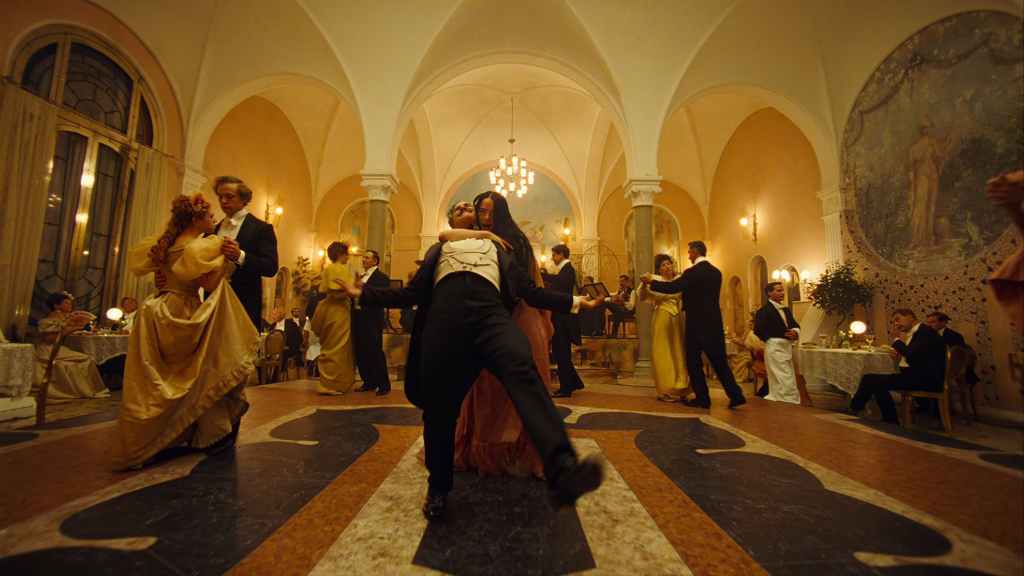

I don’t think Yorgos Lanthimos has ever directed a “normal” movie. Even his biopic-adjacent The Favourite about the life and kink-laden weirdness of Queen Anne wasn’t exactly something you’d be keen to take your nan to see. Therefore, any time Lanthimos steps behind the camera, you can easily expect an experience you’d have to engage with using parts of your brain designed to excel at other things.
Which is where Lanthimos hears this exact thought and takes it as a personal challenge to out-weirdo himself in his own weirdom to become the world champion of being a weirdo close enough to the cinematic mainstream that you just have to take him seriously. Hence, he comes along with what looks like a little bit of an iconoclastic fairy tale but smells profoundly of sexual politics and gender dynamics… again.
In a way, you could take a holistic look at Lanthimos’ work and peg his output as thoroughly entrenched in a single vision explored from a multitude of angles and with a variety of textures, but I think it’d undersell its remarkable genius in many ways. That’s because there’s simply nothing like it out there. On one hand Gilliam-esque, on other Kubrickian and on other yet Buñuelian, Lanthimos’ style and storytelling are probably best defined as elusive yet somehow concrete, but with a tinge of eyebrow-raising raunchiness that would make the viewer say “oh my” while forcing other filmmakers to adopt a cognitively dissonant stance of desperately wanting to dabble with what Lanthimos is taking full body baths in and simultaneously muttering under their noses that they wouldn’t want to be him when the world of Film Twitter decides whatever it is he’s currently engaged in crosses the line.
Deep breath.
That’s more or less where you ought to find yourself while watching Poor Things, a state of utter discombobulation because what unfolds in front of your eyes is equally weird as it is intriguing, iconoclastic and dangerously provocative… while also being somehow accessible to the masses. Lanthimos invites us into his world using the subtle perfume of familiarity as the movie opens with a handful of distinct nods to Mary Shelley’s Frankenstein. We are introduced to an eccentric (which is a fancy word for weirdo) Doctor Godwin Baxter, God for short, played by Willem Dafoe, whose field of expertise lies in exploring the fringes of human anatomy and dancing a cha-cha on the thin line between what nature intended to exist and what it said “no, thank you” to. This is to mean that God experiments with hybridizing species (his house is a roaming enclosure for a good handful of chicken-pigs, goose-dogs and other abominations), as well as with the many peculiarities of the human body. And one of his most intricate experiments as it turns out involves a young woman who… is her own daughter (Emma Stone), and whom he once found in the Thames, pregnant and dead after a tragic suicide attempt. Thus, he did what you’d expect. Which is to mean he removed the barely living foetus from the dead woman’s body, as you do, opened the woman’s skull and following the removal of her dead brain he inserted the underdeveloped foetal mind of her would-be child in there, zapped her into life and – voilà! Again… as you do, Godwin Baxter created life where life should not be created, all under the curious eye of his student (Ramy Youssef), who also serves as our conduit to the story. At least for a little while.
That is because before we can honestly appraise the festival of oddities that encompasses the Baxter residence – and it is additionally festooned with Lanthimos’ bewilderingly wide fisheye pans, Willem Dafoe’s Wesandersonian quirks and a general atmosphere of what I can only describe as a Gilliam-meets-Jeunet frenzied density – we are allowed to disenshoulder from the student’s back and attach ourselves to Bella, a child trapped in the reanimated body of a suicide victim, who learns how to walk, talk and function only minutes before she discovers masturbation and sex. Which leads her onto a sex-capade together with Mark Ruffalo, who’s in top form as another Wesandersonian carnival of quirkitude, a symbolic embodiment of a fragile male ego propelled by animalistic urges and often hamstrung by his own potty mouth. Or something.
Thus, this Frankenstein on crack becomes a journey of a Frankenstein’s monster on ecstasy, where settings change like surrealist dioramas and thematic underpinnings swap over like professional wrestlers in a tag team match. And it all somehow makes sense because Lanthimos – again, somehow, perhaps against all odds – keeps his marbles together and delivers a spectacular examination of what he knows best – sex, gender, and class, where nothing makes sense until everything makes sense. But then again, the point where everything starts to make sense might not necessarily arrive during the screening but a few days later. In fact, it took me a little while to rationalize whatever it was I thought I could rationalize about this movie, and I still remain unconvinced that I perhaps got everything right.
Not because the movie is hard to decode or awash in impenetrable symbolism – no. It’s just dense. Dense and frenetic. And discombobulating. And weird. That’s it. Stick that on the Blu-Ray cover if you please – Poor Things is dense, frenetic, discombobulating and weird. Which is where Lanthimos peers from behind the camera and just shrugs his shoulders because as far as he is concerned, I may have just described him as a person. Which is totally OK. But the point I’m trying to make is that for all its density and idiosyncratic busyness, Poor Things stays miles away from pretentiousness that often mars similarly audacious efforts. Lanthimos’ brand of crazy is just… somehow… accessible.
And I honestly don’t know why that is.
There is something magical about how this movie skims the cream off the top of what Terry Gilliam, Luis Buñuel, Wes Anderson, Roy Andersson, Charlie Kaufman or Michel Gondry would typically engage in and converts this veritable distillate of a bona fide gallery of weirdoism into a cinematic perpetuum mobile with a ferocious bite, a sailor’s mouth and a brain of a stand-up comedian high off his rocker on cocaine. It’s an onslaught. But it’s one of a kind that compels instead of alienating. Contrary to some of Lanthimos’s other works (like Alps or Kinetta) that truly require a lot of involvement and goodwill from the viewer to fine-tune their frequency close enough to resonate with the filmmaker, Poor Things just rocks. And I don’t know if it’s me – the viewer – or if it’s the filmmaker who found a way to make his weirdismo catchy and melodic.
Point stands that it does. Poor Things is perhaps the movie of this past year and had I had the chance to see it in time, it would have messed with my end-of-year rankings. For some reason, some directors make it pleasurable to watch them get high on their own farts and Lanthimos is one such specimen. Like Babylon and Beau Is Afraid were in recent past (although admittedly, at least one of the two is, comparatively speaking, a film equivalent of a normie in a Halloween costume), Poor Things is a textbook example of an utterly self-indulgent movie that not only works, but cooks on all burners. With a broiler on and the oven set to screaming hot. It’s colorful where it needs to be, damp where appropriate, clinical and cutting in other places and completely out of whack elsewhere. It’s a wholly engrossing experience capable of convincing you that certain shades of madness might look great on you and in fact they might as well go well with your shoes.
And Emma Stone? Oscar material. Please and thank you.






Leave a comment