
It doesn’t take much to broadly understand Sofia Coppola’s filmmaking portfolio and where she derives her inspiration from. While her focus can be broadly described as one aimed at womanhood, it’s much more than that. I don’t think I’ll be too provocative if I stated that Coppola’s work is for the most part permeated with semiautobiographical themes because she is uniquely placed to offer a perspective on the world you’d struggle to find elsewhere.
Through her movies you can see what it’s like to see Hollywood with its glitz and glamour surgically removed. You can feel what it must be like to grow up with stars as your parents (Somewhere) or loved ones (Lost in Translation), or how deluded the people entranced with celebrity might get (The Bling Ring). You’ll also find out what she feels about the idea of going through life as a mature woman dealing with her privileged upbringing (On the Rocks). Coppola’s lens is a unique window into the kind of life most of us only know from gossip magazines and TV screens, where it is already pre-filtered, jazzed up and warped to sell a narrative of stardom and fairytale perfection. Her perspective brings immense humanity and emotionally laden realism to describe this world as she sees it and knows it, as opposed to how this world would like to be seen, or how we’d like to believe it is.
Therefore, I think Coppola is – again – singularly placed to find kinship with certain real-life figures whom we know mostly through association with either other historical figures or events. That’s how I have always interpreted Coppola’s Marie Antoinette, which is arguably one of her movies most viewers either misunderstand or completely miss the point of; as I strongly believe Coppola instinctively knows and organically accepts some elements of this woman’s tragic life as a princess-turned-queen-turned-symbol-of-rabid-opulence-turned-sacrificial-lamb. She is surely fascinated by how this monarch’s story resonates with her and through her work – and thanks to her unique sensibilities – she can convey what it feels like to inhabit the headspace of such an enigmatic character often ostensibly reduced to just a handful of traits to fit under her visage in a history textbook. Coppola breathes life into history with her anachronistic needle drops and a truly personal approach to depicting the life of someone like the Queen of France.
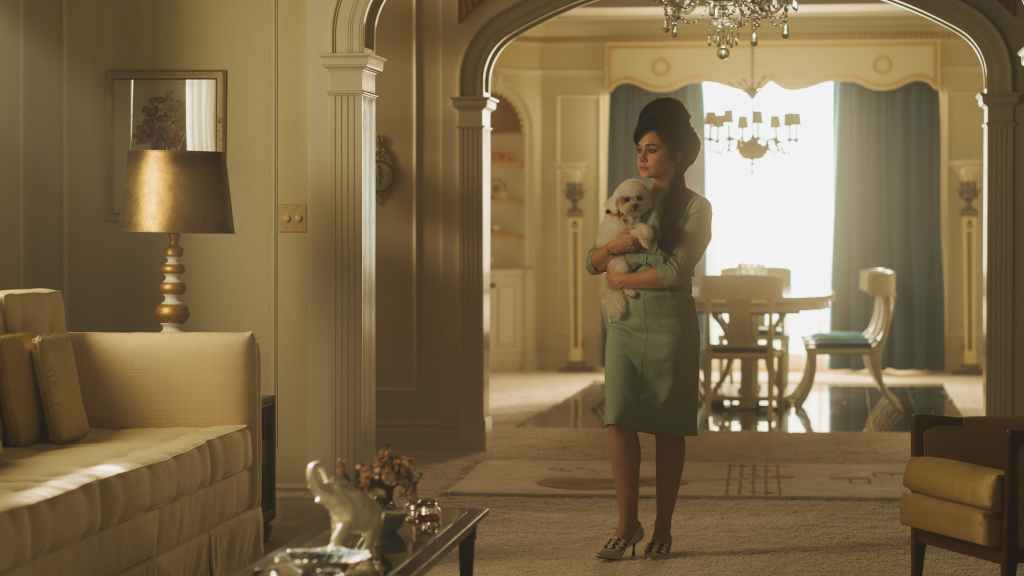
Which is what she comes back to do once more but for a different kind of royalty in her latest film Priscilla, where she points the camera at Priscilla Presley (Cailee Spaeny), the wife of the King of Rock and Roll himself, Elvis Presley (here played by Jacob Elordi who seems to be in everything nowadays). Again, like Marie Antoinette, this isn’t exactly a strict biopic because, first and foremost, the filmmaker doesn’t seem interested in just telling us the story of how this schoolgirl ended up in Graceland as the wife to the biggest musical act in the history of everything ever. Instead, Coppola’s movie places its focus on the subjective interpretation of what it was like to be that teenager stranded in West Germany in the immediate vicinity of where Elvis was stationed during his tour of duty, and – subjectively speaking – what it meant for Priscilla to fall in love with a man much older than her, or have that man become an incredibly forceful presence in her young life, so much that it clearly breached the social norms as we define them today.
However, I’m not exactly convinced Coppola, who worked closely with Priscilla Presley upon whose memoirs this movie is based, was gunning to use this movie as a pretext to go after the culture of widespread grooming well entrenched in the world of celebrity. She’s after something more nuanced because I believe her story accepts this as a factual element of Priscilla’s life, focusing on which would perhaps detract from what she’d like you to find out more about. Her idea of Priscilla isn’t half the moral lightning rod it could have been in anybody else’s hands, and instead it is a subtle piece about two central ideas that seemed to pervade Priscilla’s life – loneliness and an intoxicating desire to be loved.
I think this is where you truly need to park your own personal convictions on the matter of the age difference between Priscilla and Elvis and whether or not it was appropriate for them to even meet under any circumstances in the first place. Which it wasn’t. But it happened. However, the movie is definitely interested in looking past the obvious moral lashing Elvis’ conduct clearly deserved, and shows us the story from the point of view of someone who ended up seduced by the image of a star and found herself – like Marie Antoinette – alone at the top of the world.
Thus, the movie sends us on a journey together with Priscilla as we enter her headspace to explore both what her life was like and, most crucially, how it made her feel (thus becoming a de facto companion piece to Spencer). This is what Coppola is particularly skilled at because she has the unique capability to capture the realism of what she’s filming while elevating it ever so slightly to allow the viewer to enter the character’s mind in a profound and meaningful way. Therefore, Priscilla becomes a singular opportunity to embody this character for a little while, see the world through her eyes, and perhaps – if you’re keen enough to try – attempt to grasp why this particular filmmaker seems to have such a great connection with this young woman essentially imprisoned in an ivory tower by a possessive Prince Charming.
This de facto modern-day dark fairytale – although perhaps unique to Priscilla’s life experience, which is simply like none other – might find resonances with some people because the kind of life she had at Graceland may vaguely resemble the life of anyone born into extreme wealth or whose immediate family members are internationally recognized celebrities. If you tilt your head just ever so slightly, you might see that it is not unlikely for Sofia Coppola to see herself a little bit in Priscilla’s experiences, which is particularly visible in certain scenes, such as those involving having to live in a house which is always full of people she barely recognizes, having to listen to gossip and cruel comments right behind her back, or having little to no degrees of freedom when it comes to even accomplishing such simple and mundane tasks as walking the dog… because the paparazzi might see her through the fence.
Is Coppola’s view of Priscila semiautobiographical? I believe so, but not in the obvious way. You simply cannot fake certain elements of tone that probably weren’t on the page of the script. You must instinctively know just where exactly to position the camera in the house to give you, the viewer, a feeling of strangling isolation in a place that’s as cavernous as Graceland must have been. I think this unique perspective brought to the table by a filmmaker whose life experiences may be locally symmetrical or partially resonant with those of the central character makes Priscilla a work of “meta-semiautobiographical” historical fiction.
Following from there, Coppola may also be positioned to tell us all – as she has done already in nearly all of her films – about the side of celebrity rarely experienced by us normies. She’s talked about the boredom of living the high life of a Hollywood superstar. She’s described the depression of being always away from home. She’s depicted the rabid vapidity of living on the outskirts of the Dream Factory. And here she is giving us a living example of how a young and impressionable mind is moulded and manipulated with ease by forces beyond anyone’s control. In that, Coppola rides the line perfectly in avoiding her movie becoming this generation’s Star 80, but she nonetheless makes us all sit up and take note of just how easy it is to fall into the trap set by the twinkling lights of Hollywood. The glitz and glamour of celebrity is often accompanied by a siren song and immense scent of some magical Hollywood pheromones capable of completely overcoming one’s decision-making abilities and drawing them in like moths to a flame.
Suffice it to say, Coppola’s Priscilla is yet another standup piece of filmmaking that effortlessly captures the complexities of her central character and uses it to tell us something about the kind of life the filmmaker at least partially understands. This moody and measured exercise in subjective emotionally charged realism filtered through a lens of distinct yet barely noticeable personal experience shows once more – if you needed any more proof, that is – just how proficient Sofia Coppola is at relaying life as she knows and sees it to us. And in doing so, she also manages to reframe a historical figure and imbue her life story with an angle you just won’t find anywhere else.

 Flasz On Film
Leave a comment