
Rumaan Alam’s Leave the World Behind was picked up by Netflix shortly before its publication in October 2020. Now, I don’t know when Alam wrote it exactly, but it was a timely enough text that fed well into the pandemic-addled paranoiac state we were all in, even though I am reasonably sure the author’s goals were a bit more ambitious than that. Therefore, it made a lot of sense to channel these anxieties into the language of film and I was seriously intrigued by the notion of trying to translate the nuance of what the book was trying to get at into something accessible.
Unfortunately, movies take a while to get made and our collective memory – such as it is – might be sufficiently disconnected from the post-COVID woes to effectively misdirect you as you sit down to watch this movie and make you fail to realize that Leave the World Behind is best watched as though you did so at the tail end of 2020, rather than now… which, judging by how poorly received it has been, is not something the viewers are prepared, willing or able to do. Or maybe it’s because the world has a bone to pick up with Sam Esmail and I just don’t know why because I have never seen a single episode of Mr. Robot or Homecoming.
Nevertheless, I was immensely curious as to how Esmail (who adapted Alam’s book for the screen) would handle a vaguely non-descript narrative construct that doesn’t tether itself into any form of recognizable reality, yet which is still intimately connected to the milieu of the time when it was written. I suppose, most of the novel was left unchanged (with a handful of exceptions here and there, none of which truly departing from the original text) and it still recounts one fateful weekend where a well-to-do middle-class (aspiring to be counted as upper-middle-class) Sandford family – Amanda (Julia Roberts), Clay (Ethan Hawke) and their two kids Archie (Charlie Evans) and Rose (Farrah Mackenzie) – depart their leafy New York apartment for a weekend in the middle of nowhere in Long Island. You know, too… leave the world behind, so to speak.
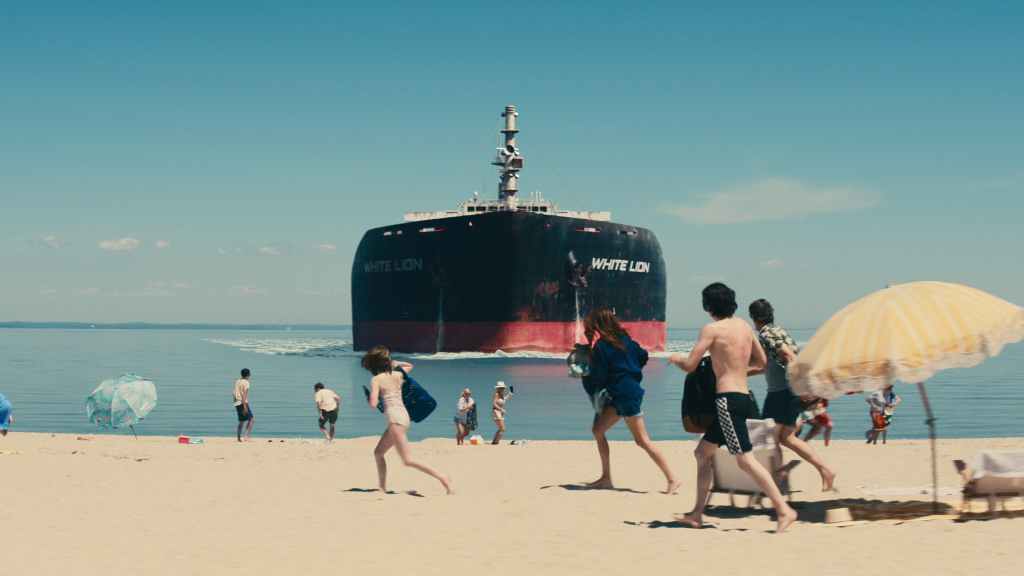
However, while they’re away, something happens. They don’t know what. You don’t know what. But there are signs. Internet disappears. Phone coverage drops dead. Weird noises are heard in the distance. A tanker gets stranded on the beach for no good reason. And in the middle of all this chaos fuelled by anxiety of not knowing what is going on, our protagonist family is visited upon by a pair of uninvited guests, G.H. Scott (Mahershala Ali) and his daughter Ruth (Myha’la), who claim to be the owners of the house. This immediately sets up a scenario most film critics will be familiar with and suggests that what Leave the World Behind is going to be is some kind of a play on Michael Haneke’s Funny Games. Which is a fair assessment to make based on the initial conditions of the predicament, but which also happens to be completely wrong.
If anything, I’d recalibrate my film-critic lens and compare this movie – perhaps provocatively, as some would say – to M. Night Shyamalan’s The Happening. After all, neither Alam nor Esmail seemed interested enough in attaching themselves to the themes Haneke explored in his movie (twice over even). Leave the World Behind isn’t quite the study on how the rich get their comeuppance and how they must find out that wealth can only provide limited protection from the evils of the outside world. They weren’t keen to study how media desensitize us to ever-present violence and I can only expect an unprepared mind to make such a mistake. It’s a red herring.
What propels this movie are the themes of alienation and mistrust, which only brush shoulders with the kind of stuff a Haneke enthusiast would pick out of the crowd. We’re not here to partake in the public torture execution of the characters the filmmaker and author so lovingly put together. We’re not here to revel in their misery. We’re here to empathize with it much more profoundly and it is completely up to the viewer to make necessary choices in this regard. After all, it is your decision as to how to interpret the undercurrent of racially charged mistrust between the Scotts and the Sandfords. I think you are obliged to take note of these subtle remarks, broad assumptions and micro-aggressions. However, it is also your responsibility to ask why they’re there and what the filmmaker is trying to do with them. Sure, maybe the film falters in fully fleshing out its convictions, because you do have to pay attention in many places to make sure you wouldn’t wholly dismiss the film on the basis of what you might think is vapid signalling aimed to take broad swipes at the current cultural polarization of the American society. And I must admit that Esmail occasionally fails to enable you in this regard because he tends to draw attention away from the characters with his swirling camera moves and other examples of visual showboating, only a fraction of which is anything more than a distraction.
But if you refuse to get angry at what you identify as uninspired pieces of snooty political preacherism and read into what you see a tiny bit, you will see what Leave the World Behind is all about and where its beating heart is. Admittedly, the book did a much better job of that, especially with how it ends without necessarily leaving you with so much to figure out, but the movie doesn’t ruin it either. Esmail’s adaptation is simply partially overshadowed by the filmmaker’s own attempt at putting his directorial choices in the line of sight between you and the story, but you can still lean to one side, turn a blind eye to all those flashes of flair and see that race, politics and class are just parts of a bigger picture, which carries its own distinct message fit for the times of the pandemic, which is when the story was likely written.
Thus, Leave the World Behind explores semi-allegorically the anxiety and alienation of what we all went through in the early days of 2020, when an invisible calamity descended upon us and we were denied contact with the outside world. We were all asked to revert to our own little bubbles and our lizard brains received survival instructions. Even the movie alone refers to this notion in one particular scene where a tanker heads towards a violent clash with the beach the protagonists were sunbathing on together with other holidaymakers. It’s a pandemic moment! A massive object is heading towards the characters and all they do is squabble and make jokes until it’s too close for comfort. The ship is COVID and what everyone does is a microcosm of what happened in 2020. Therefore, this entire film is to be filtered through a post-COVID lens to get the most out of it.
Between the undercurrent of mistrust, misinformation fed to both the characters and the viewers from all directions and the innate desires to escape the reality of what’s happening (this is what Friends are for in here, not just to capitalize on your or the storytellers’ nostalgia for the 90s or to troll you with a potentially memeable moment), this movie provides an illuminating illustration of what happens on a human level when a tragedy like a global pandemic, a sudden outbreak of war or a political coup unfolds just outside of the periphery of our vision. It’s not about figuring out what happened let alone solving the problem or saving the world. It’s about families surviving and learning to embrace one another because at the end of the day, it’s all we have. All we have is each other.
That’s what I’m taking out of this movie, which is – once you apply such an interpretation – a classed-up play on M. Night Shyamalan, not Haneke. It’s a more literary and less exploitative version of The Happening, a movie which by the way I think was unnecessarily derided at the time it was released. Granted, it was hard to love and it took me years to learn how to get the most out of it, but I got there. Ironically, Leave the World Behind is likely to suffer from that Shyamalan-esque curse because the movie hides its intentions underneath a few inches of impenetrable style and trusts the viewer would see what the filmmakers think is out there on display.
Maybe it isn’t. Or maybe we aren’t ready to have this conversation yet, so we choose to misinterpret the ending when Rose finds a house in the wilderness and starts watching the final episode of Friends she so desperately wanted to see before the world went to hell. Or maybe we’re in denial about all of it. Or maybe… our TikTok brains have been rendered unable to process the depth of thought that surely went into this movie. Or maybe it hits all too close to home because – like Clay – we are also useless people without Internet, as we surrendered our agency to external cultural forces and we just don’t appreciate having a mirror stuck in front of our noses. You tell me.
All I will tell you is that Leave the World Behind is not deserving of the derision it has received. It’s a thinking man’s The Happening made for the post-pandemic world where a keen and prepared viewer will likely find themes and ideas resonating with their own recollections of what it was like to be housebound, denied assurances from the top, bombarded with misinformation from all directions and threatened not only by unfathomable invisible forces lurking outside, but by other people some of whom living in our own houses. And it is a reminder that should another crisis unfold – and it will, perhaps even in our lifetimes – we ought to remember that underneath our skin colour, political affiliations and our social stature we share the same humanity that needs to be embraced and cherished.



 Flasz On Film
Leave a comment