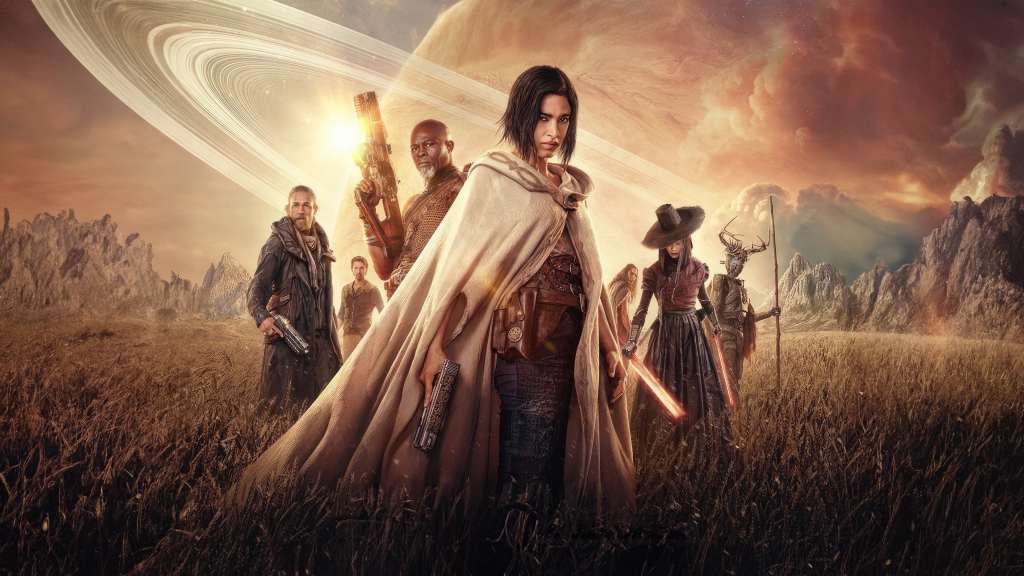

Love him or hate him, Zack Snyder’s movies are – at least as far as iconography and the visual aesthetic are concerned – unmistakably his. Rebel Moon or, as I suppose it is officially called, Rebel Moon – Part One: A Child of Fire (it’s 2023 and the use of both a colon and a dash in a title is apparently perfectly acceptable, it seems) is not an exception in this regard either. In fact, it is perhaps an interesting case study for anyone wishing to understand this “vulgar auteur” a bit better because, as we probably all know, this movie is his idea of what Star Wars is.
To be perfectly honest, Rebel Moon did in fact originate as successful pitch Snyder made to Lucasfilm right around the time the company was acquired by The House of Mouse. His idea was to tell an original – read as not tethered to the Skywalker Saga – story set in a galaxy far, far away, but aim it fully at mature audiences; which at the time would have been a considerable departure from the norm… because the Lucas-directed prequels flanked by accompanying animated TV shows were most definitely aimed at younger viewers. However, one thing led to another and Snyder’s mature idea for a Star Wars was shown the door.
This is where Netflix came along, known at this point for letting auteurs do whatever the hell they please with minimal oversight, and it just so happened they had a lot of money to burn. And now it’s almost Christmas and Zack Snyder’s Rebel Moon Part One is out ready to be consumed… and as the critical consensus seems to indicate, it is also ready to be torn to shreds on the back of its many directorial indulgences and the fact that many viewers have accused this movie of blatantly attempting to rip off Star Wars. And it’s only partially true.
Look, there’s no debate that Rebel Moon and Star Wars are incredibly alike and by sheer virtue of the fact that Zack Snyder must have grown up watching those movies is enough to have influenced the way this movie came together. Even glancing at the plot synopsis alone will inform a moderately astute observer about the many similarities between what’s going on in this film and how the eponymous Skywalker saga was set up by George Lucas back in the day. We have an evil galactic empire resplendent with a medley of visual connotations evoking the Roman Empire, Nazi Germany and even the USA (here named The Motherworld), a Vader-esque sociopathic villain Atticus Noble (Ed Skrein), and his occasionally mentioned boss Balisarius (Fra Fee), whom we could read as a stand-in for the emperor himself. We are then introduced to a girl named Kora (Sofia Boutella) who lives in a community of farmers somewhere in the arse end of nowhere and who sets out on a mission to save her village after Noble and his army promises to plunder it and raze it to the ground.
Thus, Kora must find a group of allies willing to stand up to The Motherworld and her archetypal hero’s journey begins. Which is where you’d be excused to think she is a bit of an ersatz Luke Skywalker. Which, again, is only partially true because I don’t necessarily believe Snyder and his co-writers (Kurt Johnstad and Shay Hatten) were openly attempting to rip off George Lucas and make it a bit bloodier and more stylized. Well, they kind of did, but I’d be willing to venture a guess that it is because they weren’t as interested in taking inspiration from Star Wars itself as they were interested in deconstructing how Star Wars was made in the first place.
It is common knowledge at this point that Lucas’s lightning in a bottle was a conglomeration of inspirations drawn from 1930s serials, westerns, war films (those cockpit shots alone give it away, don’t they?) and – crucially – Akira Kurosawa’s work. I think Zack Snyder, as he was developing Rebel Moon, was never openly looking at Star Wars as a primary source of inspiration, but he rather looked through it and devised a recipe George Lucas may have used to assemble his iconic culture-defining masterpiece. Like a skilled chef trying to deconstruct a complete dish into a list of ingredients, Snyder did just that. He knew it was key to draw from Kurosawa, Sergio Leone and John Ford. He figured out the key archetypes and – lo and behold – the rudimentary recipe for a Star Wars-esque space opera was more or less in place.
However, simply identifying all ingredients is not enough to replicate what came before because the relative amounts of those ingredients and the seasoning regime are what truly makes a dish come together and, importantly, where chef’s personality will come through. Zack Snyder took the list of ingredients to make a Star Wars movie and used his own judgment and style to turn them into something he felt was appropriate. In fact, he was heavily guided by Kurosawa’s Seven Samurai, whose narrative structure serves as a backbone to Rebel Moon. It is as though he instinctively knew that Kurosawa inspiration was akin to a foundational stock used in the recipe, so he deferred to a well-described sub-recipe for such a stock and essentially appropriated the veritable classic of cinema for the use in his dish/movie. He then seasoned everything with his signature visual aesthetic and here we are.
Therefore, Rebel Moon is merely an accidental rip-off of Star Wars because it is made to replicate the process Star Wars was made using. It’s a space opera mixing samurai and western elements anchored around the narrative framework taken from Seven Samurai. Now, it is inescapable that Snyder and his collaborators knowingly deployed those many pieces of symmetry between their work and Star Wars, but I choose to see it as more of a coincidence than a result of conscious copycat work. You can’t have a western without a saloon sequence. And a space opera version of such a sequence will look like the cantina scene in Star Wars. You can’t have a samurai movie without a showdown either.
All these elements, reimagined, remixed, mashed up and refiltered through Snyder-esque iconography complete with its washed out colour palette, frequently deployed elements of slow-motion and speed ramping, choral music and more, make Rebel Moon look as though it was both immensely unoriginal and somehow fresh because nobody since Roger Corman’s Battle Beyond the Stars had the audacity to come close this close to Star Wars and intend to get away with it. Moreover, Snyder knowingly infused his movie with even more references to the post-Star Wars universe of space opera and high fantasy, further complicating the collage he was building with nods to Krull, Willow and others. On this level, it is an honestly interesting piece of filmmaking to look at.
That is, if you can stomach Snyder’s indulgences with which Rebel Moon is brimming unapologetically. As I said at the top of this whatever-this-is-because-I-can-hardly-call-it-a-review, it is perhaps silly to walk into a Zack Snyder movie expecting anything but a Zack Snyder movie. You just know it will be heightened, elevated and indulgent in too many places. You can surely expect it will look like 300, Watchmen and Justice League. Why would you even think it would look like anything else? He’s never been known for exploring far outside of his comfort zones, let alone for killing his darlings. He’s to the Wachowskis what Michael Bay is to Tony Scott: a brazen, on-the-nose and stylistically indulgent filmmaker and you are well within your rights to dislike what he produces.
A bit like marmite – your choice with Snyder is binary. You can love him or hate him. Overall, I think I am pro-marmite when it comes to this man’s work. Even his weaker efforts I find weirdly watchable and fun to deconstruct. I don’t mind too much his visual heavy-handedness and occasionally, his lack of subtlety comes across as refreshing. Therefore, I don’t mind that Atticus Noble looks like an SS officer, or that his soldiers look like the US Army deployed in Iraq. His “dieselpunk” iconography filtered into a western setting is also something quite intriguing, especially when juxtaposed with aesthetic elements transplanted from ancient Rome. It’s fun.
What I do have a problem with is the fact those many Snyder-esque indulgences like insistence on slowing everything down every minute to enable some truly striking imagery to be projected on the screen don’t necessarily gel very well with a narrative reliant on so much backstory and exposition. Hence, Rebel Moon occasionally slows down to a crawl, completely unnecessarily. Maybe Snyder should have revised the recipe he identified after dissecting the body of inspiration George Lucas was using in the 70s because – contrary to what many would like to think – Star Wars was completely unburdened by exposition. It was an ingeniously simple movie that – again, contrary to what even Lucas would come to claim – didn’t aspire to become a series.
Meanwhile, Rebel Moon knows it could become a franchise starter. It is perfectly aware it must set up a world, build a lore and introduce extratextual depth to the proceedings. Therefore, we do have to sit through a lot of name-dropping and maybe you’d be occasionally excused if your attention drifts during at least one or two conversations about assassins, generals, and magical princesses. You probably won’t remember a single planet, or a moon mentioned in the film. This is all just ballast I could do away with and the movie would be just as understandable, if not a bit more propulsive.
But this isn’t the world we live in and Rebel Moon isn’t just Rebel Moon. It’s Rebel Moon (dash) Part One (colon) A Child of Fire, so even the title alone will inform you that the storytelling and the worldbuilding deployed in creating this movie will display symptoms of bloat. It’s par for the course at this point and I can only imagine that any film attempting to tell an original story within the parameters of a space opera, fantasy or even more grounded science fiction (vide The Creator) will likely fall prey to the desire to frontload its worldbuilding because – if successful – a whole series would be nicely set up for development.
So, the verdict is that Rebel Moon is what I could imagine Star Wars could be if we lived in a world where Star Wars didn’t exist. It’s an archetypal deployment of a Kurosawa story with elements of spaghetti western, all packaged into exactly what you’d expect out of a Zack Snyder movie. It’s operatic, dense and indulgent. So, if you’re not into this kind of moviemaking, you’re best advised to steer clear. But anyone who likes this stuff will have a field day. As long as they don’t mind the exposition dumps wedged in between moments of visual grandeur rarely found in big budget blockbuster filmmaking these days.

 Flasz On Film
Leave a comment