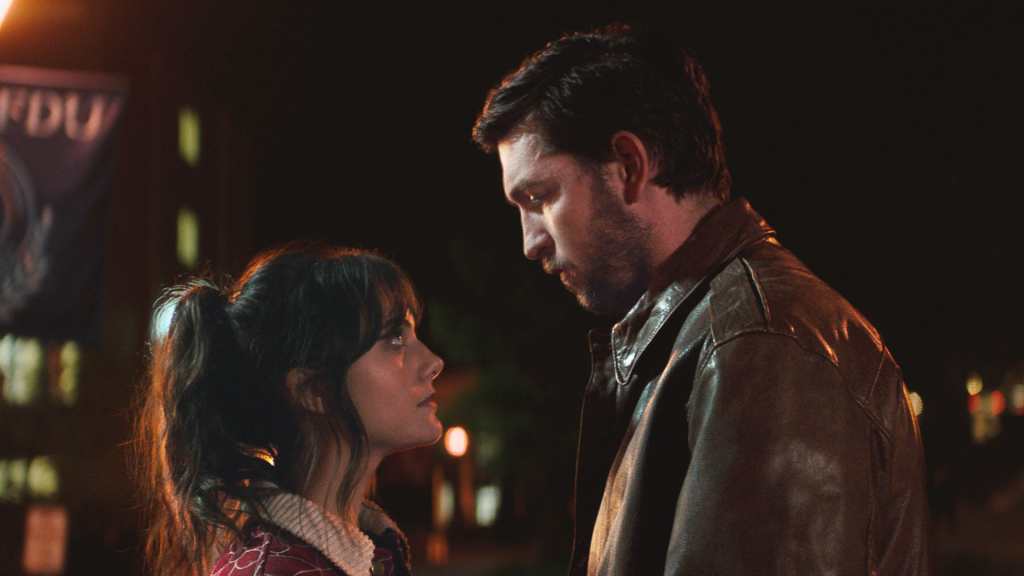

The narrative set-up of Cat Person, Susanna Fogel’s follow-up to Booksmart, suggests a canonical love story. We meet Margot (Emilia Jones), a university student who works evenings at a local repertory cinema, as she is awkwardly approached by Robert, a patron (Nicholas Braun) who looks as though he had clearly been working up the courage to talk to her for a long while. They exchange numbers and the story would typically go from there to establish a budding relationship, introduce an obstacle for the pair to overcome, they would fall out of love briefly and everything would eventually come together in a Cameron Crowe crescendo (Crowe-scendo?) where we’d find out he had her at ‘hello’ or something.
Problem is, we are not in the nineties anymore, Dorothy. We’re in the twenty-twenties where people don’t just ask other people out willy-nilly. They use hookup apps. They don’t talk to each other, but text. Men and women have retreated to their increasingly insular tribes and proceeded to treat the opposite sex with suspicion and fear. So, how exactly are you supposed to stage a love story in a world so eminently divorced from the fairy tale image found in those rom coms you most likely don’t even know exist anymore because nobody ever scrolls this far down through the Netflix library? How does a love story function in a reality of Tinder, Snapchat, TikTok, Reddit, Hashtag-Me-Too, Red Pill, porn addiction and everything else adding up to an effective tribal warfare between the sexes?
You don’t. Because why would you? After all, young adults are sick and tired of Hollywood-ending-escapism served by mass media and having wool pulled over their eyes. They are smart enough to notice the chasm between what movies show you and what real life looks like. They are all disillusioned like Minnie in Minnie and Moskowitz who knew perfectly that ‘movies set you up’. Therefore, Margot isn’t a happy-go-lucky Cinderella waiting for Prince Charming to sweep her off her feet. She probably holds her keys in between her fingers like Wolverine claws when she goes home alone at night, because becoming a victim of sexual assault is not an irrational fear of hers, but a genuine risk with a non-zero probability.
This is a world in which the filmmakers set their story. In fact, they go further and set it almost completely in Margot’s headspace, as though to reflect the ceaseless anxiety permeating this young woman’s everyday life. Thus, Cat Person immediately becomes a paranoid psychological horror built on a foundation of a canonical love story where we get to always stay in Margot’s cerebrum and partake in the utterly mind-bending rollercoaster of emotional turmoil that is her existence. Between the cacophony of conflicting advice coming from Margot’s friends, her mother, her own moral compass and other circumstantial and extraneous factors, what would have been a typical love story between a vulnerable young woman and an awkward bumbling nerd who somehow find each other in a world geared up to dissuade them from establishing a simple human connection becomes its antithesis… yet eerily enough it reflects real life to the letter, as though to remind us that life is not a fairy tale. In fact, it is quite the opposite.
Thus, we hang onto Margot’s shoulder as she interacts with Robert and slowly lets her guard down to let him into her heart. How she anxiously obsesses over playing her cards right, trying to balance letting him know she’s available and interested without advertising her crippling vulnerability. How her friend (Geraldine Viswanathan) continually blares into her ears about how dangerous it is to get involved with a man at all. How they eventually end up on a date. How they go to his place and how their sexual encounter becomes an out-of-body experience for Margot; which is a magnificently unsettling and provocative sequence in its own right.
However, this may not be the end of the story because it takes two to tango. So, even though we don’t cohabit Robert’s mind at all, the filmmakers drop hints and nudges here and there to suggest that not everything is what it seems and that because we persistently observe the world through Margot’s eyes, what we see may not be what actually happens but what Margot perceives. And I wouldn’t be at all surprised if the movie itself could eventually become a lightning rod of sorts because it openly invites a he-said-she-said argumentation, or at least it seems to look as though it was. It could become a movie that divides couples on their way out of the cinema because it gives the viewer just about enough ambiguous signals about how we should perhaps interpret certain scenes and situations to drive a wedge between sexes even further. You could easily imagine a red-pilled dudebro seeing Robert as a victim of Margot’s meddling that eventually spirals into a chaotic disaster. Meanwhile, a woman to his left in the cinema would see the same movie as validating what she recognizes as her everyday experiences.
They would both be simultaneously right and wrong in their assessment, which is a bizarre statement to make. And that’s because Cat Person works best if you pull back and adjust your perspective to encompass both worldviews simultaneously. Only then you will see it as more than an account of two belligerents in a war of total domination between the sexes. If you consider that both Margot and Robert’s experiences are equally valid and truthful, which I believe is the case, then the movie functions as a scathing indictment of how we allowed ourselves to relinquish control over the way we communicate with each other, as opposed to functioning as a blunt instrument with which one sex could clobber another. We have reverted to our own ivory towers where we interact with the outside world through screens and where we hide behind illusory avatars in hopes nobody would judge our imperfections. We build and maintain images, set up unrealistic expectations for one another and then completely fail to live up to them.
Thus, the movie is best understood as a subversion of a rom com fairy tale in which both protagonists are nothing more than a pair of self-fulfilling prophecies who take Margaret Atwood’s quote which opens the movie – “Men are afraid that women will laugh at them. Women are afraid that men will kill them” – not as a reflection of the sad situation we allowed to crystallize in our societies, but as a standard to enact. Margot lives in fear a man will try to take advantage of her and she effectively engineers a scenario in which it is bound to happen. Robert believes a woman can ruin his life because he will never be believed if he ends up manipulated and taken advantage of. Margot fears Robert could turn violent if she rejects him. Nicholas is afraid he will not be able to compete with other men. They are both anxious, afraid and all because they don’t know how to communicate. And as they are consumed by their own anxieties, they both misinterpret signals, believe what they want to believe and engineer exactly what they are most afraid of. Consequently, their pre-existing beliefs end up vindicated and reinforced in the aftermath of a truly exhilarating final act the film opts to conclude with. All because they took the risk and tried to establish a connection.
Cat Person is therefore worth much more than the price of admission. It’s a much greater than the sum of its parts subversion of a love story that truly reflects not only the anxieties of the contemporary dating marketplace but also serves as a chilling reminder that we should change course immediately. With the cunning use of internalized perspectives and subtle hints dispersed throughout the narrative, Susanna Fogel and her collaborators managed to successfully engineer a truly intense horror out of a very lifelike scenario, without necessarily departing lived-in reality for a second. I suppose this is where we are – men and women are in such dire straits that what used to be a romantic comedy is now a bone-chilling horror.




 Flasz On Film
Leave a reply to COMPANION and the Cruel Irony of Not Realizing You Are What You’re Having a Conversation About – Flasz On Film Cancel reply