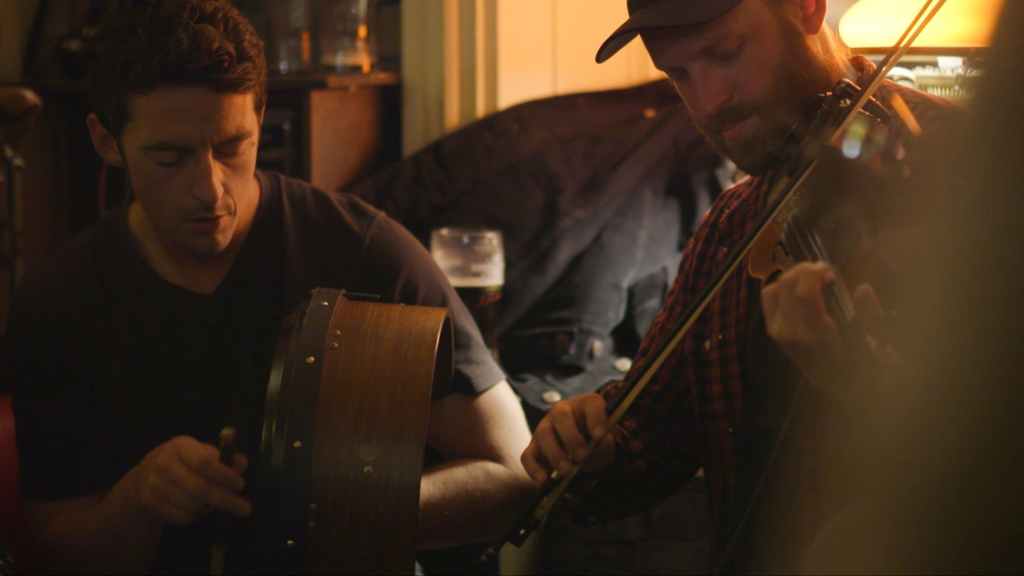

‘When we were conquered by the English, we lost our language. But we never lost our music,’ says an older-looking gentleman looking just past the lens of Lila Schmitz’s camera. What he is heard talking about probably stems from the filmmaker asking him the titular question – what is the job of a song? What is the purpose of music?
Now, on the surface this is potentially a bottomless expanse of conversational landscape, and a documentary titled The Job of Songs could take you into one of very many directions. However, the filmmakers are instead focused on something incredibly specific. They localize their focus to County Clare in The Republic of Ireland, situated on the west coast of this Emerald Island. Why there? Just google “County Clare” and you’ll immediately understand that this is a place that looks exactly how someone who has never been to Ireland would imagine Ireland would look like. It’s a land found on postcards with its phenomenal rolling hills and jagged cliffs, peppered with tiny hamlets and villages, with old churches and traditional pubs serving as their beating hearts. And if postcards could emit sounds, you’d be able to hear live music coming from inside of those Irish pubs, where born-and-bred locals together with tourists and regional adoptees would meet to drink beer, play traditional folk music and sing.
This is what Lila Schmitz’s camera is most interested in. The Job of Songs is a look at the traditional Irish folk music, not as a work of academic curiosity aiming to illuminate the beauty of this artistic endeavour to the world at large, but rather as a language bringing people together and a means to preserve the Irish heritage through centuries of oppression at the hands of their closest neighbours. On top of the rather expected definition that in contrast to stories (which make you think thoughts) and poetry (which makes you feel feelings), music is an artistic tool allowing you to feel thoughts, The Job of Songs suggests the main reason why Ireland retained its heritage and came back (literally) from the brink of extinction was because the Irish people took great care to make sure their music would never be forgotten. Even though they have dispersed across the globe, especially in the wake of The Great Famine of the 1840s, the Irish national identity has survived thanks to its music and how this music has always been a cultural touchstone for anyone with even a drop of Irish DNA in their blood, regardless of how far they may have been displaced from the Emerald homeland.
Lila Schmitz’s documentary takes a survey of the many ways in which the cultural heritage of Ireland was preserved on the back of its musical tradition and gives us a glimpse of the magic the Irish folk songs can conjure when performed by its practitioners, who are both skilled in the art and emotionally attuned to carrying out an ancient rite and safeguarding a precious tradition. She introduces us to a number of people, some born in the West of Ireland, some who adopted it as their home, all of whom have fallen in love with the Irish folk music and found it an indispensable way to express themselves. They talk about how being around music and creating music enriched their lives, and how music is a way for them to embody their national identity.
Problem is, I am not convinced that the way The Job of Songs approaches its subject matter, or the lengths it goes to in its journey call for a feature-length running time. At just over seventy minutes, the documentary feels a little bit protracted and perhaps it could have worked better as a more focused piece of short-form documentary filmmaking. I can only suppose that if – like the filmmakers and their subjects – you are completely in love with this music, you might not mind it as much as I did. Maybe you’d even wish the movie was longer. However, I feel Schmitz’s storytelling runs its course well before the closing credits and coasts on the back of its frequent musical interludes.
Thus, I think it is safe to say that as much as it is a potent attempt at drawing a connecting line between Irish national identity and its music (and how one was saved by the other), The Job of Songs struggles to settle into a rhythm that would open it up thematically to foster a conversation about a more general implications of its subject matter that it eventually wants to have with the viewer. I feel the main oomph of this movie lies squarely in this connection and any departure from it might make you wish the filmmakers would let us sit there and exist with it instead of probing in different directions.
It is almost as though they didn’t want to listen to one of their own interviewees who at one point lamented how younger generations don’t know how to just be and they fall prey to a compulsive need to explore and achieve. In a perfect world, The Job of Songs is a five-star short documentary that just lets you be there with the music and those few selected comments allowing you to appreciate the intergenerational power this music holds over those who play it and those who choose to listen. But the world ain’t perfect, unfortunately.
 Flasz On Film
Leave a comment