
OpenAI’s ChatGPT can write you a letter of recommendation, critique your essay or compose a braindead listicle. It takes a few prompts to generate a graphic with Quentin Tarantino riding a unicorn into the setting sun. I can only expect that by 2030 I’d be able to feed a Wikipedia article into some kind of an AI-enabled black box and what I will obtain is a feature-length documentary on the subject of that article, complete with a professionally delivered narration in the voice of a well-known Hollywood star.
Well, have I got news for you! It seems the future is here. Or maybe we have somehow figured out how to travel in time and somebody sent through that time portal wormhole thingamajiggy a piece of documentary filmmaking of that nature. Or maybe – and it saddens me to think it is the likeliest possibility of the above, because I’d like to think time travel is possible – the documentary I ended up watching was in fact made by humans, but somehow ended up looking as though it was hallucinated by an AI model. That’s more or less how I feel about Speed Is Expensive, or if you prefer the full title, Speed Is Expensive: Philip Vincent and the Million Dollar Motorcycle. Take your pick. I don’t know which title is better.
What I do know however is that the documentary in question, written and directed by Lancaster David in his feature debut, is in the politest way possible somewhat dull. Look, there’s nothing really terribly wrong with it, to be perfectly frank. It’s put together with competence of a journeyman filmmaker who has paid attention in film class and who knows just about enough to stage a talking head interview or to orchestrate an editing cascade between bits of stock footage, archival newsreels and elements of his own interviews. It’s all great. Unfortunately, the subject matter of this movie – the story of Philip Vincent, his rise and fall as a boutique motorcycle maker and the eventual cult re-emergence of the brand he had spawned – does not lend itself very well to this kind of filmmaking. I’m sorry but unless you are an absolute gearhead who lives and breathes motorcycle stuff, you will probably care very little about learning this much about Vincent, his record-breaking motorcycles, his rise to prominence and his eventual downfall, especially when all those facts are delivered in a veritable information dump style of documentary filmmaking.
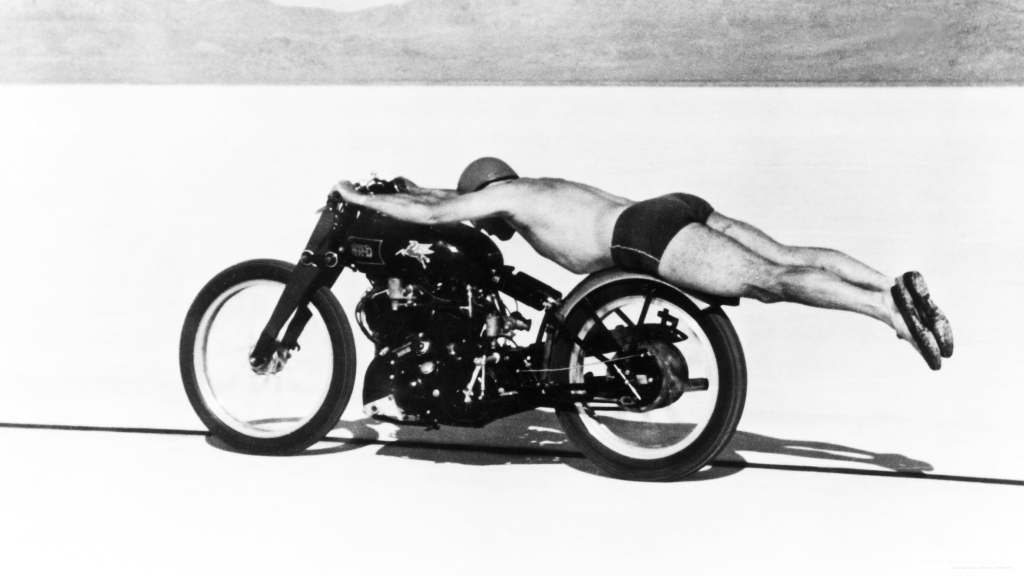
It helps that this absolute fire-hosing with historical factoids and curious nuances from the life of someone I never knew existed until I pressed play is delivered with the soulful and twangy voice of one Ewan McGregor, a fact the filmmakers made sure would be front and centre of the entire production and plastered across the screen right after the title card. In actuality, this is by far the first thing you will learn from this movie – that it is narrated by McGregor. And if you’re not much of a bike guy, it might be the only thing you will retain because the rest just flies by at the speed of a motorbike breaking world records in the desert.
However, there are some little nuggets of promise in this unfortunate conglomeration of facts and figures festooned with bits of archival footage, some of which could have made a better movie instead. In their efforts to record their interview with Philip Vincent’s surviving family members, descendants and friends, the filmmakers managed to capture a few minutes of footage of an actual functioning Vincent motorbike in motion. And it got me to think that I’d rather watch that movie than the visual equivalent of a Wikipedia article resplendent with facts I can find myself online if I so choose. I know this is at the very least a little bit unfair to review a film I wish I had seen instead of the movie I did see, but c’est la vie, you know?
I think info dump documentary festivals of splicing talking heads with archival newsreels and animated auxiliaries are better suited to other, more sprawling subjects. I don’t usually mind them so much when the subject matter revolves around over-fishing or deforestation in Brazil. And even then, it is so easy for such documentaries to settle for artistic mediocrity, as opposed to challenging the form even a little bit. An educational documentary must succeed on the back of its subject matter, like Blackfish. Meanwhile, I think Speed Is Expensive maybe had an opportunity to follow in the footsteps of more personal documentaries like The Cove where the film captures the investigative process involving the filmmakers themselves. Perhaps they had an opportunity to turn the camera on themselves and take me on a journey to find that speed-breaking daredevil, or to source a working Vincent motorbike. Maybe they’d have to find one that’s completely decrepit and unusable and embark on a mission to restore it. They do mention in the film that keeping these beasts of bespoke engineering was an art form in its own right because spare parts are incredibly hard to come by. And as they would go on to find parts and ways to make the bike work and then to get that guy to ride it again at speed, they could sneak in some facts, too.
I’d watch that film. Sadly, there is but a total of three minutes of actually interesting stuff in Speed Is Expensive, while the rest is just a tedious compilation of facts and factoids. Therefore, I can’t bring myself to recommend this film to anyone who isn’t right now already writing a research paper on this subject, and who would benefit from finding a few extra nuggets of information to supplement their thesis or something. Fine, Ewan McGregor completists can find something useful here, too. And maybe gearheads. But only patient ones.
So, if you’re not currently writing an essay on Vincent and are not too lazy to read, or if you’re not a McGregor stan, or if you don’t care about motorbikes one bit, do yourself a favour and sit this one out.

 Flasz On Film
Leave a comment