
The Antoine Fuqua-directed The Equalizer was released in 2014, only a few short weeks before the now regarded as eponymous John Wick. Both films dabbled in the same ideas of shadowing a ruthless assassin as he comes out of self-imposed retirement to embark on a quest for revenge. Both spawned multiple sequels, but only one of them has had enough staying power and follow-through to become a bona fide cultural item.
I’m not here to tell you all about my problems with the John Wick franchise, as I have done so before; however, I believe it may be of interest to ask why the Keanu Reeves-starring vengeful saga set in a sprawling universe of assassins, high tables, excommunicados and deconsecrations connected with the audiences much more profoundly than a similarly-themed series anchored in a more grounded – yet still somewhat heightened – reality. I wonder, because at least from where I was sitting, Robert McCall – the titular antihero of The Equalizer portrayed by Denzel Washington – had what I desperately wanted John Wick to have – character and rock-solid motivations underpinned by tactile screenwriting.
My biggest gripe with the Stahelski film from 2014, and with the entire franchise by extension, was that John Wick was more a hollow avatar than a fully formed character with his own agency. He was propelled by inertia and knee-jerk responses to externally applied stimuli, which was just about enough to push him through four movies. We never met his wife. We did not take part in the idyll of their life together. We never experienced John Wick’s grief. We were told all those things and then we were expected to get on board with his quest because a bunch of baddies killed a dog his dead wife had sent him from beyond the grave.
Meanwhile, Robert McCall was a guy we got to spend time with and marinaded in his everyday interactions with work colleagues, neighbours and, crucially, the young prostitute whom McCall would come to avenge. The Equalizer actually commits a substantial percentage of its running time to establishing McCall as a human first, before letting us shadow him as he reactivates his inner superhero and becomes Travis Bickle unshackled by a downright sinister mental derangement. Therefore, it allowed us to connect with McCall’s mission on an almost personal level.
Unfortunately, there’s no such thing as a free lunch and there are almost always difficult choices to be made. Because The Equalizer spent so much time investing in its protagonist and making sure we all felt he was a living and breathing human being before unveiling him as a ruthless killing machine with veritable superpowers and a spiritual descendant of Kevin McAllister, the film could not invest anywhere near us much in its spectacle, which is a basket in which John Wick had placed most of its eggs instead. Ironically, seeing how John Wick has blossomed into a pop cultural icon and an event series drawing countless crowds into cinemas, it looks as though cinema-going audiences are nowhere near as interested in character as they are in spectacle.
I suppose this is where the problem is, because the moviegoing demographic tends to be on the younger end of the spectrum and the teenage-to-young-adult audience latches onto different things, it would seem. Perhaps it is a serendipitous blessing, or maybe a result of intelligent design on behalf of the filmmakers, that John Wick movies evoke the spirit of video games so readily. While for me it is a major turn-off to sit there impotently and watch a characterless avatar fight his way through waves of mindless mobs while navigating a world populated only by him, his enemies and conveniently placed NPCs programmed to react to very specific triggers, most younger viewers resonated with this aesthetic much more profoundly. At the same time, because they grew up with modern video games as their primary form of entertainment, they weren’t necessarily geared toward appreciating what The Equalizer was trying to sell them. Or, maybe equally so, The Equalizer didn’t try to sell them what they were looking to buy.
It has been a long while since franchise-based comic book movies completely took over the blockbuster landscape. In fact, it has been so long that we now live in a world where comic book movies and franchise blockbusters are what movies just are for an entire generation. People in the age range most likely to spend money at the box office have grown up with video games at home and with cinematic universes in their movies, so they resonate with such films much easier than with stuff that would have ruled the roost in the 70s, 80s, or 90s. In fact, they are likely to reject them outright as culturally obsolete, or even look at them as tribally incompatible with their own worldview. Is it far-fetched to assume that Robert McCall is not a cool hero to follow because he is an ex-CIA operative and therefore he is somehow connected to the apparatus of government? And therefore he is somehow right wing? Maybe. Maybe not. But it is certainly impossible to make such connections with the character of John Wick, who is only defined by his suit and tie and the fact he’s thinking he’s back, and in fact, he is waging a war against a sinister institutionalized machinery, which makes him a man of the people.
I can only surmise that the simple fact The Equalizer never made a comparable impact to John Wick, despite being an objectively better written piece of character building is only indicative that the audiences it was geared towards do not go to cinemas that much. And when they do, they don’t adopt movies as parts of their personality. The Equalizer is John Wick for dads who are too busy working and supporting their families to find extra time to devote to turning Robert McCall into a cultural item. They don’t have the time or the energy to play video games. They have the money to buy them, and they frequently do. They may even keep promising themselves that maybe this next Sunday they’d carve out some time to play that shooter they had dished out nearly sixty bucks on three years ago… only to find out that life got in the way of things again and they ended up taking the family out for a day somewhere and when they came back, all they could do was put on The Gray Man on Netflix and pass out twenty minutes in. Such is life.
The Equalizer is a relic which truly belongs in a different era because audiences have evolved to overlook what Fuqua’s film treats as a central tenet and instead latch onto world-building, which this movie ignores completely. It’s a film that would have been a massive hit in the 80s and a cult darling among men, thanks to its potential longevity on home video. It just can’t stack up against John Wick and its cinematic universe appeal tuned to resonate with audiences raised on Marvel and DC spectacles. It’s too simple. Too local. Too… small.
Perhaps, there is a lesson to be learned here and maybe someone will come along in the future with an intention to cater both to dads and their young adult sons with a movie that looks like John Wick and feels like The Equalizer. I bet it wouldn’t take much to breathe some life into the lifeless avatar John Wick was as a character and to make old farts like me care about his fate as much as youngsters cared about imagining what the world he lived in was like. Maybe we’d have to give the role to someone a bit more emotive than Keanu Reeves to achieve that? Don’t get me wrong, I love the guy, but he’s as expressive as a decrepit phone booth, especially if you compare him against Denzel Washington, probably the most effortlessly likeable actor working today.
All we need to do is fill the hollow expanses in John Wick’s character-building and implant The Equalizer inside them. See what happens. Maybe even upregulate the violence to make it more tactile and organically connected to some kind of reality, as opposed to attempting to evoke the spirit of video games? You know, make these henchmen deaths count. Make them memorable. Make them gruesome, too, as if to show those youngsters what was fun back in the day. I’m sure it’ll work.
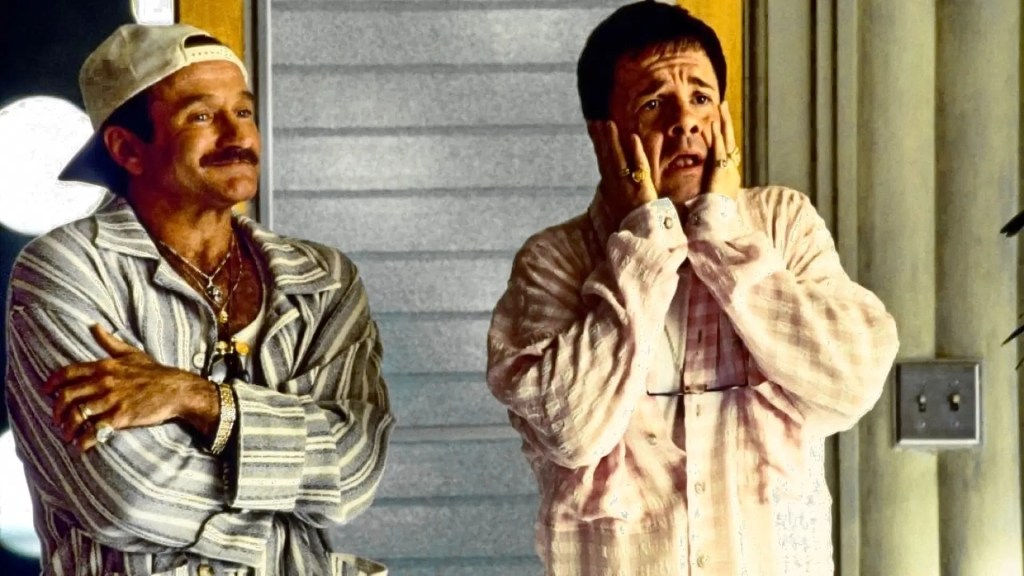
However, while I see a distinct pathway to evolve John Wick into an item of cross-generational appeal, I don’t think the same process can be applied in the other direction. If you throw some lipstick on The Equalizer and give it some world-building shades to wear, it won’t look genuine enough to pull it off. It’ll be a cinematic equivalent of Steve Buscemi with his baseball cap backwards asking his fellow teenagers how they are doing. Which would be laughable and pathetic. John Wick could benefit from some character-based maturity, but The Equalizer should not be de-aged to make it resonate better with the youth. It needs to stay a dad movie because it is a reminder of what used to be cool way back when.
And while I’m here I might as well end on a Simpson-esque memento mori. John Wick movies might be cool now, so enjoy them, soulless as they may be in my eyes. But they will get older, and so will you. They will become dad movies of the future.


 Flasz On Film
Leave a comment