
In our often-futile efforts to understand the nature of evil, we tend to personify it. We give it a face, a body and an ability to speak for itself. There’s something intrinsically safe about this cultural process where we teach our children about many dangers they may encounter out in the world by telling them that evil takes the form of people. Perhaps we wouldn’t be able to comprehend a shapeless, remorseless ancient force which just exists out there in nature, and which cannot be defeated the way personified evil can be. We can drive wooden stakes through a vampire’s cold heart. We can fire a silver bullet at a werewolf. We can ask the state to remove a sociopath from society until he withers away and dies. But we can’t defeat what we do not understand or what we have no ability to interact with.
This is the kind of evil The Moor is interested in exploring. Directed and written by Chris Cronin in his feature debut, this story attempts to recontextualize the idea of personified evil and – using tools of sophisticated artistic expression – engender a conversation about repressed guilt and a futile search for solace. To this end, we are told the story of Claire (in the opening scenes played by Billie Suggett and later in the film by Sophia La Porta), whom we meet as a young kid in the 90s. The camera roams behind her back as she convinces her friend Danny (Dexter Sol Ansell) to go into a corner shop and distract the shopkeeper, while she’d nick some sweets for them to share later. Typical shenanigans a free range-raised 90s kid would probably recognize with ease. However, Cronin’s camera is not nostalgic. It is brooding and menacing. It forces us to focus on the negative space and slowly zooms in and out of dark corners where our imagination wants us to believe something evil may be lurking.
Indeed, Claire’s friend disappears without a trace, and we later find out he was brutally murdered, thus germinating interminable guilt within Claire’s supple conscience. This unresolved childhood trauma of both narrowly evading the grip of a faceless serial killer – an evil personified – and seeing her friend dissipate into nothingness leaving only but a trail of tears, leads Claire to revisit her childhood hometown and to reunite with the boy’s father Bill (David Edward-Robertson) who has spent the last twenty-five years painstakingly searching the seemingly endless Yorkshire moorlands for his son’s body… and some kind of closure to his everlasting personal nightmare.
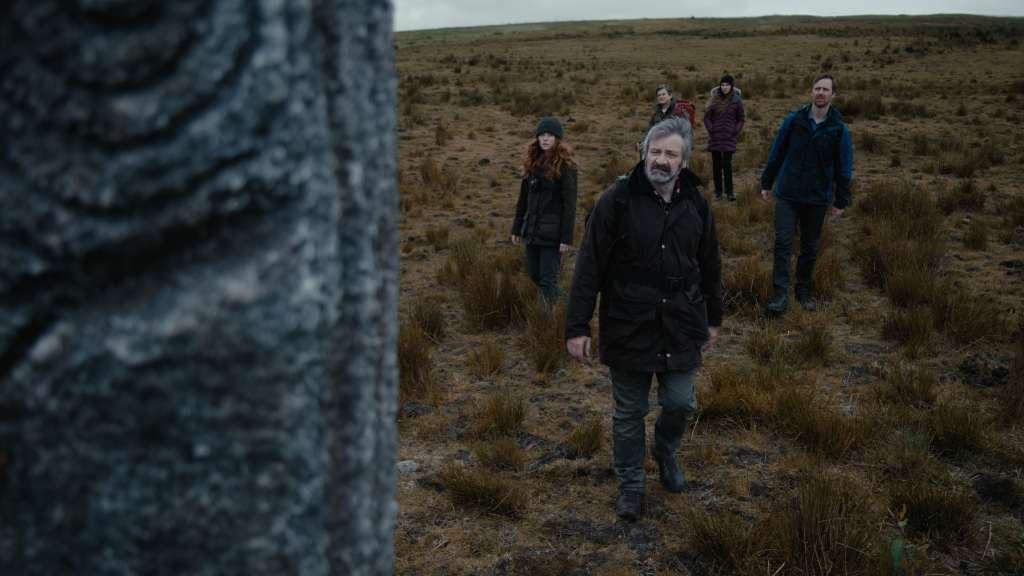
Cronin’s camera then latches onto Bill and Claire as they enlist the help of a young medium Eleanor (Elizabeth Dormer-Philips) and her father Alex (Mark Peachy), hoping their supernatural abilities would be able to find the body of Bill’s long-lost son by means of finding his spirit, aimlessly wandering through the allegedly haunted moorlands. What they find, however, is that the personified evil that took the life of this young child, and many others, was tethered to something more nefarious and that perhaps it was not personified at all. It was merely a manifestation of some ancient and incomprehensible forces that have silently brewed under the epidermis of the Yorkshire Moors for eons demanding sacrifice to appease their malevolence.
The Moor forgoes the vocabulary of a familiar genre piece to enable this emotionally complex conversation about grief and unrequited trauma and anchors itself only tangentially in the language of horror. In a way, it functions as an elevation of the genre it builds on and departs from what could have been a more straightforward story where possession and haunting function as de facto symbolic stand-ins for fundamental human emotions the filmmaker is interested in exploring. It goes quite a bit further and resorts to the language of tone and atmosphere as opposed to narratively generated suspense and dread. Cronin and his cohorts make phenomenal use of their setting in this regard – the seemingly endless expanses of the Yorkshire Moors covered in thick mists – and hint at a possibility that somewhere in there lurk powers we do not wish to disturb. That if we gaze into these mists for a second too long, the mist will gaze right back at us. And consequently, as the evils swirling in the moorlands come to haunt Claire, Bill and Eleanor, they invade our subconscious selves just as well, which is exactly how this movie will get under your skin.
Make no mistake, The Moor is not a conventional genre movie aiming to entertain by way of scaring you out of your wits. It is a stirring film that will linger for hours, infect your cerebrum and inflame your deepest fears and traumas. It is a horror film that takes place in Claire’s mind and by extension in yours because it is not interested in pandering to our safely reductive assertions that evil can be personified and defeated like a foe in a romantic novel. In The Moor, evil is all-encompassing, penetrating and omnipresent. Almost Lovecraftian. It is in Claire’s mind, in the air she breathes, in the soil she steps on.
And this is what makes this entire film so immensely oppressive, terrifying and most importantly intellectually titillating. The Moor is a moody and classy search for closure in the dense mists of folk horror. It is the kind of movie Ben Wheatley would have directed before he had made his move to Hollywood. And in fact, it is a good indication that Chris Cronin may be on his way to take his place and continue the long tradition of British folk horror by elevating it even further, especially if we consider The Moor to be his Kill List. It is an honestly fascinating deployment of tone and atmosphere as effective means to convey a deeply layered conversation about the nature of evil, the lengths we go to in search of solace and how little we understand about the world we walk on.



 Flasz On Film
Leave a comment