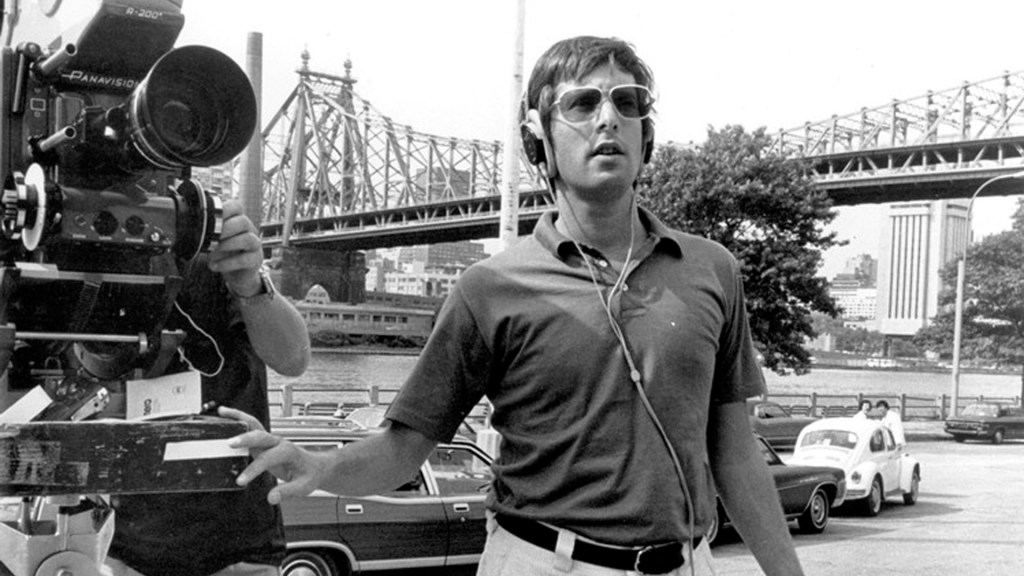
The world became emptier with the loss of William Friedkin who died today, on the 7th of August 2023, at the age of 87. What he leaves behind is not only a filmography like no other, but a legacy of no-holds-barred rogue filmmaking of truly singular nature.
However, as messages of well-earned affection are pouring in from all corners, it is worth remembering that – despite being consistently highly regarded among cineastes and film critics – Friedkin was always a bit of an outsider. A bad boy. An enfant terrible. Even in the early days of his career, when working on The Alfred Hitchcock Hour, he would end up told off by Sir Alfred Hitchcock himself for not wearing a tie on set… which was merely the beginning of a lifelong career of going against the grain, speaking his mind and making movies in a uniquely audacious way.
Even though Friedkin got his flowers quite early in his career when The French Connection swept the Oscars, he rarely gets a mention as one of the most prominent voices of the New Hollywood. And although many normies out on the streets might be perfectly aware of his movies, they might not be able to connect them to his name in a way they’d be able to do it with Coppola, Scorsese or Spielberg. In fact, we often talk about Spielberg’s Jaws as the birth of the blockbuster, specifically because of its wide release across the summer of 1975, but it is a matter of fact that Jaws stood on the shoulders of giants. And one of those giants was William Friedkin whose 1973 The Exorcist, together with Coppola’s The Godfather which also enjoyed a stunning box office run, helped Hollywood write the playbook for turning great movies into bona fide cultural phenoms of lasting significance.
From there, having produced a stunning one-two punch with The French Connection and The Exorcist, Friedkin went on to direct Sorcerer, a re-adaptation of The Wages of Fear, a piece of homage to one of his own idols, Henri-Georges Clouzot, and in the eyes of many – mine included – his magnum opus. Without going into excessive detail, Friedkin’s movie about a group of stateless criminals driving trucks full of unstable dynamite through the South American jungle is a movie like you’ll never see. It is a true testament to human perseverance and a pinnacle of what could be achieved in camera. Unfortunately, again despite the fact critics and cineastes are perfectly aware of how important Sorcerer is to cinema as a field of artistic achievement, Friedkin’s unabashed genius was overshadowed by the arrival of Star Wars, which took the world by storm, left his iconic masterpiece to play in front of empty auditoriums and – quickly enough – to be shelved and forgotten for decades.
But this wasn’t the end for Hurricane Billy – as he was affectionately referred to on the set of Sorcerer – who never rested on his laurels. Although his 1970s output was by far the most impactful, Friedkin continued to make great movies until the end. Between Cruising, To Live and Die in LA, Blue Chips, and Killer Joe, Friedkin left us today with a legacy of moviemaking which can only be rivalled by other Hollywood greats. An iconic and cantankerous potty mouth, Friedkin earned his stripes by virtue of sticking a camera where others wouldn’t dare and telling stories in ways that oozed tactile greatness and perspired with artistic endeavour. He was a one-of-a-kind individual, a masterful storyteller and a true champion of cinema who should be remembered as one of the foremost Hollywood legends.
So, on a day like this, when his soul is committed to the nether, we must remember to keep William Friedkin’s legacy alive. Go and watch one of his movies because, now that he has departed this world, there’s nobody out there who would even come close to directing movies like he did.


 Flasz On Film
Leave a reply to How Millie Bobby Brown Validated the Way I Develop My Craft – Flasz On Film Cancel reply