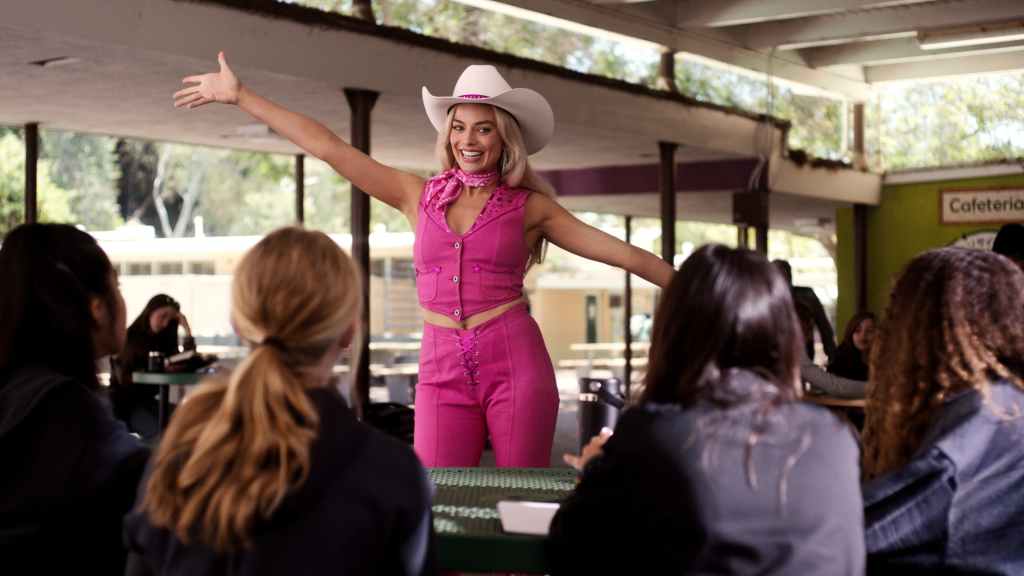

Ever since transitioning from full-time acting to full-time directing, Greta Gerwig’s output indicated her primary thematic interest – that authorial demon on her shoulder – was to interrogate the complex landscape of being a woman. It shouldn’t take long to realize that, as much as Lady Bird and Little Women were accomplished pieces in their own right, Gerwig still had a lot to say on the matter. Therefore, following her own directorial pathway of wanting to increase the scale of the canvas upon which to project these ideas, she challenged herself to pick up that conversation using a vehicle of immense pop cultural significance – a story about a Barbie doll coming to life – and turned it into a cerebral satire.
On its surface, Barbie is a glitzy and glamorous eye-candy all awash in pink and resplendent in kitschy stylizations reminiscent of Wes Anderson and Tim Burton. In fact, to many viewers it may be a tacit invitation to partake in a camp phenomenon where you get to go to the cinema all decked out in pink attire and turn the Barbie into a shared experience that is as culturally valuable as the movie itself. And these viewers wouldn’t be entirely wrong if they decided to do so because Gerwig’s Barbie is in many ways just a fun piece of ambitious entertainment full of cultural references – in fact, the movie starts with Gerwig’s take on 2001: A Space Odyssey – pervasive self-awareness and light-hearted yet stinging comedy. It has the fish-out-of-water allure of Richie Rich appended onto the structural familiarity of The Matrix, all bedazzled with distinctly heightened style reminiscent of a 1950s musical.
And to what end?
After all, the primary narrative is probably just about enough to ensure Barbie becomes a stunning success; which is already based on its box office revenue. However, there’s plenty more to be found in Gerwig’s movie and it doesn’t take a whole lot of scratching to reveal that under the thin layer of pink gloss the filmmaker has hidden a satirical juggernaut and effectively – most assuredly, knowingly and confidently – hijacked what could have been an easy IP installation and a franchise starter and gave it a false bottom. In doing so, she imbued Barbie with cerebral power nobody would ever expect from a pink-clad summer blockbuster based on a toy.
What she did under the guise of flashing Mattel-branded products in front of your eyes was to take this iconic doll and interrogate its cultural power as a symbol of emancipation. It encapsulates values we as a society have decided to cultivate in our daughters, whom we religiously tell that their destiny is effectively unmoored from the traditionally carried expectation for them to grow up and become mothers. Barbie isn’t a baby doll, but an adult one. She can be a doctor, an engineer, a teacher, or a CEO. Or can she?
Well, yes. In Barbieland. In a fantastical land of make-believe fantasy, Barbie (Margot Robbie) has it all. She has a house, a career, her morning breath smells of daffodils, the milk in her fridge never goes out of date and Ken (Ryan Gosling) is perfectly subservient to Barbie’s every whim. But we all know Barbie’s life is essentially divorced from reality. In a way, Gerwig’s Barbieland is a facsimile of a university, a walled-off micro-universe where we send our kids to practice being adults, acquire skills necessary to express themselves, actualize and embark on their own personal journeys into real life. Problem is, real life and Barbieland have absolutely nothing in common, just as the university experience is thoroughly divorced from any semblance of the reality of entering the workforce, having to pay your bills, saving up for your home and starting a family.
Barbieland is a utopia where women are top dogs, small children don’t exist, youthful beauty never fades and despite the fact everyone is extremely attractive, female sexuality (and sexuality in general) remains a weirdly omitted taboo. Nevertheless, nobody is ever aware of the fact they live in a made-up world because they never interact with anyone from the outside reality. They effectively live in The Matrix. Until they no longer do.
Barbie begins to see changes in her body, mood and environment and – as it is explained to her by an unsettlingly elastic female Morpheus aka Weird Barbie (Kate McKinnon) – it is because the girl who’s been playing with her in the real world has awoken from her own idyllic slumber and understood that life as a woman is a struggle filled with anxiety and hard work. So, Barbie and Ken leave Barbieland (or the university, if you are willing to continue with this satirically functional analogy) and enter the real world where things are just different. Barbie immediately identifies that life as we know is far from perfect. She immediately can’t feel safe when out on the street, she finds out you must pay for clothes you want to wear, and food just doesn’t magically jump into your mouth. Meanwhile, Ken finds out that for men it is just about the opposite and surmises that being a guy is just the best, so he comes back with his newly acquired knowledge and a mission to turn Barbieland into Kendom, while slowly morphing into a glitzed-out Tyler Durden (Dur-Ken?), thus setting the stage for a grand confrontation of the sexes where Barbie, aided by Gloria (a disillusioned woman desperately juggling her career and motherhood, played by America Ferrera) and her daughter Sasha (Arianna Greenblatt), will find out that being a real woman is nowhere near as simple… and that for the world to become a better place, everyone has to collectively understand the utter complexity of the female experience.
Such is the power of Barbie that it lures you into the cinema promising a Cats-like shared experience and then it will leave you both intellectually enriched and in tears, if you’re evolved enough not to be threatened by a movie suggesting that women are great and deserve at least a tiny bit of appreciation. It is a truly powerful cinematic experiment that audaciously uses a branded toy to effectively undermine its own existence and teach the audience something meaningful about the world as experienced by a woman. Gerwig’s lens interrogates many paradoxes of female adulthood which most young girls are not aware of until they bash their heads against the brick wall of reality. Without breaking a sweat or ever abandoning the film’s abundantly elevated tone, Barbie functions as a conversation about the frequently demonized female sexuality, the paradoxically unrealistic position a woman is expected to hold within the family unit as a carer and a breadwinner, the fact that being a mother is somehow equated to being a failure in the eyes of successful women, and much more.
However, Gerwig’s Barbie is not a militant treatise aiming to inflame tribal animosities between the sexes, upon which some corners of the political discourse would like to thrive and build their own bases. It is a soulful exploration of womanhood that encompasses all its aspects and recognizes the uphill struggle women face every day. It is equally a stylistically ambitious call to arms for all women to wake up, stand up and be counted and – more importantly – become aware of their innate powers, as it is a love letter to all mothers whose sacrifice is the reason the world exists at all.
And – perhaps surprisingly to all the threatened naysayers – Barbie is quite simply a reminder that perfect is the enemy of good, an adage that applies to both men and women in here. When the pink confetti have settled, all the song-and-dance numbers have faded away and the central conflict has gone through its organically climactic resolution, the movie will leave you remembering that it’s OK to be just ordinary. It’s nowhere near as important – regardless of if you’re a Ken or a Barbie – to win and climb the pinnacle of success in life. It’s perfect if you want to be a mom or just want to have a job. What matters is finding people who will see you for who you are and be happy to be there for you.
And that’s why Barbie is much more than a sum of its parts. It’s not only a collage of cultural tropes and references. It’s not only a social exposé aimed to denude life’s injustices. It’s not only a camp musical awash in style. It’s an elevation of all those aspects built to send you home wanting to make both your life and the lives of those around you better.
It’s Greta Gerwig’s Rocky. Decked out in pink.



 Flasz On Film
Leave a reply to GODZILLA MINUS ONE, Neo-realism, and Spielbergian Fundamentals | Flasz On Film Cancel reply