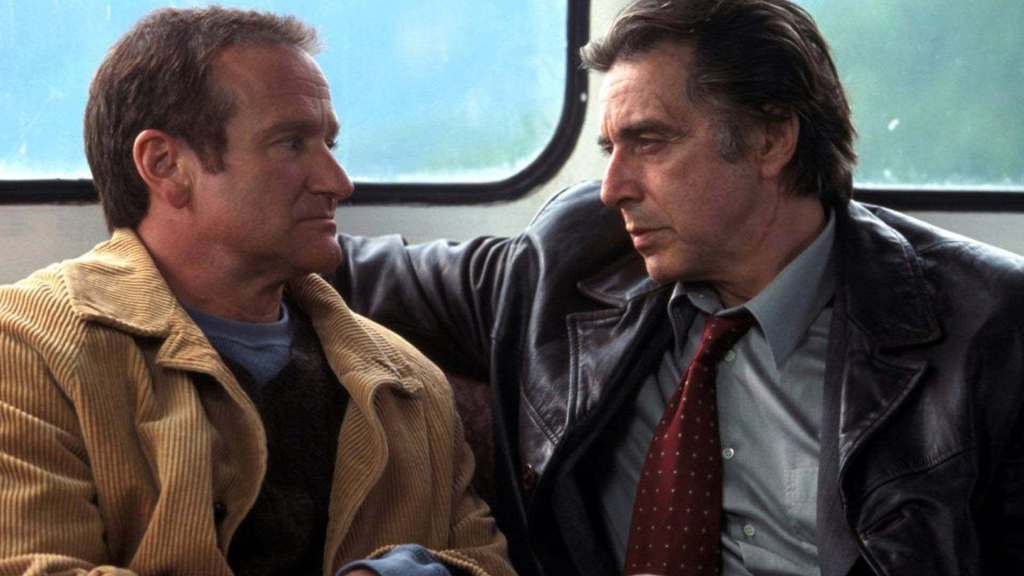
Released in 2002, Insomnia stands as the most underrated movie in the filmography of one Christopher Nolan. In fact, it is so underrated that (1) a good fraction of Letterboxd lists titled “Nolan Movies Ranked” or thereabouts wouldn’t feature it at all and (2) even the filmmaker himself once opined he wished this movie would be seen by more people, as he was quite proud of what he achieved in his attempt to bring a dour Nordic thriller to American audiences. And it makes you wonder why in a filmography that isn’t exactly vast you can still find a movie that barely gets a mention and the mention it gets relates only to the fact that it is underappreciated, not why it is so.
And that’s an interesting question because you will rarely see anyone opine on Insomnia in any appreciable depth. Instead, you will now find it in ample listicles (some of which may or may not have been written by ChatGPT, by the way) as an example of an underrated gem, but if you start digging, you shall find that it’s underratedness is innately tautological. Insomnia is underrated because it is the least watched Christopher Nolan film, and it is the least watched Christopher Nolan film because it is underrated. And the reason why that is, is because it just doesn’t fit within Christopher Nolan’s authorial modus operandi. Or at least it would seem that way.
In fact, as I started thinking about the why of it all, I dug out my old piece I penned for CLAPPER a few years back, where I carefully examined Christopher Nolan’s filmography in the context of what I think makes the man tick and why some of his movies hit way better than others. To summarize, though I would refer you to my essay for more (especially because I was particularly proud of myself), looking at Nolan’s movies you can surmise he is interested in three key foundational aspects of storytelling: (1) deconstructing the narrative structure, (2) building a visceral spectacle and (3) an intimate human drama boiled down to a simple relationship between two people. And he really bats a homerun when he gets all three of these interests to resonate at sympathetic frequencies.
However, as I went through my essay, I noticed I never mentioned Insomnia in it, even though I have always loved this movie. And this is simply a product of the fact that Insomnia does not place appreciable focus on any of these three pillars of Nolan’s filmmaking philosophy. It is a structurally straightforward thriller of a literary variety, where the spectacle is reduced to a single action sequence (which is great by the way) and whose character machinations do not resonate with the viewer in a way Nolan’s more successful relationships would. This movie does not have a Cobb and Mol, or a Coop and Murph. In fact, it is emotionally closer to a Dostoevsky novel than any other Christopher Nolan narrative.
So, as an armchair film analyst and a recreational believer in the auteur theory who thinks that at this point if I mention Rainer Werner Fassbinder in my essay, an angel up in heaven is going to get the runs, I asked myself what exactly Christopher Nolan saw in this project that made him want to jump on board and see it through as the captain. Now, the cynical answer is that it was his first bona fide studio project so he would have been an idiot if he had turned down the opportunity to direct it, especially when it came from someone like Steven Soderbergh. Of course. Nobody could have said no to a movie like that. But I beg to differ. Something tells me – and you can see it already in Memento – that Nolan knew in his heart of hearts when he was being showered in praise for his noir detective mystery told backwards, that he was destined for greatness. He felt it in his bones that it was a matter of when, not if, and that he would one day climb to the highest echelons of Hollywood. Which then makes me believe that he chose to direct Insomnia because he had a good reason to do it.
He saw this as an opportunity to direct two great actors, Al Pacino and Robin Williams, in a showdown of personalities, which he must have seen as a perfect opportunity to pretend he was Michael Mann.
After all, it is a matter of public record that Christopher Nolan is massively fond of his 1995 masterpiece Heat, so much that he effectively ended up remaking it under the guise of a superhero movie when he directed The Dark Knight. However, I think he needed to make Insomnia first and effectively turn it into a dry run for The Dark Knight in one key aspect of having to develop two towering performances across a plot-heavy narrative. What is more, he got to practice the iconic diner scene from Heat before getting Christian Bale and Heath Ledger to re-enact it in an interrogation booth. He got to direct Al Pacino in a scene with Robin Williams (who’s also playing against type in this movie, which is an added challenge) and convince me, the unsuspecting viewer, that detective Will Dormer could just as well be Vincent Hanna ten years after gunning down Neil McCauley in the understated ending of Heat.
Therefore, Insomnia is a bridge between Mann and Nolan, or better yet, it is a movie in which Michael Mann’s spirit gives Nolan permission to become a great filmmaker. It is a movie without which Christopher Nolan as we know him now simply does not exist at all! He gets a once-in-a-lifetime opportunity to make Heat without actively trying to make Heat. He gets to practice the necessary technique needed to execute it later as a part of a much more complex routine.
And nobody noticed! Insomnia came and went and to this day nobody ever sees it as a dry run for The Dark Knight because the obvious perspective to look at this movie from is as a remake that reimagines and rejigs the Norwegian original in interesting ways without ever referring it to any other movie. But I think once you see it the way I see it, your appreciation of Insomnia as directed by Christopher Nolan will be instantly elevated, because you will be able to see the “Brother, you are about as mysterious to me as a blocked toilet is to a fucking plumber” line that Pacino’s character utters at Robin Williams as a direct reference to “Brother, you are going down” Hanna fires at McCauley in the diner scene in Heat.
Consequently, because Insomnia allowed Nolan to get the idea of directly re-enacting the diner scene in Heat out of his system, he could elevate it into something original and inspired – imbued with Mann’s spirit more than simply aping him – in The Dark Knight. In a roundabout way, Insomnia was for Nolan what L.A. Takedown ended up being for Michael Mann – a learning experience. A dry run. An exercise. However, in contrast to L.A. Takedown, which is a movie only its father could genuinely love on the film’s own terms, Insomnia transcends the idea of just being an opportunity for Christopher Nolan to pretend he was Michael Mann and Al Pacino was playing Vincent Hanna who for some reason didn’t think he could go to the shop and buy a facemask to help him sleep. Still, it is an exercise in many ways, but one executed by someone who already knows what he’s doing. Two movies in (if you forget Following, I suppose), he is already self-assured enough to handle two of the greatest living acting talents in Hollywood and make them shine. Even though it is effectively a dry run for what he would end up doing a few years later in The Dark Knight, Christopher Nolan is already fully aware of what he is doing and how well he is doing it!
Therefore, no wonder he occasionally reminds people himself that Insomnia is not to be omitted. It is an indispensable piece of the Nolan puzzle that shows both the promise of this modern Hollywood titan and the level of mastery the world would bestow upon him much later. It is an early masterpiece that nobody ever gives enough time or attention to understand where its importance is. Like the title of this piece suggests, it’s Nolan’s L.A. Takedown… but better. Which is a confident challenge, a gauntlet laid at Michael Mann’s feet by a young up-and-coming wunderkind. It is as though he wanted the world to know that he used to idolize Michael Mann, but now he is ready not only to draw from his legacy, but to make an attempt at surpassing his achievements altogether.



 Flasz On Film
Leave a reply to Is OPPENHEIMER Autobiographical? | Flasz On Film Cancel reply