
Continuing the long tradition of film noir is impossible without trying to reinvent it or at least appropriate it to the tone of the current era. To this end, certain elements of the noir iconography and style have survived untouched, while others evolved, changed and disappeared completely to make space for new, potentially transformative ideas. Door Mouse is a film that attempts – for the most part rather successfully – to bring film noir out of the smoke-filled watering halls and into the current zeitgeist. Or, better yet, it adapts the noir vocabulary to suit the needs of modern storytelling and, even more importantly, to resonate with audiences who walk into genre movies expecting them to function as elevated incarnations of their past selves.
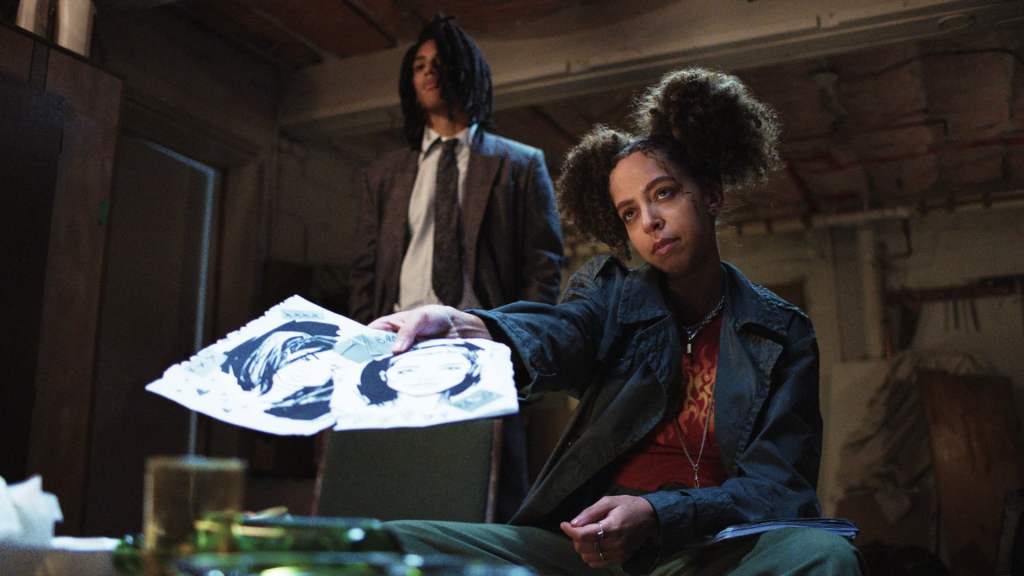
To this end, we meet Mouse (Hayley Law). She wears a trench coat as a matter of personal choice. She narrates the story for us. She is essentially Humphrey Bogart as she eases us into the world she inhabits, which – while heightened for the purposes of fitting within the neon-washed neo-noir – is strikingly accurately rooted in day-to-day realities of being a twentysomething in the current era. She makes money by working as a burlesque dancer at a night club owned by Mama (Famke Janssen). However, describing what Mouse does for a living as such is a polite understatement. She is a performative victim who wears a gag on stage, where she is shackled and smacked by paying customers, all of them rich old men.
She then goes home and draws comic books which she unsuccessfully tries to sell at a local indie bookstore. This is Mouse’s life. In fact, as the filmmaker (Avan Jogia, an actor-turned-director in his feature debut) would like us to know, comic books are life to Mouse, so much that occasionally the line between what’s drawn on the page and what occurs in reality may be blurring for her… and for us, by extension. Every now and again, the live-action proceedings make way for flashes of animated comic book panels, which both establishes a connection to the era of ultra-stylized neo-noir courtesy of Robert Rodriguez’s Sin Sity and hints at a distinct possibility that Mouse is an unreliable narrator in a story where what we see is not necessarily what happens, but rather what could happen.
And what happens is thus: Mouse’s life is turned upside down after her two friends disappear in close succession. This leads her and her sidekick Ugly (Keith Powers) into the underbelly of local criminality, as expected in any self-respecting attempt at film noir. However, in a more post-Chinatown and post-Gone Baby Gone style, Door Mouse uses this familiarity as a canvas upon which to project the current ceaseless frustrations of social inequality and the ongoing abuse of the young by the rich and powerful.
In short, Door Mouse is a slick anti-Boomer noir that transposes the easily identifiable generational traits into the language of trench coats, off-screen narration, seedy warehouses and stoic protagonists. Jogia’s script effectively personifies the sentiment of “Eat the rich” attitudes permeating the generations currently coming of age and those who have recently entered adulthood only to find themselves in a game rigged against them and stages a narrative that leverages these attitudes with ease. As the leads – Mouse and Ugly – investigate the disappearances of their friends, the film little by little shows its hand and – aided by the ever-present Bogey-esque off-screen narration – interrogates the entitlement of upper classes and their contempt towards the young whom they see merely as chattel to be abused and eventually discarded.
Although it takes a little while for the movie to get going and for the viewer to clue into how to position themselves in this otherwise dense and perhaps tonally oppressive experience, Door Mouse eventually comes into its own. Perhaps it would have been a bit more welcome to have been swiped off the floor by the intrigue, but it is equally simply a familiar trait of a competent film noir to – instead of dropping us into the pot of boiling water – allow us to lounge for a long while in tepid temperatures before letting us boil to death.
However, this is perhaps where the movie shows its only major deficiencies. Contrary to its many successful neo-noir predecessors, Door Mouse is quite happy skimming on the surface of its own narrative and tonal ambitions and perhaps decides to commit to boil the viewer alive a bit late into the game. Therefore, as much as it is an overall enjoyable and immensely slick genre exercise that prods at the axes of power and dynamics of intergenerational abuse, it doesn’t have enough follow-through to leave you on your knees. To borrow a boxing analogy, Avan Jovia’s film is a powerful jabber who knows how to punch at a target but who hasn’t yet learned that in order to knock the opponent out, you have to punch through them.
Nevertheless, a competent jab at the solar plexus is more than enough to knock the wind out of the opponent and force them to regroup. Which is more or less what Door Mouse does. It’s not Chinatown, or Sin City, though it is decidedly their descendant. It is a competent and assured Zoomer noir that pays as much attention to its thematic innards as it does to the aesthetics of its garb, which in a way perfectly summarizes its generational standing as a noir movie appealing to the cohort of young adults who also pay attention to both what the movie has to say about the world they inhabit and whether it looks slick and cool as it does so. Consequently, because rarely in life do we get to have it all, Door Mouse pays a bit less attention to making sure the intrigue would jump off the page and instead settles for a familiar narrative template capable of carrying both the movie’s style and themes. Again, this movie packs a ferocious punch. It’s not a knockout but it can give you a good bruising despite the fact it looks perfectly defenceless, just like its titular character in that trench coat two sizes too big and her innocent yet somehow caustic smirk. It’s a solid noir underdog.




 Flasz On Film
Leave a comment