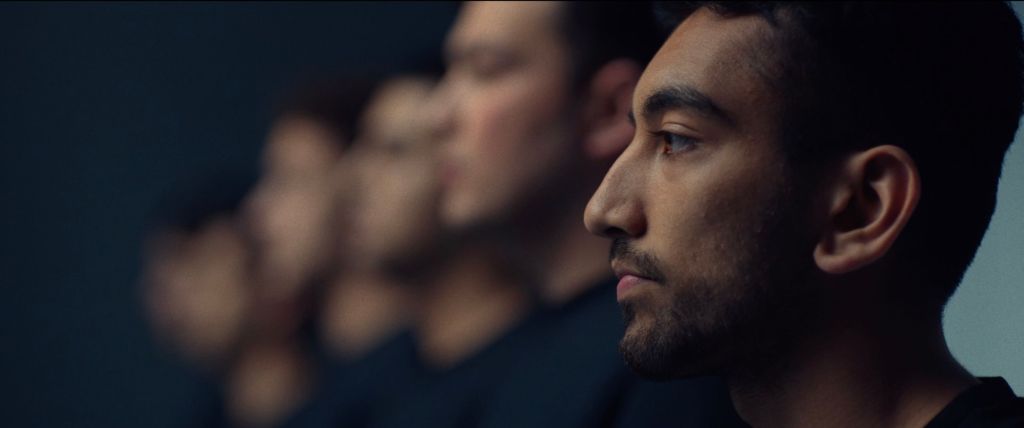

What sets cinema apart from theatre is the presence of a camera that filters the story being told through a lens – a perspective, if you will – of the storyteller who wields the ultimate power over what is said, how it is said, and how it is to be received. Thus, cinema elevates the fundamental idea of reciting lines and embodying characters and gives the viewer a unique opportunity to experience something they would otherwise only be able to live through in their own dreams. Or nightmares.
In Camera is one such nightmare. Directed and written by Naqqash Khalid in his feature debut, this movie is a stirring phantasmagoria that mesmerizes and ensnares with the unique combination of the relatability of its surface-level narrative and the elusive enigma of what’s beneath it. It all begins with a dead body, or at least a man pretending to be one. Aden (Nabhaan Rizwan) is a struggling actor who barely makes ends meet by occasionally getting a chance to lie still on the set, covered in fake blood while other actors recite cringy lines overhead. He has no money. In fact, he has so little money that his bank charges him fees for having no money.
However, Khalid’s camera is not quite as interested in exploring the fact that he is struggling, but rather he chooses to inquire about the why of it all. In a string of vignettes, In Camera interrogates not only the strife baked into the experience of any young artist, but also the universe of microaggressions and a plethora of abuse that all add up to Aden’s collective life experience. In one audition he is asked to recite some lines and, after asking for direction and character background, he is told to imagine he is an alien who forgot he was an alien, and his memories are slowly coming back… which leads him to pause for half a second because that’s exactly how he feels every day. Like an alien trapped in a world he cannot call his home, shackled by building frustration, loneliness and lack of human connection.
Aden frequently finds himself in small rooms filled with men who all look just like him, but with whom he does not know how to connect. His struggle is not shared or collectivized in any way. He is all alone. What is more, he feels further denuded of any discernible identity because he is herded together with those other people – whom he frequently recognizes anyway – because people in charge of the auditions he goes to fail to see him as a real person. He is only perceived as a member of a particular ethnic group. Nobody is interested in leveraging his personality or even asking him to be natural – he is persistently, consciously and callously pushed to embody a stereotype. He is therefore dehumanized.
And what can possibly happen to a man who is constantly and perfidiously reminded he is not to be perceived as a person? His own identity will eventually dissolve under the compounded pressure of being persistently asked where he is really from, or if he could put on a hammy accent for a role that is interested in seeing him as a caricature. Thus, In Camera pays stunning attention to the process of Aden slowly losing his grip on reality and descends into a nightmare soon after establishing a base-level connection between the audience and Aden. And this is crucial to the film’s success as we are effectively dragged into this world through the semi-permeable membrane of the cinematic artifice, where we are allowed to experience the turmoil and horror of what Khalid is interested in exploring with his lens.
Granted, not all of it might immediately make logical sense or translate readily to the viewer; however, the movie successfully evades any accusations of being needlessly cryptic or tonally pompous by virtue of always relating its imagery to the central character, even as he interacts with other ancillary people. Therefore, you can’t help but find it fascinating and overall enticing to be a fly on the wall when Aden shares the frame with who could be his flatmate (or maybe a figment of his imagination, who knows?) played by Rory Fleck-Byrne, a young junior doctor in whose visions and personal phantasmagorias we also get to partake, or another man (Amir El-Masry) who comes in and out of existence, as it were, to serve as a strange counterweight to Aden’s own strife… and lead him to boil over eventually.
Where the film truly succeeds is in finding a tight balance between indulging the symbolism and letting the story (and the central character) lead the viewer into the gaping maw of its own madness, as he slowly detaches from reality as you may recognize it. Consequently, what starts as an intellectual treaty on race relations, crises of identity and cultural homelessness woven in between the lines of an otherwise straightforward narrative, eventually reveals its true colours as a viscerally affecting psychological horror show that symbolically dismembers demons of social injustice. Khalid operates in the twilight zone between the on-the-nose iconography of blue-blooded beneficiaries of privilege meeting their fate and the subtle symbolism of using people as objects upon which to project unresolved grief, all working harmoniously to craft an experience that is as enigmatic as it is easy to decode.
Thus, In Camera seems both perfectly accessible and somewhat impenetrable, which gives it its innate allure of mystery that so many other movies simply cannot generate. It is as though the filmmakers knew instinctively how to convey the complexity of their thematic messaging without alienating the viewer, while equally looking as though they were trying to alienate them anyway. I fully realize this may not make too much sense to anyone, but at least from where I’m sitting In Camera belongs to a subset of pop-psychological horror movies that understand their place and know how to avoid flying too close to the Sun. It is a perfectly accessible piece of inaccessible filmmaking that offers the viewer an emotionally engaging journey and something to chew on as they leave the cinema without patronizing anyone in the process. And while you can feel it could have just as well been a stage play – which also would have been cool to watch, I can tell – it is immensely elevated by Naqqash Khalid’s cinematic perspective that makes him a newcomer to watch.



 Flasz On Film
Leave a comment