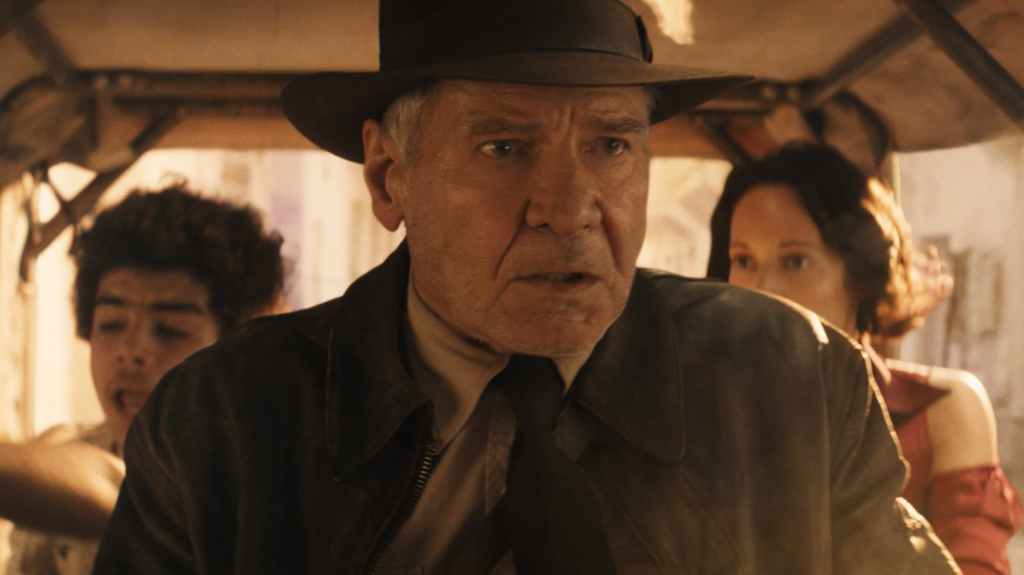

After a decade-and-a-bit of going franchise to franchise and decapitating them one by one with a nostalgia sequel scythe, the Grim Reaper has finally parked up in the post code where Indiana Jones has been enjoying his well-earned retirement. In fact, it was merely a matter of time before we’d witness Indiana Jones: The Force Awakens and the real question was if it was going to live up to the legacy of the series – by many accounts already severely undermined by Indiana Jones and the Kingdom of the Crystal Skull – or whether it would put it under six feet of dirt forever while infuriating swathes of Gen-Xers and elder Millennials who grew up with Indy and who would require a lot of emotional reassurance to abandon their view that the series has always been a trilogy.
It’s both. And it’s neither.
But how?
Well, let’s have a look, shall we? I think the most charitable reading of Indiana Jones and the Dial of Destiny as a nostalgia sequel involves acknowledging the simple and inescapable fact that James Mangold (who directed it) and his partners in crime somehow convinced the iconically cantankerous Harrison Ford to come back to put on his fedora and have a good ol’ crack at the whip one more time. Simply by virtue of being able to shadow an octogenarian as he’s going on adventures engineered to resemble those he had when he was in his prime, the movie is bound to appeal to your own nostalgic recollections of skipping school to watch Temple of Doom with your mates for the umpteenth time or maybe seeing The Last Crusade with your dad at the cinema. However, just as our brains are primed to subliminally reject the de-aged visage of Harrison Ford flanked by his audibly non-de-aged voice on the basis of the uncanny valley effect, you may find it difficult to acknowledge that The Dial of Destiny is not a nostalgia sequel; at least not according to a “jay-jay-abramsonian” definition of the phrase. In fact, it is an anti-nostalgia sequel that lures the viewer with a promise of Indiana Jones: Afterlife with its potent suggestion we might see a few familiar faces make an appearance or that Indy will once again face off against Nazis, which he always did so well… only to teach us a lesson in the end.
Yes, a few familiar faces do make an appearance, as we get to witness John Rhys-Davies and Karen Allen, both of whose appearances can easily parry any accusations of base-level pandering. And yes, Indy does face off against Nazis again. But the Nazis he must square off are a bit different to what you might expect, which also should suggest that the movie as a whole is equally different to what you might expect. That’s because Indiana Jones and the Dial of Destiny is not here to cheaply cash in on its franchise clout, but rather to reflect upon its own age and maybe even to leave a few choice suggestions for Hollywood as a community that perhaps it is time to finally unshackle the nostalgia sequel cash cow they have milked for so long, because it is severely dehydrated and if they continue milking it, it will be tantamount to animal abuse.
The way Mangold achieves this outcome is quite ingenious in its simplicity, as he quite literally commits to take inspiration from Spielberg as opposed to blatantly ripping him off or nonchalantly winking at a small selection of his directorial quirks. In contrast to other entries in the series, he chooses not to match-dissolve from the Paramount logo directly into a similar-looking structure, but he still opts for a cold-open action set piece that is decidedly Spielbergian in spirit… some would maybe even say Tin-Tin-esque. His in media res greeting introduces us to the aforementioned de-aged Indy as he engages in a series of spectacular skirmishes against his Nazi foes and battles for possession of the film’s McGuffin – the Antikythera, which is an ancient artifact allegedly capable of imbuing its user with the power to travel in time. If it looks familiar, it is because it is built to look that way. De-aged Mads Mikkelsen positioned as the film’s main antagonist is there for a reason, just as the entire opening action sequence is purposefully not too dissimilar from the ones you remember from the openings of Raiders of the Lost Ark or The Last Crusade.
But then, we are transported into the future where Indy is old, frail and checked-out. He’s about to retire from his professorial position at the university and he’s so tired that he doesn’t even care Neil Armstrong just landed on the Moon. He’s no longer hot enough for his students to write secret messages on their eyelids and leave their mouths agape in an expression of tacit arousal. He’s an embarrassing relic in the eyes of people he’s supposed to teach about the wonders of history, but who are more attuned to the injustices of the present instead. He then crosses paths with Helena (Phoebe Waller-Bridge), his old friend’s daughter who grew up to become a passionate acolyte of archaeology… or at least so it would seem because she too is revealed to be out of step with the ideals Indy has espoused for decades. She is nothing but a grave-robbing shill who sells what would belong in a museum according to Indy on black markets in an effort to pay off her gambling debts. She is not here to carry Indy’s torch, but rather to extinguish its flame because times have changed.
Equally, times have changed for the film’s main villains too – the Nazis – who have moved on from wearing recognizable uniforms and fetishizing Imperial Roman iconography. They wear suits and ties, and they hide in plain sight. In fact, they have been adopted by America and helped her put a man on the Moon, something to which Mikkelsen’s character contributed personally. However, their thinking has not changed. Their true desire is to uncover the location of the Antikythera and use it to turn back time and ensure Hitler would win the war. And so, adventure begins… because the Nazis are propelled by the smouldering embers of nostalgia. They yearn to live in the past when they felt mighty and powerful and for a brief moment held the world under their thumbs.
Hence, The Dial of Destiny becomes a roller coaster of spectacle and self-reflection as it pits Indiana Jones, an old man grieving the loss of his son and the necrotic demise of his marriage, against a well-oiled machine of unadulterated evil wishing to literally change the course of history, with nothing more than a morally corrupt youth, who only superficially resemble people he may have once known, as his sidekicks. We grab onto Mangold’s camera and witness how Indy is dragged through intricate action set pieces, which all look vaguely familiar, but not enough to feel we are directly pandered to. We follow along as Indy barely makes it out alive, loses friends, alienates people, and limps to the final act where the movie swings for the fences in a “marmite” moment that will likely leave some fans completely disengaged, while it will inspire others to embrace the film to the fullest.
Suffice it to say that I count myself among the latter as the way Indiana Jones and the Dial of Destiny comes together in the end and resolves its main intrigue flies in the face of the nostalgia sequel trend. With requisite subtlety and poignance, the movie makes a choice to leave the past where it belongs – in a museum – and let time pass. Thus, Indiana Jones refuses to become the Grim Reaper’s next victim and dodges the swings of his scythe with ease, as though he was reborn Neo at the end of The Matrix. His fifth adventure becomes a teachable moment for the movie industry as it shows that it’s OK to grow old. We don’t have to follow the formula to the letter and cash in on our youthful connections to great movies. We can let them age.
This might be a controversial statement in some circles, but it is my understanding that Indiana Jones and the Dial of Destiny might be the second-best entry in the franchise, as it commits to the Spielbergian ambitions of its spectacular set pieces while refusing to over-indulge in the goofiness that Spielberg could never turn down. While it is perhaps twenty minutes longer than it should be (which is a piece of criticism I’d apply to all blockbusters these days anyway) and perhaps it may be occasionally overwhelmingly Tin-Tin-convenient in the way its set pieces are spliced together, I believe this movie succeeds as an admirable send-off to an iconic character who has earned the right to put his bullwhip in a drawer, let go of his past and live the rest of his Lebensabend in dignity. Hence, Indiana Jones and the Dial of Destiny is perhaps not the sequel you’d expect, but one this series deserves: one that takes inspiration from its past without necessarily wanting to capitalize on it. One that seems to herald the end of the nostalgia sequel era, which is at this point long overdue.



 Flasz On Film
Leave a reply to SOUND OF FREEDOM and the Dangers of Playing Heavy Metal Records Backwards | Flasz On Film Cancel reply