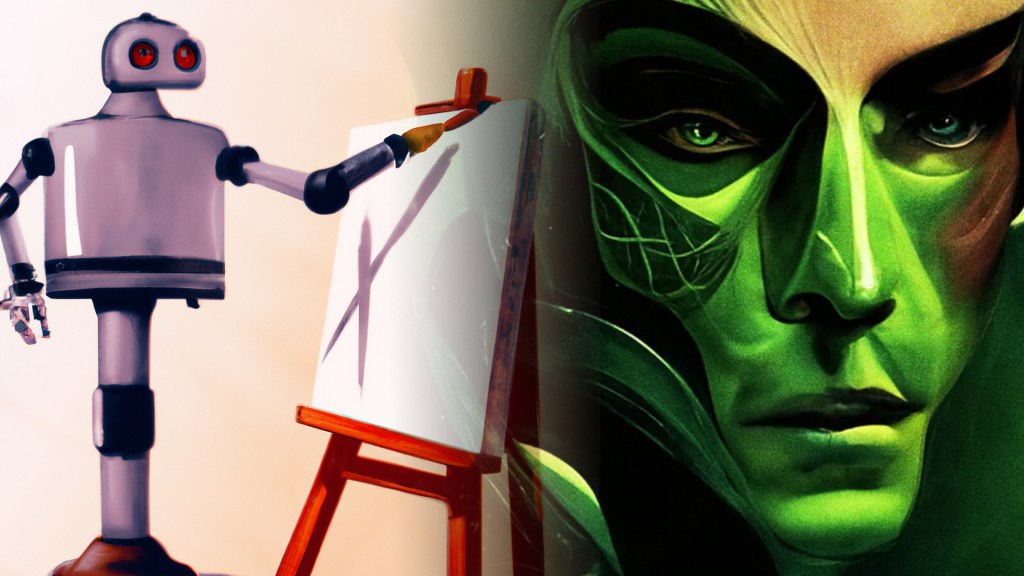
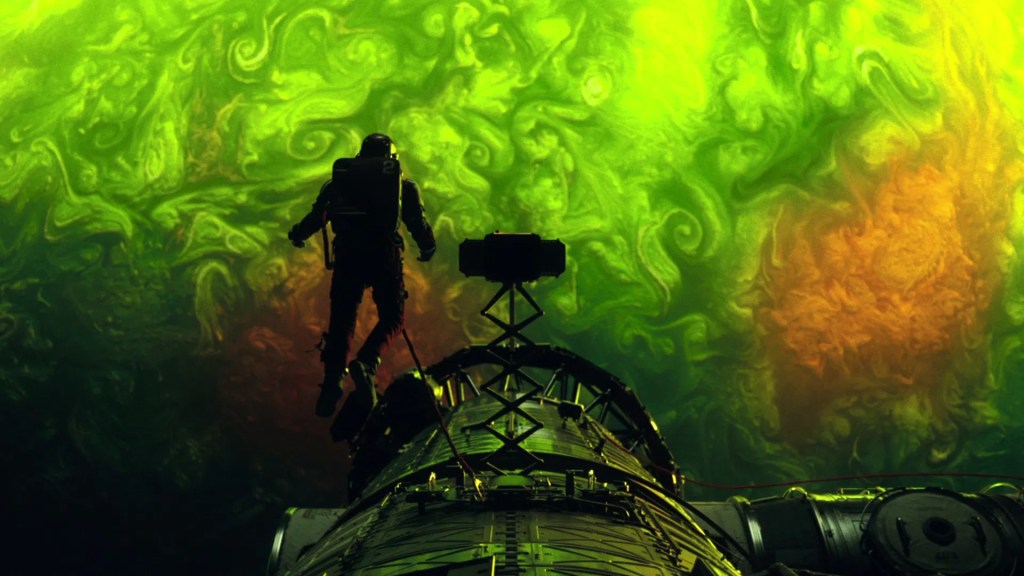
In case you are not aware, Marvel has recently released its new addition to the now comically expansive Marvel Cinematic Universe, a direct-to-Disney-Plus TV series titled Secret Invasion. Ironically enough, apart from the Marvel hardcore fanbase, nobody really seems to care enough to engage in any meaningful discourse concerning the show’s quality, plot machinations or anything of that nature, which in itself is a tacit indication that Marvel’s TV output consistently trails their theatrical offerings.
However, it seems that this show’s release has conveniently been accompanied (and perhaps) overshadowed by apparent outrage expressed both by film journalists and denizens of Film Twitter, because Marvel had the audacity to use AI to generate their opening title sequence. Now, if you scroll through your timeline on any social medium that strikes your fancy, you probably will still find a number of the usual suspects telling Marvel to “do better” in an expression of wild exasperation bordering on disgust. How dare they ask Skynet to take what could have been the job of hundreds severely underpaid and overworked animators?
Let me ask you this: do you think this AI got out of bed on its own and turned in the opening credit sequence to Secret Invasion on its own? Make no mistake, whenever you read a headline stating anything about AI doing anything, what is inherent in those statements are people. The opening credit sequence wasn’t made by AI. It was made by people who used AI to make it. AI is just a tool. Now, the people involved in it may have been different to who you’d normally expect to make a CG-animated opening credit sequence, but still – people were involved in this process from start to finish.
Another long-standing concern which seems to enrage sections of the society has to do with intellectual ownership because AI tools must be trained on something, which likely will be data hoovered up on the Internet. Now, this will be addressed by regulation and from-the-top legislation describing what can and cannot be treated as public domain knowledge, but at the same time, AI vendors are probably aware this is coming. Which will likely result in them keeping animators employed because someone has to create training data sets for these AI tools to work with. So, worry not. Animators are not going anywhere. At least not today.
I wonder, if Twitter had been a thing in the early 90s when CGI-generated animation was being introduced into the mainstream, would there have been the same outrage in defence of traditional animators whose jobs were going to be displaced by the advent of computer animators? In all likelihood, this turmoil – if we could call it that, I don’t know – took place over the course of a decade or even more and it most likely included some people adapting to new workflows and opportunities presented by the very idea of animation being generated digitally. And even at that, classic hand-drawn animation didn’t go extinct. It’s still there. It’s just no longer in the mainstream.
Now, will AI-enabled animation take over and successfully replace what we know as an industry standard? Maybe. Time will tell. Will it be accompanied by some people losing their jobs? Possibly. However, at the same time, some of those affected people will simply adapt. Some will move to other studios because demand for their work will still be there. My guess is that AI-enabled image generation will occupy specific niches and for that reason specialist vendors will arise who take care of those needs. Also, current VFX houses are most likely well underway to adopt AI-enabled tools together with people capable of using them to slot in these niches as well, so you might as well sit down and relax. Your performative outrage is not required because the AI revolution has been going under your nose for a while now and you weren’t screaming, and it will continue for a long while too without people losing their jobs in bulk.
Remember, life finds a way. Animators will find theirs too. Some will learn to use AI-enabled tools to generate animated imagery, some will remain married to what they know and love. Remember, life isn’t T2. Demonized as it conveniently continues to be in the media, AI is just an umbrella term for a whole number of mathematical tools which enable us to do things in new ways and quicker. But it is still people who do the work. Remember, robots will not replace you. Other people – who use AI – will, on the other hand. Maybe instead of stoking fear and spreading doom and gloom, we should learn how to roll with the punches. Because this revolution is happening whether we like it or not. So, it is perhaps a better avenue to funnel your rage, if you necessarily need to vent, to keep telling the world that animators of all extraction continue to be severely underpaid. It doesn’t matter if they use AI or not.



 Flasz On Film
Leave a comment