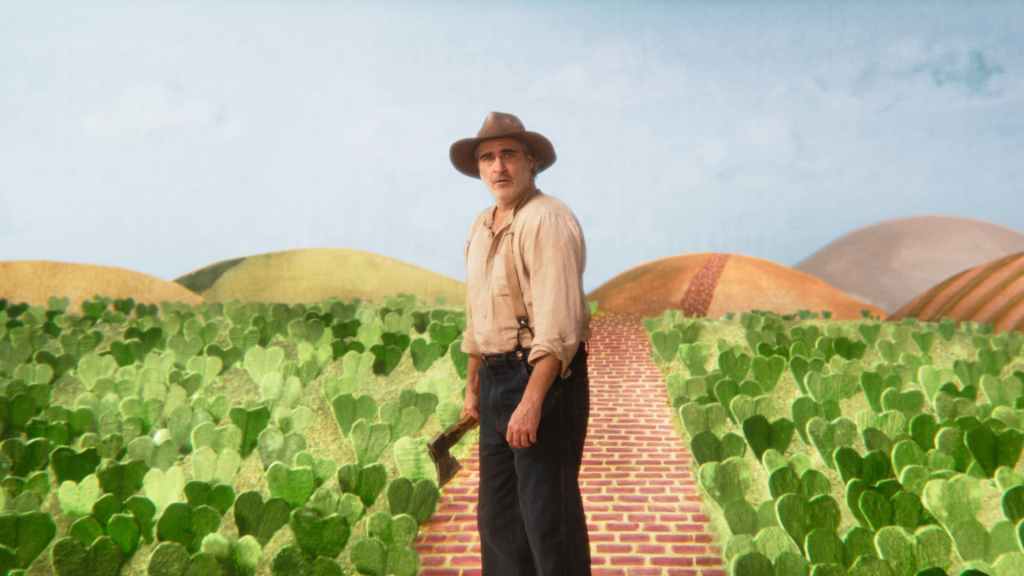

One data point is just what it is – a data point. Two of them form a line. Three is where the fun begins because it is the absolute bare minimum to begin talking about trends within the data set. So, in the context of a growing filmography of a young and up-and-coming filmmaking maestro – like Ari Aster – the third directorial effort is for lack of a better term pivotal. Which is what Beau Is Afraid is. Pivotal. Because it pivots from what audiences think and expect from Aster’s work. Albeit… not entirely.
So, how does it pivot exactly? I think at this point – two movies in – Ari Aster has already cemented himself in the eyes of many as a filmmaker confined to a genre of horror, or more specifically, ‘elevated horror.’ Therefore, if he decided to follow his two previous efforts, Hereditary and Midsommar with a movie that broadly fits together with his other movies, i.e., by way of using the template of genre to engineer a thematic exploration of complex emotions on an allegorical level, he would have effectively pigeonholed himself, like many other successful genre masters before him. He didn’t want to become the next M. Night Shyamalan who, in the span of three or four movies, became a self-confessed ‘twist guy’ to such an extent that even if he turned in a rom-com, audiences would watch it with an expectation of something radical happening in the last five minutes.
Therefore, Aster’s newest film departs from the methodology he used previously and instead goes off the deep end and takes quite a few risks because I don’t think anyone could reasonably expect Beau Is Afraid would be anything else than an elevated horror. What it is instead, is probably best described as a pop-surrealist odyssey that veers frequently into self-indulgence, all in pursuit of the same fundamental exploration of complex emotional aspects of the human condition complementary – thematically – to Aster’s previous work.
To achieve that, Aster employs the titular character of Beau (Joaquin Phoenix) to whose back he straps the viewer in anticipation of a nearly three-hour-long journey into the mind of a man crippled by anxiety. However, what we witness is probably best not described as a story in the most canonical sense, as – thanks to everything being filtered through a perspective of a completely unreliable narrator – the adventure Beau embarks on takes place at least in part (if not wholly) within the confines of his own seriously unwell mind. Therefore, we ought not to take this movie at face value and instead see it as a medley of symbols and allegories laid out by the filmmaker for us to use to understand the inner workings of Beau’s mind. He is less a character in an elevated horror than an avatar for complex emotional states in a Charlie Kaufman movie, so it may be instructive to attune yourself to Beau Is Afraid by viewing it in a similar way in which you’d watch Darren Aronofsky’s mother!, Spike Jonze’s Eternal Sunshine of the Spotless Mind, or Kaufman’s Anomalisa and I’m Thinking of Ending Things.
However, it also bears reminding that in contrast to these other movies, Aster’s film most likely does not invite a wholesale allegorical interpretation that would function across the entire narrative. I don’t think we are supposed to interpret every side character, mini-plot, tableau and symbolic sequence with an expectation of them fitting together and producing a take-home message, let alone any of them functioning in the service of a puzzle box mystery. I don’t believe Aster takes pleasure from leaving a trail of breadcrumbs as he sends Beau on a journey to visit the home of his dead mother through a cacophony of sub-stories about home invasions, police brutality, parental asymmetry of care, repressed sexuality and more. In contrast to the aforementioned I’m Thinking of Ending Things, though you probably could map a holistic interpretation onto the film, I don’t believe it is its intention to comment on the state of the world in all these different aspects in any structured way. This movie is not a mystery to solve.
Instead, what Beau’s journey delves into is the veritable anatomy of debilitating anxiety induced by a devouring mother on her unsuspecting child and how this parental abuse impacts on and warps the child’s perception of the world. What we see through Beau’s eyes is not a real world but rather a projection of his deeply seated fears and anxieties implanted in his mind at a very early age. We witness what it would look like to inhabit the skin of someone so profoundly repressed that they cannot perform even such simple tasks as leaving the house or going across the street to buy a bottle of water because they fear someone could trash their house when they are away, or that they would lock themselves out, or that they wouldn’t have enough change to pay for the water, or that a police officer could gun them down on the way back home, or that a homeless person could attack them with a knife, or… you get the picture.
This movie is a brilliant illustration of what it feels like not to be able to pick up the phone and talk to someone on the other end of the line, which some people report as a real anxiety they struggle with, and which better adjusted people simply cannot comprehend. Aster uses the power of cinema – the image and sound working in tandem – not so much to explain what it’s like to suffer from anxiety but rather to show it and, better yet, to induce it in the viewer by virtue of embedding them inside the story’s central character. And once you make peace with this realization and put to bed any ideayou may have about what it should be based on preceding films, you will see that Aster’s movie is clearly attempting to defy your expectations of an elevated horror as you most likely know it and define it, and you shall get a lot out of this experience.
However, what you will extract from this is not going to be easy to process either, because – by virtue of functioning in a Bunuel-esque space of wholesale surrealism – you are not expected to find definitive answers in what you witness. That is, the story will probably not make sense if you attempt to find a logical explanation to its constituent elements, like you would to mother! or Anomalisa. I fully realize this don’t-think-but-feel approach is often seen as a cop-out and indicates the filmmaker or the viewer infatuated with the movie (or both) know the movie makes no sense and doesn’t work but choose to persist in their own denial. But I truly believe this is the best way to get the most out of Beau Is Afraid, i.e., by pulling back and refraining from attempting to rationalize each little symbol, character and subplot. Instead, take the movie more as an experiential thrill ride through the peaks and troughs of an anxiety-riddled mind medicated into societal ineptitude and partake in – if not enjoy – this ride.
That way, the movie will become less of an indictment of whatever social woes you’d like to pin onto it and shall become a panoply of micro-scenarios Beau, an anxiety sufferer, experiences on a day-to-day basis, all woven around the massive elephant in the room of having to deal with the looming shadow of his mother’s oppressive presence, even to the point of thinking she’s still alive and judging him from beyond the grave. Granted, this might be – and it comes towards the end of the movie – where Beau Is Afraid could potentially be seen as ‘jumping the shark’ as it floors the acceleration pedal and redlines its engine of symbolism with imagery of anthropomorphic penises, women frozen mid-orgasm and operatic exposes delivered by Beau’s toxic mother (Patti LuPone), but I assure you it all works perfectly in the context of trying to embody someone’s anxiety reaching critical levels when he must cross the threshold of his family home and deal with the very demons he had spent his entire life hiding away in the blind spot of his cerebral operations.
All in all, I think it is safe to say that Beau Is Afraid is not a movie for everyone. Moreover, it is impenetrable enough to ensure that even a willing participant in this experience should likely expect to commit another three hours of their precious time to make the most of this surreal fantasy about parental oppression, medicated anxiety, and criminally repressed sexuality. Make no mistake, this is a spectacle and a brave attempt on Ari Aster’s behalf to continue exploring ideas he seems attracted to without falling into the trap of becoming a genre filmmaker pigeonholed by audience expectations. Sure, it is an indulgent experiment in many ways, and I fully expect a proportion of the viewership will walk out of the cinema before the credits roll or end up distracted by their own phones somewhere halfway through the movie. But I am glad that Hollywood of today still harbours unbridled spirits like Aster or Jordan Peele (whose Nope similarly flew in the faces of audiences expecting something the movie wasn’t intending to deliver), who choose to make bold choices and take risks in pursuit of artistic honesty. Say what you want about Beau Is Afraid, but at least it is honest and adventurous in what it does and how it goes about doing it. At least to my mind, it rides the line between inspiration and indulgence with aptitude and requisite razzmatazz and reminds us that cinema can be an experience the viewer is an active participant in.


 Flasz On Film
Leave a comment