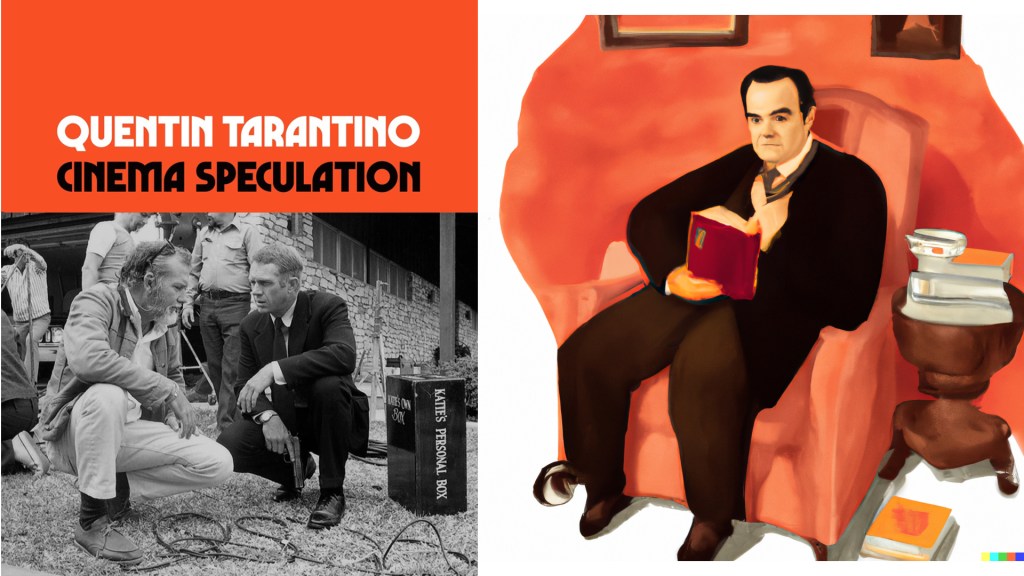
I don’t know how to review books. Quite frankly, I don’t have a clue where to even begin. My Goodreads account is a joke. In fact, come to think of it, I don’t know how to review movies either. I never went to school for film criticism, I don’t know what to look for and I don’t care for stacking adjectives as substitutes for fleshed out opinions. All I do is pour into the keyboard what a movie I watched makes me think about and just leave it at that. So, I suppose I can only apply the same methodology here, because I do have a book to recommend.
Over the last couple of years, Quentin Tarantino has become increasingly vocal with his threats he would retire from filmmaking once he has made ten movies. In actuality, he has been making these threats consistently for the past fifteen years or so, but back then nobody took them seriously. Now, with his tenth film slowly taking shape, the prospect of Tarantino standing down as a working filmmaker has become frighteningly realistic. To a lifelong fan of his directorial work, the idea of Tarantino disappearing from the zeitgeist is at the very least disconcerting and perhaps downright depressing.
However, in addition to clarifying that he wishes to go out with what he sees as a perfect filmography (and I agree with this assertion, by the way) and that old filmmakers rarely make great films, he has always followed up with promises he’d redirect his energy elsewhere. Maybe he’d work in TV. Maybe he’d do some stage work. What seemed obvious to me is that whichever avenue he’d decided to pursue, he would continue writing.
Which is what he did. He published a novelization companion to his latest movie Once Upon a Time in Hollywood, which was a wonderful taste test of what Tarantino’s prose could actually look like. And – surprise, surprise – it was exactly what you’d think it would be. I know. Circular definitions are of little use to anyone but in this case, it is warranted to make a note that Tarantino’s novelization was written in what I can only describe as Tarantino’s organic voice, which is unbridled, prone to tangents and extremely flowery.
Now, he has since followed up his writing efforts with Cinema Speculation, a book of Tarantino’s own musings about the world of cinema. He has been vocal about transitioning from filmmaking into becoming a more or less full-time critic (which he has been his whole life, I suppose, as a function of being extremely opinionated about movies and willing talk about what he likes and dislikes to anyone who’d like to listen). He has also started a podcast together with his pal Roger Avary where they talk about movies nobody else talks about (kind of what we do at Uncut Gems Podcast, but for a much bigger audience). But I was very curious to read the Tarantino-critic and see what it’s like to learn about cinema from a guy who is both a bottomless pit of knowledge and a completely unshackled spirit.
In the interest of full transparency, I should probably note that I have not read many film books in my life so I don’t have much to compare Cinema Speculation against. Therefore, you will have to excuse my ignorance in this regard. However, I think it might be reasonable to assume that this book isn’t necessarily interested in formally exploring an area of the medium or in providing even a modicum of objective thought. It is a collection of opinions from the most opinionated – and the most entertaining – voice you could possibly imagine giving opinions on movies. In fact, the entire book is divided into chapters devoted (loosely) to movies Tarantino found personally formative (i.e. Dirty Harry, Deliverance, The Getaway, Taxi Driver, Rolling Thunder and others) as well as movies he uses as excuses to rant about things he feels passionate about, like the career of Sylvester Stallone, the censorship of the 1980s, Blacksploitation, how Paul Schrader disowned Hardcore etc.
So, I think before you even pick up Cinema Speculation for your own personal amusement, you have to agree that you are not going into this book with an expectation to be exposed to hard facts. You are going into an experience where an unreliable narrator will give you his personal take on what he thinks happened in the 1970s and 1980s and how this era of Hollywood shaped him as a person and eventually as a filmmaker. By staying on Quentin’s shoulder as he raves about Dirty Harry, The Outfit and Paradise Alley (and Rocky), you tacitly agree to embark on a journey to discover things about Tarantino’s view of the world as opposed to the world itself. Granted, you will learn quite a few cool things about movies and people behind the camera, because Tarantino does have access to people like Walter Hill, John Milius, Paul Schrader and Brian De Palma, but you are not here to pick up these pieces of trivia. You are reading Cinema Speculation because you want Uncle Quentin to read you a bedtime story. A messed-up bedtime story about violent movies that shaped him, where he swears like a sailor, loses the plot half the time and actually achieves the opposite effect to what a bedtime story should do. It’s the most energizing bedtime story you’ll probably read in a while.
Hence, all I can say is that if you are on the lookout for a book that will teach you a thing or two about The New Hollywood and the cinema of the 1970s, I suggest you look elsewhere first. Pick up Easy Riders, Raging Bulls first and then come back to this. However, if you are like me – someone who truly loves Tarantino’s work and enjoys his voice – go bananas. This book is exactly what you think and hope it is: an extremely personal account of why movies are cool, written as though it was dictated into a tape recorder and transcribed with minimal editing – in fact, Tarantino uses italics for emphasis to make the writing ‘sound’ like him in your head, which is perfect.
Now, even though I wish he changes his mind and that once The Movie Critic is unleashed in cinemas, he shall continue directing great films, I think I can find solace in the fact he will continue lending his voice to the world through such great writing as Cinema Speculation is. It’s honestly a great book and maybe a great Father’s Day gift if your dad happens to love Tarantino like I do, but be warned that once you finish reading, you will immediately go on a spending spree and acquire a lot of the movies Tarantino mentions in the book that you may have not seen yet or maybe haven’t been aware of at all. And they aren’t cheap, I’ll tell you that much.


 Flasz On Film
Leave a reply to 2023 in Review: Reflections and Resolutions | Flasz On Film Cancel reply