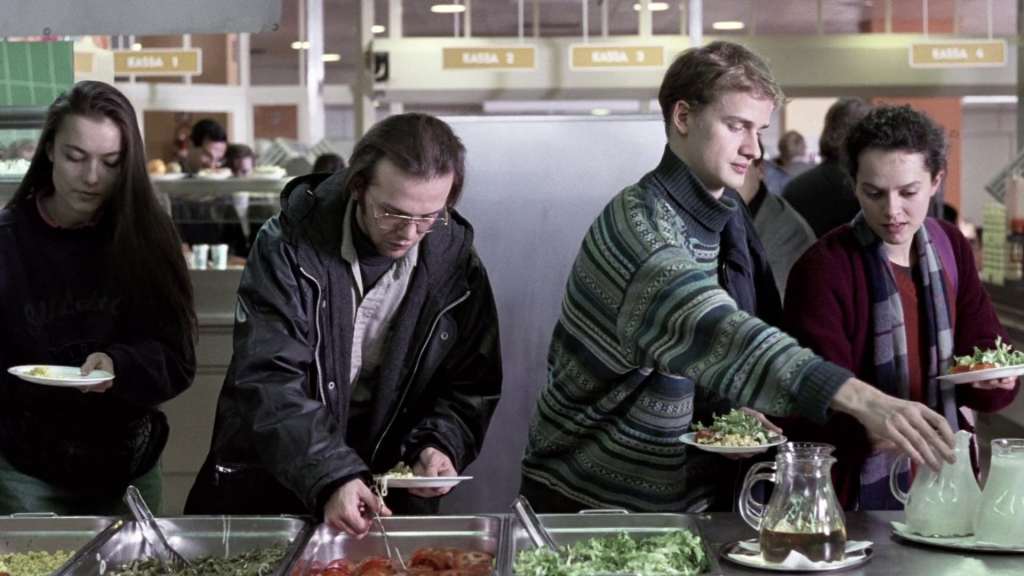
©Wega Film

Released in 1994, 71 Fragments Of A Chronology Of Chance was meant to cap the so-called Glaciation Trilogy, which also includes Haneke’s two preceding efforts, The Seventh Continent and Benny’s Video. In some ways, this film seems symmetrical to both of them. It is inspired by a true story of a student who – out of nowhere – walked into a Viennese bank and opened fire killing a bunch of by-standers before blowing his own brains out, which tethers the film thematically to The Seventh Continent in particular. In addition, the entirety of its fragmented narrative is also interspersed with various bits of archival news footage mostly covering the Balkan War in graphic detail, which is consistent with the crucial role TV screens played in his other movies. However, this film did not resonate with me the way these other films did. 

That may be because in contrast to the two previous films, 71 Fragments Of A Chronology Of Chance comes across as a work of a detached cynic as opposed to a frustrated humanist, the logical consequence of which is that the film doesn’t add up to much. It is just an experiment in upsetting the viewer. Being a scientist myself I find it redundant and perhaps even unethical to design and conduct an experiment on live subjects for no other apparent reason than to hurt those subjects. This is tantamount to cruelty. However, I am more than willing to extend an olive branch on the off-chance the nuance lies in the subterfuge of trying to convince me this experiment is meant to be seen as a joke. Still, this line of logic smells profoundly of apologist post-hoc-ergo-propter-hoc mental gymnastics one would likely engage in to rationalize their own attachment to something profoundly indefensible.

Furthermore, this highly formal collage of short vignettes in which Haneke focuses his gaze on a seemingly homogeneous atmosphere of menace and chaotic indifference permeating the lives of contemporary inhabitants of Vienna quickly betrays its manufactured nature. From the bank worker who slaps his wife after she sneers at his confession of love to a couple rejecting an orphan, to a Romanian beggar getting picked up the police, a man aggressively chastising his adult daughter for not wanting to spend time with him and more, these vignettes are meant to build a bleak collage of societal degradation, as though it was the only way to rationalize the seemingly random act of violence around which the film is revolving. At this point I am fairly confident that Haneke lost control over the tonal intensity and thematic profundity of what he was trying to convey, thus crossing the line between satire and farce. As a result, almost everything about this story has a false note somewhere in the background and as such the film teeters on the verge of unpalatability and might convince some viewers Haneke is not a cruel teacher I honestly think he is, but rather a desensitized cynic.

All in all, 71 Fragments Of A Chronology Of Chance is definitely the weakest of the entire Glaciation Trilogy thanks to Haneke’s lack of tonal restraint, which drowns the entire movie in unnecessary preachiness. Though, it is hard to expect the filmmaker to stay in touch with the subject matter, however compelling it may be, if he decides to operate from atop a high horse, which is a position he seemingly retained in many of his future productions, such as Code Unknown (it also happens to be a structural and thematic sibling to this movie) and his highly acclaimed The White Ribbon as well.

Published originally on Letterboxd.

Discover more from Flasz On Film

Subscribe to get the latest posts sent to your email.

9 responses to “Understanding Michael Haneke: 71 Fragments of a Chronology of Chance (1994)”

  1. […] why I am writing this short paragraph – that I watched Code Unknown before I was able to see 71 Fragments of a Chronology of Chance, to which it is undoubtedly related structurally and thematically. In hindsight, I would have maybe […]

    Liked by 1 person

    1. Gwen Killerby avatar
      Gwen Killerby

      If a reviewer makes 3 or more mistakes in his review, it shows he didn’t really watch the film, and that his judgement is flawed. He then deserves ridicule, and to be laughed at, as well. Your mistakes are:

      “to a Romanian beggar getting picked up the police”Nope, he went to cops himself, wasn’t picked up, he mainly shoplifted and stole, not begged, and it was a kid, not an adult

      “a man aggressively chastising his adult daughter for not wanting to spend time with him” Nuh uh, he was begging for her attention, but was never aggressive about it, and it was more that she was rejecting him. You got who was doing what to whom reversed.

      ” to a couple rejecting an orphan” Again, it’s the couple who WANTS the girl, but the girl, with possible ADHD issues, rejects the mother, pushes the mothers hand away at the zoo.

      “From the bank worker who slaps his wife after she sneers at his confession of love”It’s a security guard, not a bank worker, and he begs to God, to make her happy.

      I would really like your glasses for watching films, and then I would watch “Manchester by the Sea” “Seven” and “The Mist (2007)” again.

      Like

      1. I can’t possibly verify your comment without watching the film again. And it has been a good few years at this point. But does it change the overall picture of what I explain it comments on? The social indifference and degradation the filmmaker observed around him? I think not.

        Like

      2. Gwen Killerby avatar
        Gwen Killerby

        Your review, aside from being really different from what I saw, is also really different from other reviews. There is value into never following the crowd. But sometimes… people’s judgement is just … slightly off? And perhaps there’s value into rewatching (certain elements of) the film.

        Oh … well.

        Best of luck,
        Gwen

        Like

      3. Gwen Killerby avatar
        Gwen Killerby

        PS
        Thanks for the swift reply, truly appreciate that.

        Like

      4. Truth is always in the eye of the beholder and I find it most interesting to see how differently others can interpret a piece of work like a film. In fact, how our perspectives differ says quite a bit more about us than it does about the film. Granted, I am aware that my takes on movies tend to come across as strange to some. I might read into movies a bit more than I should or connect dots that might not be there for everyone to find, but I hope – even if we may disagree on interpretation – we can appreciate each other’s points of view.

        I don’t think I am too far off mark on Haneke as his entire body of work seems geared around a small handful of pet subjects he revisits frequently, but I appreciate your challenge here. Perhaps I might need to rewatch his vignette-esque movies as I remember liking them the least. The problem is, as always, that with the scarcity of time, it’s hard to find the time to do so.

        Anyways, thank you for commenting and taking the time to read my work.

        All the best,

        Jakub

        Like

  2. Gwen Killerby avatar
    Gwen Killerby

    You (and about half the AI’s) also make the mistake of thinking this was based on a real event. It is not. That’s an error deserving to be corrected, IMHO. But as they say, YMMV….
    All the best, good luck in all your endeavors.

    Like

    1. I don’t know. Maybe you are right. But there are reputable sources claiming it is based on a true story so that’s what I based this on. Not that it matters as far as the movie analysis is concerned, but what do I know.

      Like

  3. Gwen Killerby avatar
    Gwen Killerby

    Truth is certainly not always in the eye of the beholder. Such as gravity. If you jump from a skyscraper without any measures, you fall at 9.8 m/s2 and die. Without oxygen you die in minutes.
    And sure, this is a movie, there are interpretations possible, but you’re simply wrong about the father daughter dynamic, and the couple rejecting the girl, etc.
    The thing is, if you get such basic things wrong, you lose credibility. And in your efforts as a reviewer, credibility and reputation is all you have. And of course, standing by your opinion can be a good thing. But doing so when it the error is so obvious seems … silly.
    Oh. Well.
    All the best to you.

    Like

Leave a comment

FEATURED