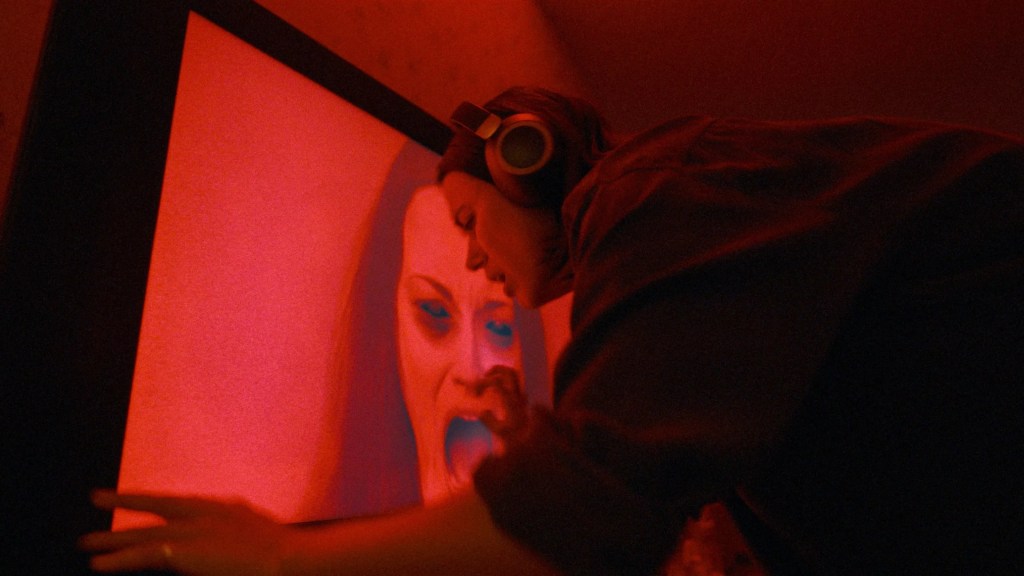

Every now and again the field of the horror genre—typically prone to sustained trends—gets a vitamin booster shot in the form of the occasional gimmick movie that takes audiences by surprise. Some of them, like The Blair Witch Project or Saw, germinate their own micro-trends, i.e. found footage horror and torture porn. Others, like Paranormal Activity or A Quiet Place, might have it in them to spawn franchises while fitting into larger trends. Some others yet, like Devil or Unfriended, largely fall into obscurity having failed to negotiate enough elbow room for others to follow and for their oftentimes innovative gimmicks to crystallize into discernible movements.
And at this point it remains to be seen which of these potential routes will Undertone, a written and directed by Ian Tuason in his feature debut, is likely to follow. All we know for now is that—at least on paper—it is a movie that wants to do something new to bring some freshness into the horror space. Or does it?
The film tells a rather seemingly simple-looking story with only two actors performing on camera and a handful more giving voice-only performances. Evy Babic (Nina Kiri) is a young woman who lives with her bedridden mother dying of cancer (Michèle Duquet), and who by night records a podcast with her friend Justin (voice of Adam DiMarco). Together they form a paranormal-hunting duo—Evy a skeptic and Justin a believer—who look for strange and supernatural things in creepy audio recordings. After they are sent a small collection of recordings by an anonymous sender, which contain supposed evidence of a couple being haunted or even possessed by a supernatural being, Evy’s own life becomes affected and reality begins to blur into a nightmarish hellscape.
Based on this short synopsis alone you wouldn’t necessarily accuse this movie of any originality whatsoever. In fact, it is very much an execution of a well-worn “forbidden media” template where the protagonists find stuff they shouldn’t read/listen/watch, then they read/listen/watch it anyway and in doing so they invite demonic entities to haunt their existence. It’s there in The Evil Dead, Sinister, The Ring, The Babadook, In the Mouth of Madness and many others.
However, the point of differentiation that Undertone zeroes in on relates to the main preoccupation of its characters, which is podcasting. Because they mostly deal with sound files, songs and recorded dialogue, the movie itself invites the viewer into the aural sphere where the majority of its horror unfolds. Again, this is not the first time where sound or lack thereof has been deployed in service of evoking thrills and chills. Berberian Sound Studio, Hush, or even A Quiet Place have placed considerable emphasis on the sound design when engineering their mood and delivering scares. And in fairness, Undertone sits somewhere adjacent to Berberian Sound Studio, though much closer to mainstream conventional storytelling manifold, and quite close in narrative spirit to the massively successful and franchise-spawning Paranormal Activity. If anything, the movie could be described in a one-sentence review as Paranormal Activity where instead of CCTV we have podcasting and with elements of artsy aural horror inspired slightly by Peter Strickland’s Berberian Sound Studio.
As a result, the movie registers both as familiar and original in equal measures. It effectively capitalizes on the daytime-nighttime format borrowed from Oren Peli’s found footage juggernaut (which is familiar) while it unpicks Evy’s perception of reality in novel sound-based ways. Arguably, this is its own unique gimmick. It’s not the idea of playing with sound or silence like in Hush or A Quiet Place, nor is it the idea of trying to revivify the tried and true possession horror template using arthouse-adjacent mood generation. It’s the combination that makes Undertone special in this way.
Thus, Tuason’s film mostly evades the constraints of its central conceit and allows the viewer to have a rather novel experience, which is refreshingly unnerving, calculated and for the most part effective despite relying occasionally on familiar tropes, scare tactics and other well-described genre jiu-jitsu. The filmmaker clearly behaves as though he knew his stuff and his desire was to put the viewer in a protracted state of suspended dread while delaying the relief—sometimes indefinitely. This understanding of basic viewer psychology comes in the form of well-calculated use of negative space, creeping zooms, slow pans and hiding scary elements out of focus, all the while detaching the experience aurally. While images connect the audience to Evy’s reality, the sound design keeps them tethered to her mental state and the horrific mystery unfolding on those recordings, all of which generates sufficient friction to additionally upset and emotionally dislocate. And this is certainly worthy of commendation.
However, at the same time—just like Paranormal Activity—Undertone slips into a predictable rhythm much too quickly. Although events escalate in interesting ways and the movie makes inspired moves in an attempt to convey how Evy’s mental state is compressed and painfully pulverized by what looks like a demonic infestation seeping through the headphones into her subconsciousness and the world around her, the movie establishes a pattern that it refuses to break. We always know that we are mostly safe in daylight and that crazy stuff happens at three in the morning… which is conveniently when Evy and Justin record their podcast episodes, piecemeal over the course of multiple nights (which undermines the realism of podcasting that anyone who has ever podcasted would know).
Thus, even if the tools used to unnerve and unsettle used by the filmmaker are themselves quite innovative and well deployed, Undertone can only evade conventionality for so long. In fact, it uses its own novelty as a mask draped over familiar genre ideas, and occasionally stops itself dead in its tracks from escaping the orbit of familiarity in pursuit of more inspired catharsis. Tuason only dabbles in original ideas before pulling back. This is of course effective: unsettling figures coming slowly into focus, holding steady on shots that keep the viewer’s eye trained on negative space, leaving whispers and little annoying sounds in the back of the mix all function as intended. Moreover, they could have taken the movie into completely uncharted territory if trusted just a tiny bit more.
With a little more conviction and directorial bravery, Undertone could have been easily seen as belonging together with more visually audacious and a bit more artful horror movies like the aforementioned Berberian Sound Studio or Censor from a few years back (which I loved dearly). You can see just how much potential this movie has with its steady control of scare generation and occasional flourishes of brilliance. But the movie just doesn’t have enough firepower to counter the gravitational forces of conventionality, where it eventually finds its climax. You can almost feel that the filmmaker didn’t want to push his luck. Having concocted a string of incredibly successful moments and having built dread and horror aurally for two entire acts while teasing and unnerving, he decided to cash in his chips and chose not to risk going home empty-handed. But the trade-off was that he didn’t get to hit the jackpot either.
Consequently, as the movie lumbers unnervingly towards its climactic resolution and the stage is set for the viewer to be ejected from their seat propelled by their own stored potential energy of acutely unrelieved suspense, Undertone chooses not to risk it and wraps up in a way that makes the entire movie look not like a start-to-finish novel trend-setter but rather only a well-grounded conventional horror with a solid differentiating gimmick. This is both an indication of the film’s overall success—because the experience of watching this movie counts as incredibly effective—while it also looks like a missed opportunity too.
It just goes to show that sometimes what separates very good movies from truly great ones is found in the courage to go those extra few steps. Undertone knows it’s a good movie and looks as though it chose not to rock the boat, perhaps out of fear of alienating the bulk of the audience. Therefore, it is but a well-engineered roller coaster ride that is suspenseful, dreadful (in a good way), moody and exhilarating. But it doesn’t have the guts to commit to its own weirdness and authenticity fully the way The Blair Witch Project did. In its defence, though, Paranormal Activity also chickened out at the end and gave wide audiences a conventional ending while jettisoning its original, much more unsettling resolution.
So, it’s hard to say if Undertone is going to spark an aural horror revolution. If I were to bet on any outcome, I’d say that it won’t, specifically because by seeking sanctuary in convention the movie truly positions itself as subservient to those other films mentioned in this text. In fact, it might just be that it was a “resume” indie whose main mission was to draw attention to this filmmaker and show that he knows how effective horror movies are made. After all, Ian Tuason was just tapped to direct the next Paranormal Activity movie, which only seems fitting. Still, Undertone is well worth watching and even with its safe conventional resolutions it must be counted as one of the more effective supernatural horrors in recent memory.

 Flasz On Film
Leave a comment